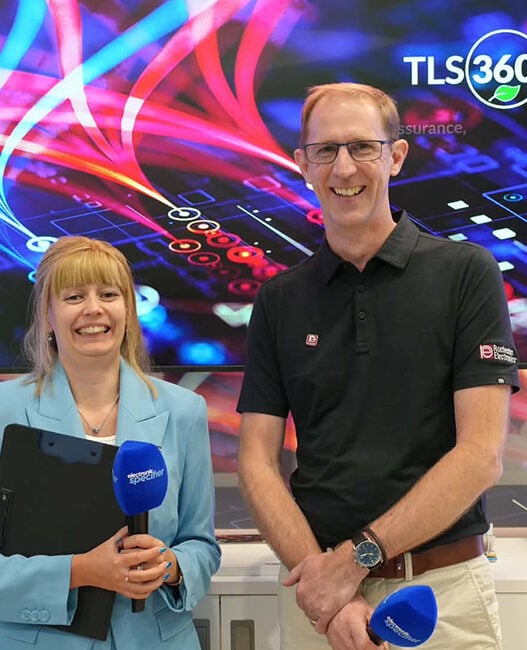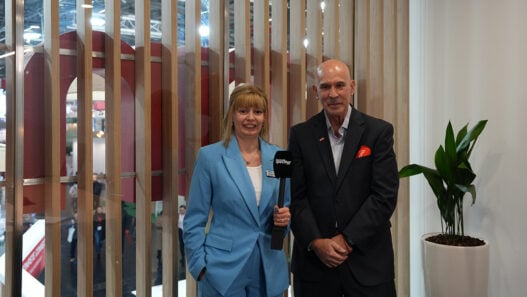


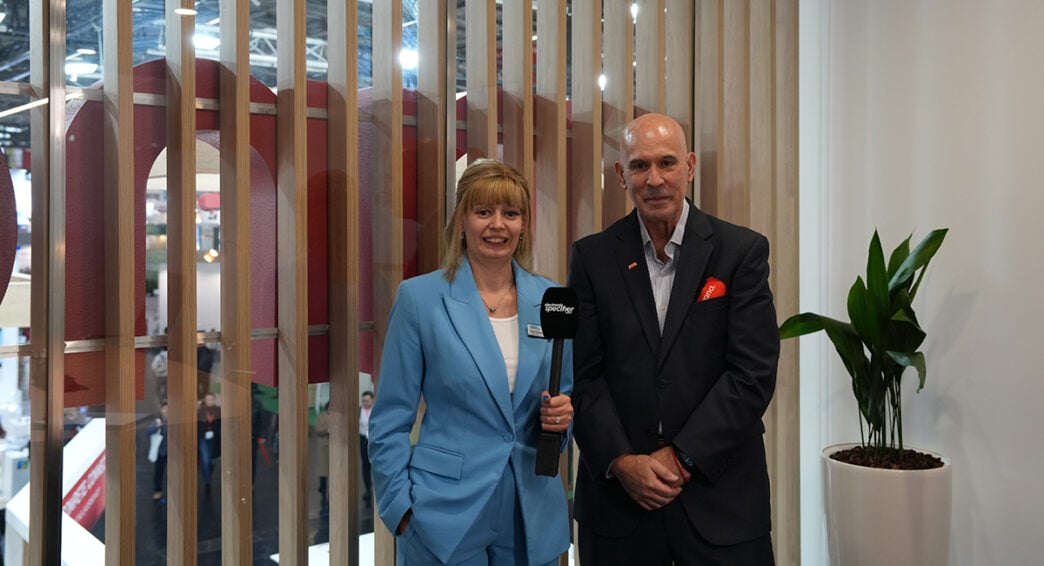
At electronica 2026 in Munich, Electronic Specifier’s Paige Hookway caught up with James Hill, President and COO of Rand Technology, to talk about the AI build-out, a tougher market ahead in 2027, and why buyers should treat their independent distributor as an extension of their own team.
It was the start of a long week at Messe München, but Hill was clearly enjoying being back among colleagues and friends on the Rand Technology stand. “It’s fantastic so far,” he said, before setting out how the company is positioning itself for a supply chain that is anything but predictable.
Balancing supply and demand
“Rand is a global independent distributor,” Hill explained. The company steps in when supply and demand don’t match, supporting customers through shortages, selling their excess stock, helping them reduce costs, and mitigating risk.
“More and more, it’s about managing risk over time,” he said. Rather than a purely transactional relationship, Rand aims to understand each customer’s fit for use and to become “an integrated part of what they do and how they do it.”
Priorities: the AI ecosystem and its ripple effect
Asked about the company’s priorities, Hill said: “The priorities are really helping the build-out of the AI ecosystem.”
Some customers are directly involved, such as the hyperscalers and neoclouds building out AI infrastructure. Others are affected by the supply and capacity those companies are consuming. “[Y]ou’ll see demand pop up in places that you might not expect … because of that ripple effect,” Hill said. Rand works with these customers to understand where the risk sits in their bill of materials, so issues can be prevented, and supports them with shortages or excess when problems do arise.
Earning a seat at the table
The supply chain has seen plenty of turbulence in recent years, and Hill believes it has reshaped the role of the independent distributor. Rand has just celebrated its 34th anniversary, and over that time it has built up its operational capabilities and its testing and authentication. “We’ve gotten … aerospace-level certifications for authentication,” he said.
That track record matters because customers’ own teams have often become smaller, or are fully consumed by the AI build-out. Work once handed to contract manufacturers and ODMs is now stretching those companies too, so customers are turning to the next link in the chain: the global independent distributor. “[B]ecause we’ve earned the right to be at the table through that credibility, they’re more and more comfortable to hand off some of that work to us,” he said.
Responsive, not just efficient
When it comes to where Rand adds the most value, Hill said: “It’s all about responsiveness.” Manufacturers and franchise distributors are built around efficiency, innovating on product and managing the efficient parts of the supply chain. “Independent distributors, and Rand in particular, is positioned to be responsive as opposed to efficient.”
In practice, that means responding within lead time and to unpredictable conditions as they emerge. It also means helping customers prevent risk through value engineering, or by designing in alternatives so additional components can be qualified on the approved vendor list (AVL).
2026 was the easy part
On the state of the market, Hill pointed out that everyone knew going into 2026 that memory would be in significant shortage. In that sense, the year was relatively straightforward, though he acknowledged not everyone would describe it that way. “I think it was a lot easier than it’s going to get.”
He expects next year to be busier and more complex. “So 2027, I think, is going to present … many more opportunities than what we saw in 2026.” Those opportunities will be spread more widely across industries and component types, and will be more challenging to execute on.
Memory and the move to the Edge
“Memory will definitely be a challenge,” Hill confirmed. But as the AI build-out moves beyond training and inference towards the Edge and physical robotics, the components in demand will change, with more low-power parts needed, for example, and those will become harder to source.
Rand’s global footprint across industries and sectors is key here, as imbalances will always exist somewhere. “[P]art of what we can do is capture those components that are in excess in one area, one geography, one segment, and help redeploy those where they’re needed.”
Heat maps for obsolescence and end-of-life risk
Obsolescence is becoming harder to plan for. Many customers are pushing out the end of life of their products because components are either unavailable or now prohibitively expensive, leading to design changes and less predictable product life cycles.
As a result, customers are engaging Rand earlier for risk assessments. Customers share their bill of materials, and Rand produces a heat map highlighting the areas of greatest risk. “We’ll do a heat map from a cost … lead time, and life cycle perspective,” Hill explained. The two then work together on mitigation strategies.
This sits alongside a broader range of support customers increasingly ask for beyond sourcing: value engineering, qualifying alternative components, engineering support, trade compliance, and logistics expertise. And where customers are left holding surplus stock, Rand sells that excess and redeploys it to the geographies and segments where it is needed.
Tariffs and geopolitics: “an unending dynamic”
Tariffs and geopolitical pressures remain “an unending dynamic,” Hill said, with the recent elections in the US presenting a whole new set of conditions to work through. “However the market shifts, we will shift with that. That’s the role that we play in the supply chain.”
To stay agile, Rand is bringing together expertise in logistics, trade compliance, sourcing, customer interaction, and engineering. “We’re continuing to bolster our engineering because we know that there’s some limitations that customers put on the country of origin,” he said. The aim is a cohesive team that can respond “at the pace and scale of the market.”
Advice for the next 12 to 18 months: engage early
Hill sums up advice to buyers in one word: engagement. Customers should “engage … early and often because we are willing to interact as an extension of their team. It’s not costing them anything to do that.”
By drawing on its data and expertise, Rand can help customers spot and prevent issues up front, rather than simply putting requirements out to standard brokers to complete a transaction. “[I]t’s going to be much more effective the more proactive you can get and the more you collaborate with us,” Hill said, allowing Rand to respond based on the fit for use for each customer’s applications.
With 2027 shaping up to be more complex than the year before, that message of collaboration and information sharing looks set to resonate with buyers across the industry.
Watch the full interview here: