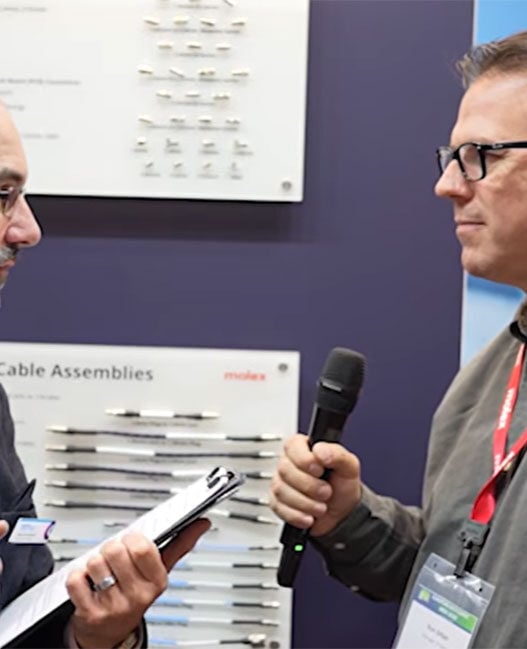

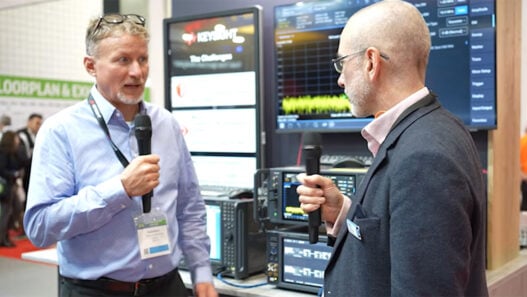



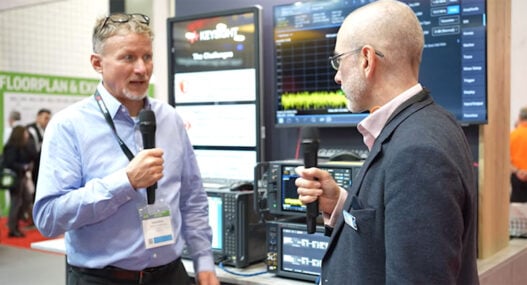
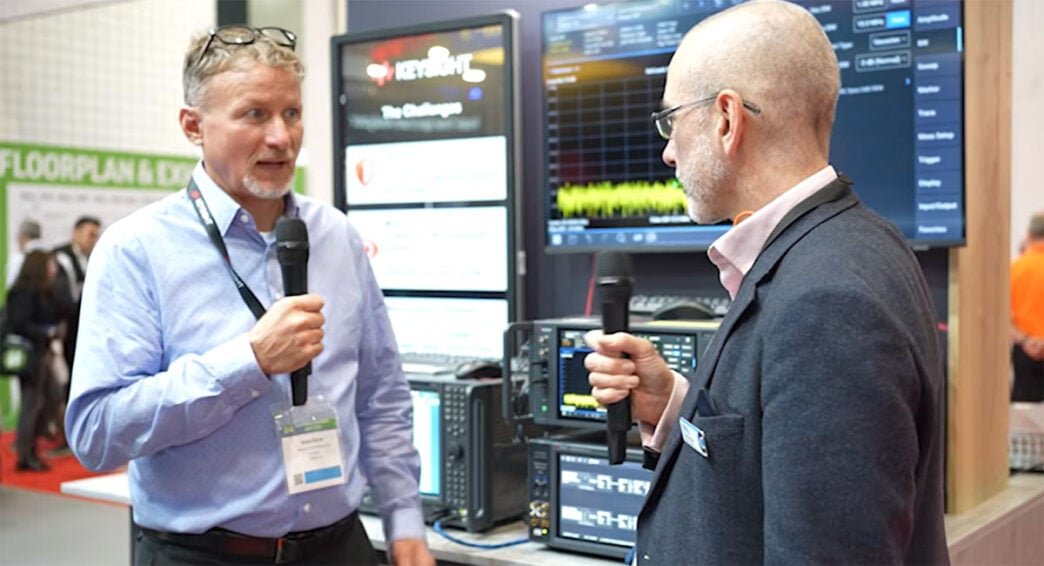
At European Microwave Week 2026, Randy Becker of Keysight Technologies demonstrated the company’s new flagship spectrum analyser to Electronic Specifier‘s Mark Gradwell, showing how a lower noise floor, wider demodulation bandwidth, and built-in GPU processing are designed to stop the test equipment from becoming the bottleneck.
As components and devices get better, the instruments used to characterise them have to keep pace. That was the premise behind Keysight‘s showcase at European Microwave Week 2026, where Becker walked through the capabilities of what the company describes as its highest performance spectrum analyser to date.
“Today everybody’s pushing the envelope on technology,” Becker explained. “Technology’s getting better, components are getting better, devices under test are getting better, and people need up-to-date test and measurement equipment to make sure that they’re testing the true performance of their device under test, and that the test equipment isn’t a limiting factor.”
A lower noise floor
The first capability Becker highlighted was the analyser’s displayed average noise level (DANL), which he identified as one of the things customers most need when hunting for very small signals.
“Here we’re measuring about -164 with the preamp on,” he said. “If I turn the preamp off, we’re down around -150.”
That flexibility gives engineers room to tailor the instrument to the job in hand. “Customers have a lot of options to optimise the measurement for their particular needs, and this allows them to really look for low level spurious and to do it very quickly.”
Speed without gaps
Speed was a recurring theme throughout the demonstration. Applying a simple modulation to the test signal, Becker showed the analyser tracking it smoothly and without gaps, which he attributed to a very fast swept-tuned engine.
Running the same test on a comparable analyser in the same configuration made the difference plain. “You’d see that it wouldn’t update nearly as fast as we’re showing here,” he noted.
Demodulation at 5G and beyond
Becker then moved on to demodulation, a common requirement for engineers who need to see how a signal is actually performing rather than just where it sits in the spectrum.
Demodulating a standard 5G New Radio waveform with 100MHz of bandwidth and 64-QAM modulation, the analyser returned an error vector magnitude (EVM) of around -58dB. “That’s an extremely good result for this bandwidth,” Becker said.
But he was quick to acknowledge that 100MHz is increasingly modest. “Customers are going wider and wider,” he said. “This has an eight gigahertz demodulation bandwidth.”
To illustrate, he switched to a wider signal and moved up to 40GHz. Even at that frequency, measuring across 2GHz of bandwidth, the analyser held its performance: “We’re still getting close to 1% over that two gigahertz of bandwidth.”
GPU processing for immediate results
Wideband demodulation at high frequencies is computationally heavy, and this is where one of the analyser’s more distinctive design choices comes in. Becker pointed out that the display was still updating relatively quickly during the 40GHz measurement, “which is due to the fact that we have a built-in GPU to do those complex calculations.”
A second analyser on the stand, performing the exact same measurement under the exact same conditions, took noticeably longer to process the result. For engineers iterating on a design, that gap matters.
“You can see the advantage in being able to make adjustments to your device under test and the configuration and get the results immediately,” Becker said.
Shorter waits between a change on the bench and the result on screen mean more iterations in a day, and faster progress through characterisation and debug, particularly at the wide bandwidths and high frequencies where processing loads are at their highest.
Better across the board
Summing up, Becker positioned the new instrument as a step forward on almost every headline specification rather than a single standout feature.
“The new analyser has better capability in almost every category: frequency range, bandwidth, DANL, TOI, EVM performance, and all enhanced with the internal GPU,” he said.