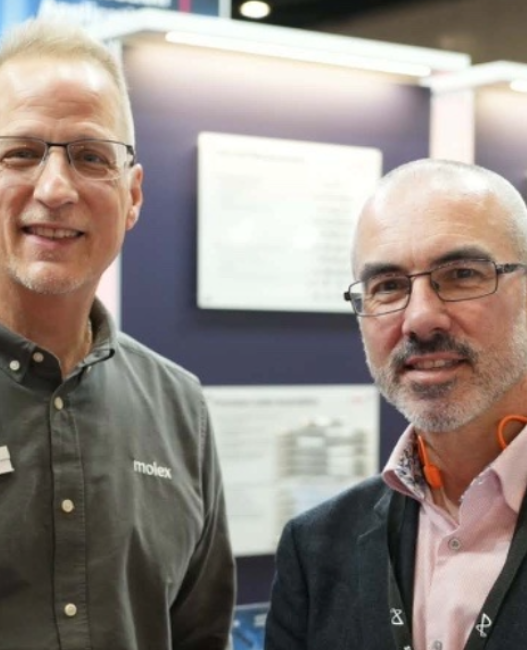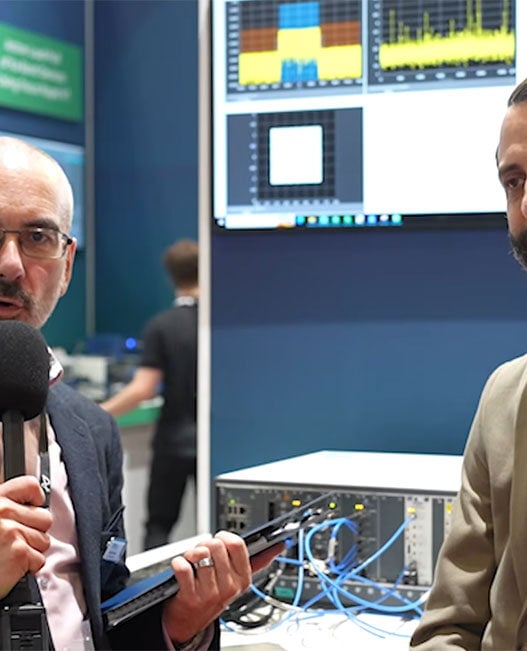






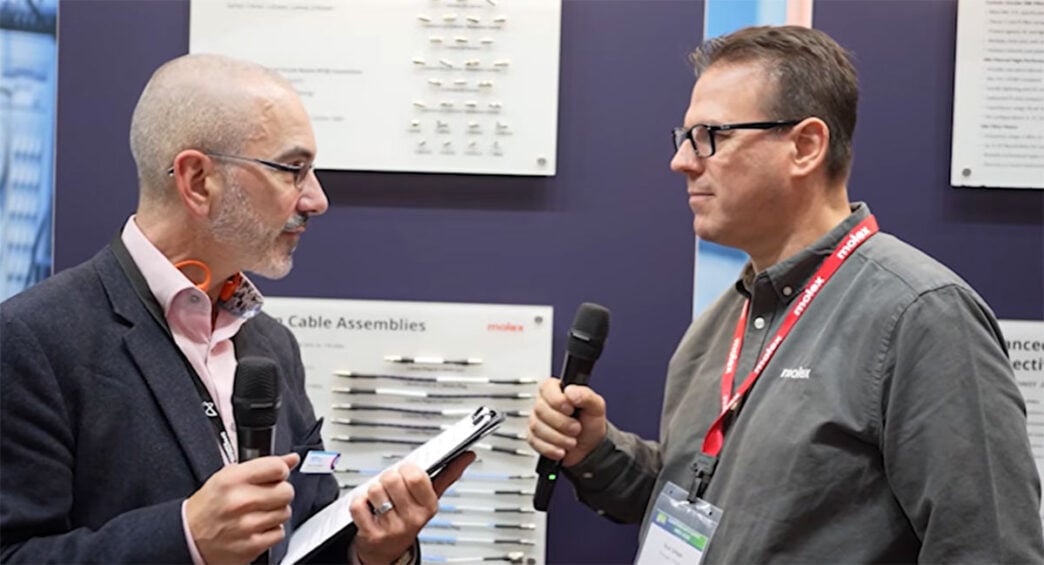
At European Microwave Week, Electronic Specifier‘s Mark Gradwell spoke with Ronald Orban, Product Manager for RF and Microwave at Molex, about why measurement consistency has become the defining challenge for RF engineers, and why the cables and connectors in a test setup deserve as much attention as the device under test.
Ask an RF engineer what keeps them up at night and the answer may not be the design itself. Increasingly, it is whether they can trust the numbers coming off the bench. As frequencies climb and tolerances tighten, the test setup has become a source of uncertainty in its own right, and engineers can lose hours chasing problems that have nothing to do with the circuit they are trying to characterise.
That was the starting point for a conversation on the Molex booth at European Microwave Week. According to Orban, the biggest issue facing RF engineers right now is “consistency in their measurements and reliability in what they’re getting out of their test setups.”
Trouble in the signal path
The culprits, he explained, tend to sit in the signal path between the instrument and the device. “Everything from cable movement to additional flexibility in the cables causing problems, to multiple connector points in the RF line. These can all be trouble spots for the test setup.”
Anyone who has worked at microwave frequencies will recognise the symptoms. Flex a test cable and its phase and amplitude response can shift. Re-route it between measurements and results may not line up with the previous run. Add an adapter or another connector interface and every mating point becomes another opportunity for loss, reflection, and drift. Individually these effects can be small, but across a full test chain they add up, and they can be difficult to separate from genuine changes in the device being measured.
The practical consequence is time. When results are inconsistent, engineers have to work out whether the fault lies with their design or with their equipment, and troubleshooting a test setup is rarely anyone’s idea of productive engineering.
Designed for repeatability
Molex’s response is to treat stability as a design requirement for the interconnect itself. Orban pointed to the company’s Cardinal family of test cable assemblies, specifically the Cardinal Test, Cardinal Wave, and Cardinal Flex product lines, which he said are “manufactured and designed for stability and consistency in their measurements.”
The aim is to give engineers assemblies that behave predictably regardless of where and how they are used. “They can be used in multiple setups, in multiple conditions,” he said, “that can provide the consistent, repeatable results that they’re looking for.”
The underlying philosophy is simple: the test equipment should fade into the background. “They can worry about their design and not the products that they’re using to test their design,” Orban said.
Only as strong as the weakest link
Cables are only part of the picture. A test setup typically includes connectors and adapters at multiple points, and each one has to hold up to repeated mating and handling without degrading performance.
“A test setup is only as strong as its weakest link,” Orban said. Molex’s test connectors, he explained, are designed to the same principles as its cable assemblies: stability, consistency, and repeatability.
That whole-chain view matters. Investing in a high-performance, phase-stable cable delivers limited benefit if an adapter further down the line introduces its own variability. Treating the cable, connector, and adapter as a system, rather than as separate purchases, is what ultimately determines how much confidence an engineer can place in a measurement.
Confidence as the end goal
Asked for the bottom line for customers, Orban framed it in terms of trust. “Really, we’re here to remove the uncertainty that they have in their test results, or their test setups,” he said. “We want them to have confidence in the products that they’re working with, and that’s what we’ve designed and what we’ve kept in mind as we’ve introduced products and kept ahead of the market for them.”