







In the race to power the artificial intelligence (AI) revolution, attention often fixates on graphics processing units (GPUs), advanced chips, and massive compute clusters. Yet behind the scenes, a century-old technology is quietly reshaping the infrastructure landscape. High-capacity power transformers, particularly those operating at super-grid levels, have emerged as critical strategic assets. They not only manage voltage conversion with efficiency but also unlock grid-scale capacity, enhance resilience, and support the transition to sustainable energy models for hyperscale facilities.
Driven by AI training and inference workloads that can consume tens of megawatts per cluster, data centre power demands are surging, and traditional electrical architectures are reaching their limits. Forward-thinking operators are turning to direct transmission-level connections and advanced transformers to build facilities that are larger, more sustainable, and more reliable than ever before.
The fundamentals: electromagnetic induction in the modern era
At their core, transformers operate on the principle of electromagnetic induction, first demonstrated by Michael Faraday in 1831. Alternating current in the primary winding generates a changing magnetic field within the core, which induces a corresponding voltage in the secondary winding. The voltage ratio is determined by the turns ratio between windings, allowing precise step-up or step-down functionality.
This simple yet powerful mechanism delivers profound efficiency gains in power transmission. Losses scale with the square of current (P = I²R), making high-voltage, low-current transmission essential for minimising energy waste over distance. Traditional distribution transformers typically interface between medium voltages (e.g., 30-110kV), but super-grid transformers connect directly to high-voltage transmission networks (such as 380kV systems) before stepping down to levels suitable for data centre operations.
These units are engineered for demanding environments. They are synthetic oil-filled for optimal insulation and cooling, physically substantial in size, and built for decades of continuous service under variable loads. In data centres, they form the backbone of the electrical system, supplying everything from cooling infrastructure and uninterruptible power supply (UPS) units to server racks and emerging high-voltage DC architectures like 800V systems.
Even marginal efficiency improvements yield significant dividends at scale. For AI-dense racks exceeding 100kW, reduced transformer losses translate directly into lower heat output, diminished cooling requirements, and a smaller overall carbon footprint.
The AI power crunch
Projections indicate global data centre electricity consumption could triple by 2030, fuelled by Cloud expansion and exponential AI growth placing unprecedented strain on electrical grids and forcing operators to rethink power delivery from the ground up.
Conventional setups relying on multiple transformation stages introduce cumulative inefficiencies, higher costs, and potential points of failure. They also struggle with the voltage regulation and capacity demands of modern AI workloads. Super-grid transformers address these challenges by minimising transformation steps, enabling higher overall capacity, and delivering tighter voltage control at the campus level.
This shift supports greater operational reliability and reduces dependence on fossil fuel-based backups, aligning with both performance needs and environmental goals. As grids incorporate more renewable sources, the ability to connect directly at transmission voltage levels becomes a decisive competitive advantage.
Case study: VIRTUS Data Centres’ Wustermark Campus
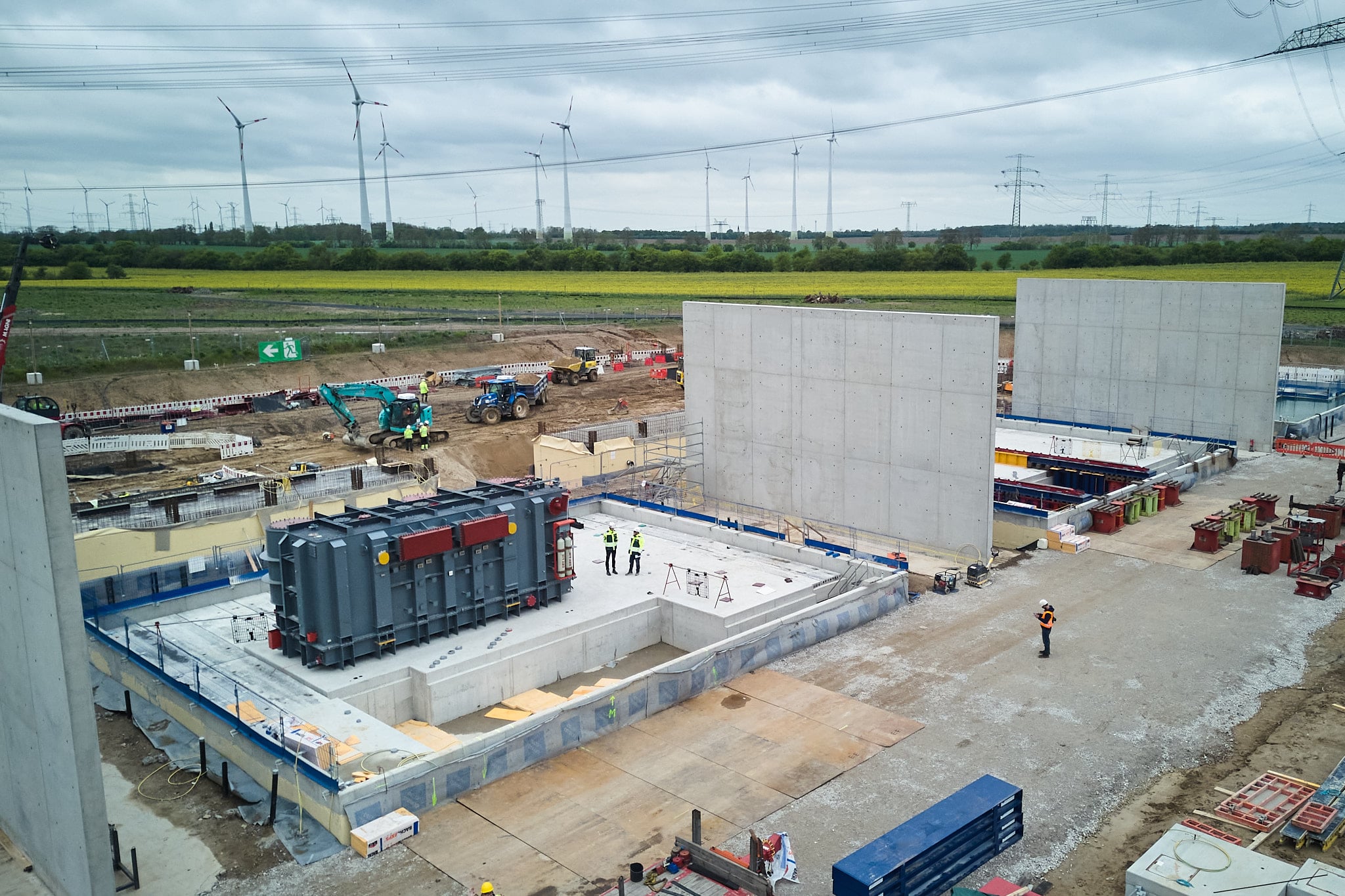
A compelling example of this evolution is underway at VIRTUS Data Centres’ Wustermark Campus, located west of Berlin. In early 2026, the company commissioned two 185 MVA super-grid transformers – one of the largest such deployments in a European data centre. These units connect directly to the 50Hertz 380kV transmission network, providing an initial 300MW of capacity with clear pathways to scale toward 500MW.
This direct high-voltage connection will bypass lower-level distribution networks, avoiding strain on local businesses and residential users while delivering substantial efficiency and cost benefits. The campus design incorporates 2N redundancy across critical systems, targeting 99.999% (five nines) availability. And it will operate entirely on 100% certified renewable energy, with onshore wind resources from the region contributing directly to the supply.
What sets Wustermark apart is its holistic approach. The architecture offers a viable zero-generator strategy for customers, leveraging the inherent stability of the ‘stiff’ 380kV meshed network. Multiple renewable infeed points and robust topology enable high uptime, making diesel generators optional rather than mandatory. This flexibility appeals to organisations prioritising sustainability without compromising resilience.
Engineering resilience: from grid connection to zero-generator operations
The Wustermark project reflects detailed engineering planning. The dedicated on-site substation, fed by the super-grid transformers, will enable seamless scaling and lower system usage charges. Customers will gain access to predictable, high-quality power at reduced operating expenditure, which is critical when energy can account for 40-60% of total cost of ownership.
By minimising reliance on diesel backups, the facility sidesteps challenges including emissions, fuel logistics, maintenance overheads, and local air quality impacts. The combination of super-grid connectivity, renewable integration, and redundant design creates a resilient platform suited to AI’s continuous, high-intensity demands.
Economic, environmental, and strategic advantages
The business case for super-grid transformer deployments is compelling. Efficiency gains are compounded across hundreds of megawatts, reducing waste. Less losses also contribute to decreased carbon emissions and compliance with stringent European regulations, such as the EU Energy Efficiency Directive and national net-zero targets.
Strategically, robust power infrastructure represents control over a vital resource. Hyperscalers investing billions in AI clusters require certainty in capacity availability and deployment timelines. Direct grid connections paired with advanced transformers facilitate faster build-outs and better alignment with clean energy sources through power purchase agreements, on-site solar, or battery storage systems.
This evolves data centres from pure consumers into integrated energy hubs. Facilities that master multi-vector energy management i.e. those that blend grid, renewables, and storage, will lead the industry, whilst others risk capacity constraints, regulatory hurdles, and stranded assets.
The backbone of digital infrastructure
The VIRTUS Wustermark Campus serves as a blueprint for the next generation of data centre development. Its 185 MVA super-grid transformers, 380kV feeds, optimised energy costs, and sustainability-focused design demonstrate that ambitious engineering can reconcile explosive AI growth with environmental stewardship.
The transformer, once viewed as basic utility hardware, has become a cornerstone of digital progress. Re-engineered for the super-grid era, it stands as a quiet hero powering the algorithms that will define our technological future.