





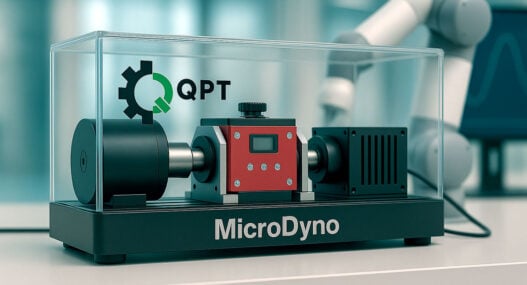
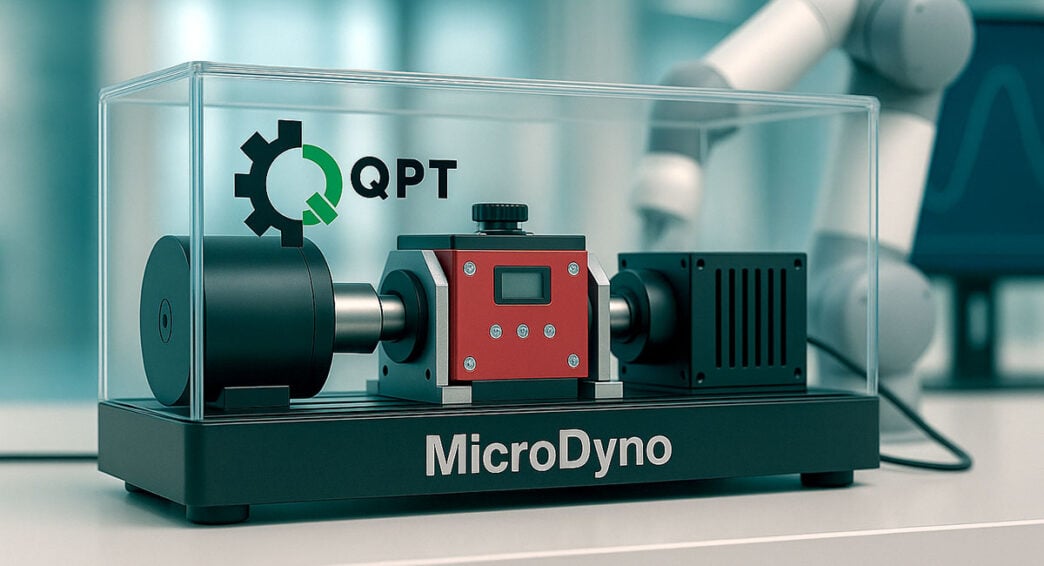
QPT, the deeptech company behind the world’s first 1MHz GaN motor drive, has opened customer demonstrations of its MicroDyno test platform, now updated with full Field Oriented Control (FOC) and real-time dynamic cogging correction.
The platform is available for in-person demos at QPT’s new R&D facility in Edinburgh, with remote-access demos available for international customers unable to travel.
The August 2025 launch of MicroDyno introduced the underlying 1MHz hard-switched sine wave drive, a 100x increase over the ~10kHz switching frequencies that have defined motor drives for two decades. The platform’s latest update closes the loop between QPT’s high-frequency hardware and the application-level performance that collaborative robotics, machine automation, and precision drive customers actually need.
Speaking exclusively to Electronic Specifier, James Cannings, CEO, QPT, said: “MicroDyno is the culmination of seven years of R&D, solving the challenges that enables ultra-high frequency motor drives, which deliver huge cost and performance benefits due to the pure sine wave output. We’re delighted to be launching this ahead of PCIM, and excited to start working with partners on integrating our drive technology to create next-generation solutions for cobots and machine automation.”
FOC at 1MHz: control bandwidth catches up with switching bandwidth
Field Oriented Control is the gold-standard architecture for high-performance motor control, mathematically decoupling torque and flux to enable direct, precise torque regulation. Running FOC at conventional 10kHz switching has long imposed a hard ceiling on control-loop responsiveness. MicroDyno is the first commercial demonstration platform to run FOC natively at 1MHz, with control-loop updates approximately 100x faster than industry norms.
That bandwidth headroom unlocks one of MicroDyno’s most commercially significant new capabilities: dynamic cogging correction. Due to the ultra-high signal-to-noise ratio of the drive the platform measures torque cogging directly within the drive itself, part of a core capability that QPT calls “sensing without sensors” (since QPTs internal qSense system can determine everything within the drive without the need for any expensive external sensors) and corrects the torque cogging in real time within the drive. No look-up tables. A simple setup on any motor. No drift over time. The result is high-precision control of a low-cost motor that would conventionally require a precision servo motor paired with a high-resolution encoder, a hardware combination typically costing £500-£1,000.
Additionally, QPTs new software generates a complete digital twin of the system allowing offline training of an edge AI system that can detect and classify mechanical and electrical issues within the system, reporting and potentially correcting dynamically; again all without any external sensors required.
“When we launched MicroDyno last August, we showed that GaN can switch at 1MHz in a working motor drive. What we’re showing now are examples of the core benefits that this step-change actually delivers. Running at 1MHz isn’t just faster, it changes what’s possible at the control layer. Dynamic cogging correction without look-up tables removes a pain point that the motor drive industry has had to cope with for decades, and our demonstration shows how we can use it to achieve very high precision with a low-cost motor,” said Rob Gwynne, Founder and CTO, QPT.
Live demonstrations: in person or remote
MicroDyno’s new bespoke motor control platform allows customers to interact with the system in real time. Live capabilities include sensorless electrical and mechanical diagnostics, dynamic cogging correction, digital-twin visualisation of motor behaviour and Edge AI enabled fault detection.
“The industrial motor drive industry hasn’t seen a step-change in underlying hardware performance in twenty years. What QPT has done with MicroDyno is to prove, at the application level, not just the device level, that 1MHz GaN combined with modern control algorithms can deliver the kind of precision that has historically been the preserve of expensive servo systems. For collaborative robotics and machine automation OEMs in particular, this fundamentally changes the bill-of-materials economics,” said Simon Hart, Former CTIO at YASA.
QPT will be showcasing MicroDyno at PCIM. Customers interested in arranging a private demo, in person in Edinburgh or remotely can contact QPT directly. For more information see https://www.q-p-t.com/microdyno