





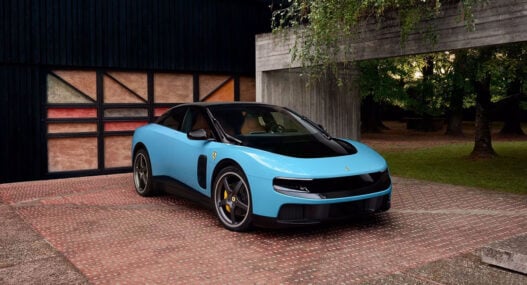
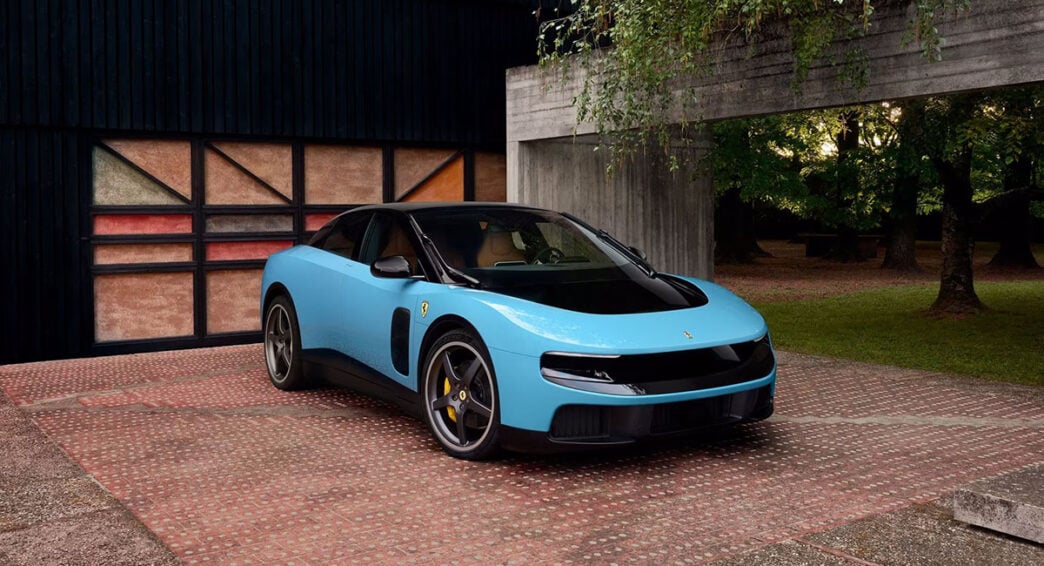
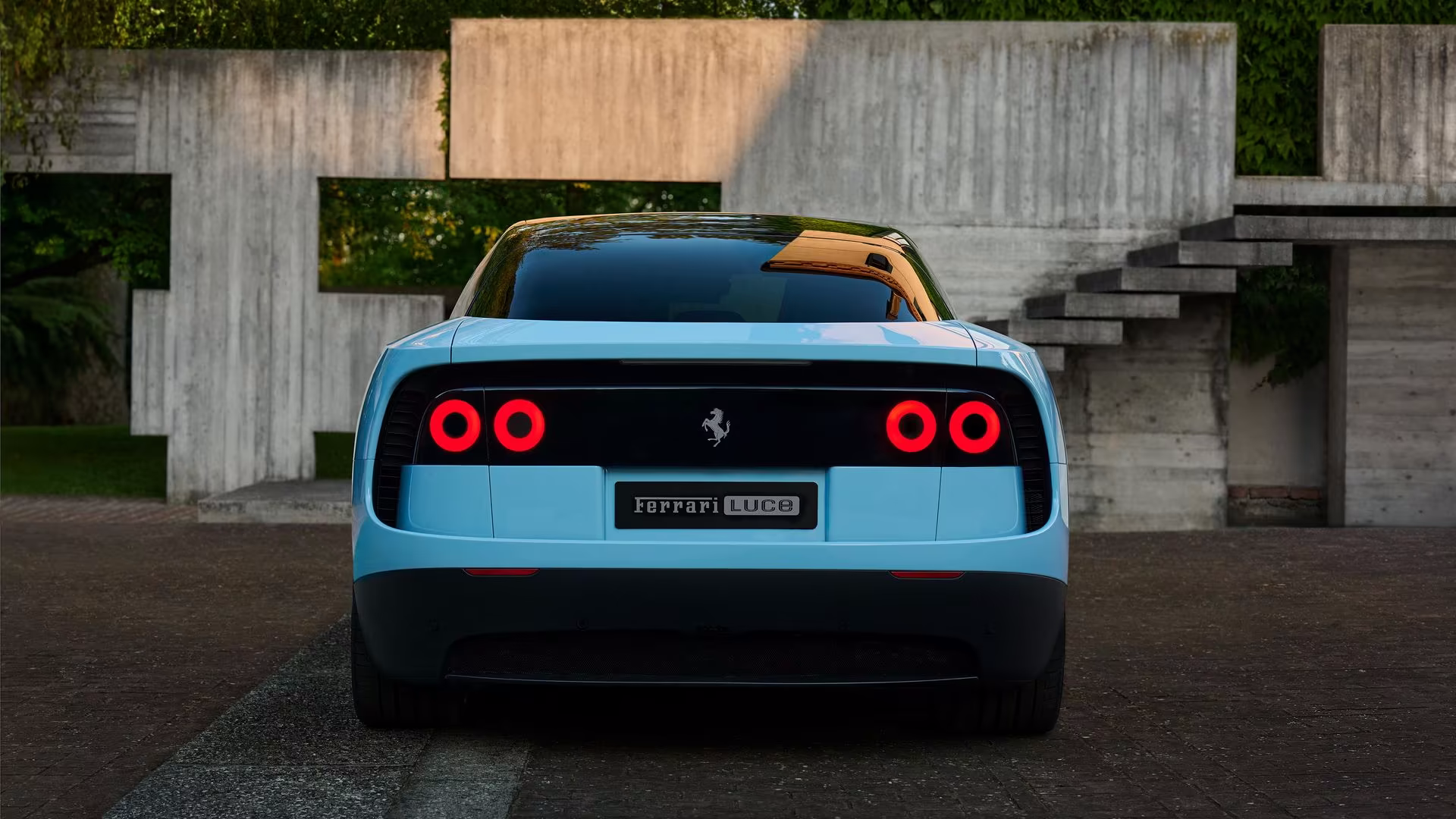
Ferrari has unveiled its first fully electric production vehicle – Luce. Created in collaboration with former Apple design chief Jony Ive, Luce is priced at £475,000 and has already created a stir in the automotive industry.
The Luce uses a quad-motor, all-wheel-drive layout with radial-flow permanent-synchronous motors. Ferrari has arranged these in a Halbach array — a configuration it says is derived from its Formula One powertrain work — which directs magnetic flux toward the stator to increase torque density.
The rear motors produce 416 horsepower each; the front units produce 141 horsepower each, for a combined system output of 1,113 horsepower. On top of that, a launch mode activated via a pull handle in the overhead console unlocks an additional 54 horsepower. During cruising, the front motors disengage to reduce energy consumption.
Ferrari claims a 0-62mph (0-100km) time of 2.5 seconds, 0-124mph (0-200km) in 6.8 seconds, and a top speed of 193mph (530km).
John Elkann, President of Ferrari, said: “With Ferrari Luce, we are once again redefining the limits of what is possible. Today, we are not simply unveiling a new car, we are inaugurating a chapter that turns our vision into reality, strengthening Ferrari’s tradition of anticipating and shaping the future. Such a leap forward in product innovation could only have been achieved through process innovation … And, as always, our research and engineering excellence have been placed at the service of driving emotions, without compromise.”
The battery pack is integrated into the floorpan, helping to lower the car’s centre of gravity. It consists of 210 cells connected in series and delivers a gross energy capacity of 122kWh at 800V. Peak discharge power is 830kW, and it is possible to recharge 70kWh in 20 minutes using a fast-charging station capable of delivering up to 350kW.
The cells, co-designed together with SK on, are of the pouch type with a capacity of 159Ah, with a graphite anode and a high-nickel nickel-manganese-cobalt cathode and liquid electrolyte. This technology achieves a density of over 740Wh/l and a specific energy of 305Wh/kg; in the application co-developed with Ferrari, the cell is capable of delivering up to 1200A peak discharge current.
One module is made up of 14 cells; each pair of cells shares an aluminium heat sink to remove heat; between each mini‑module there is an insulating layer that distributes compression and creates a thermal barrier.
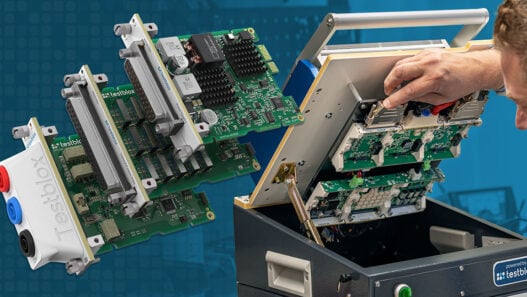
The e-Boxhouses the power electronics, which include the BMS (battery monitoring system), fuses, relays, and various sensors (current, gas, etc.). The e-Box manages power flows and communication via the CAN bus. In addition, there is a main fuse that interrupts current within three milliseconds in the event of a short circuit exceeding 2000A.
The battery follows Ferrari’s philosophy of total integration: the six rows of modules fixed to the floor contribute to stiffness via the module compression plates. This approach has made it possible to achieve an energy density close to 280Wh/l and a power density of around 1.9kW/l, at the top of the segment, making it one of the most competitive battery/chassis systems in the world.
The Ferrari Power Pack (FPP) is an extremely compact integrated power module equipped with six SiC modules, gate drivers, and a cooling system. To ensure the best charging performance on any infrastructure, Ferrari has developed a high-voltage DC/DC booster that raises the voltage delivered by the station, enabling charging up to 150kW even on 400V columns; the component operates with a switching frequency above 1MHz, weighs just 8kg, and is designed to guarantee the highest possible power density with no compromise on charging performance. The Combo component integrates the electronics required to convert the alternating current from charging stations into direct current and thus recharge the high-voltage battery at up to 22kW in AC, as well as incorporating the DC/DC converter to charge and maintain the 12V auxiliary battery.
Benedetto Vigna, CEO of Ferrari, said: “In line with our belief in technological neutrality, we are the first in the world to combine fully electric, hybrid, and combustion engine architectures for sports cars. We have not limited ourselves to innovation in powertrains; with Luce, we have launched a whole new segment in our range. This model is the result of more than 60 of our new patents and lies at the heart of an ecosystem of collaborations with outstanding technology partners. We have created a car that combines unique driving emotions with extraordinary performance, driving pleasure, and comfort for the Ferraristi of today and tomorrow.”
The launch of Luce, however, has lead to some mixed reactions. Ferrari’s share price dropped 8%, recovering to a 6% decline, but this suggests that investors are unsure of its success.
Some feel the design strays too far from what Ferrari has become known for – the classy sportscar. People have even likened the design to a Honda Accord EV (which isn’t far off the mark) and a Tesla 3.
Ferrari’s plan is, by 2030, to have a lineup of 40% internal combustion engine models, 40% hybrids, and 20% fully electric – a plan that was actually scaled back last year.
Only time will tell whether people will buy into this new “simplified and rationalised” design.