

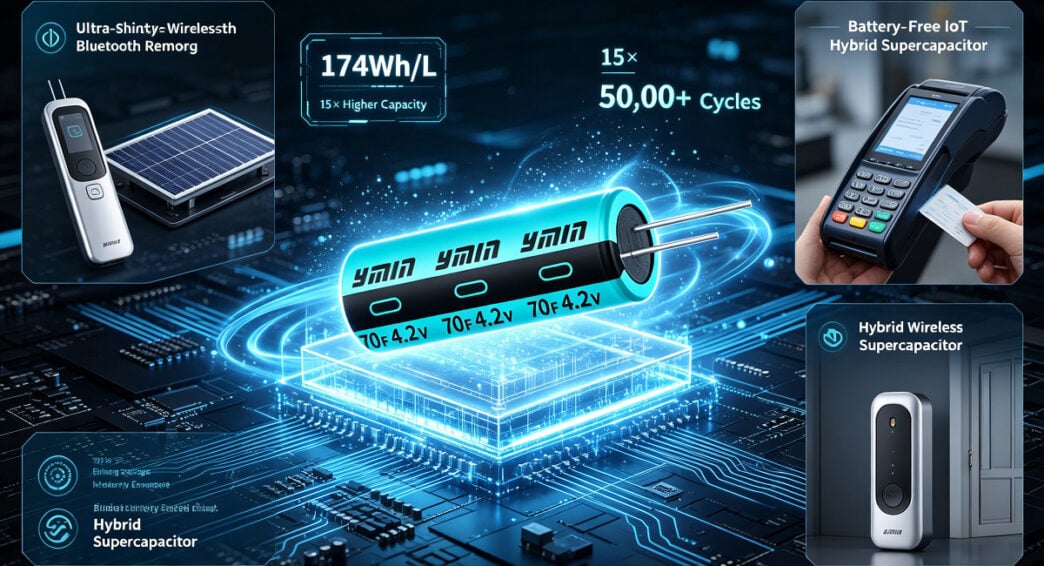
Industry pain point: when compact size meets long battery life, what are engineers compromising?
In the design of smart homes, IoT terminals, and portable devices, engineers almost always encounter the same challenge: devices are becoming smaller and smaller, while battery life requirements are becoming longer and longer.
Although traditional dry battery solutions are simple, they have obvious shortcomings. Batteries are bulky and difficult to integrate into thin and lightweight products. Frequent replacement affects user experience. Their low-temperature performance is poor, causing rapid power loss in cold environments.
On the other hand, ordinary supercapacitors, such as electric double-layer capacitors, offer long lifespan and high safety, but their energy density is too low. Under the same volume, the stored electrical energy can only support operation for a few minutes to dozens of minutes, which is far from sufficient for practical application needs.
So, is there an energy storage component that can be as safe and long-lasting as a capacitor, while also storing enough energy like a battery?
This is exactly the question that the SLD Series Hybrid Supercapacitors launched by Shanghai Yongming Electronic (hereinafter referred to as YMIN) aim to answer.
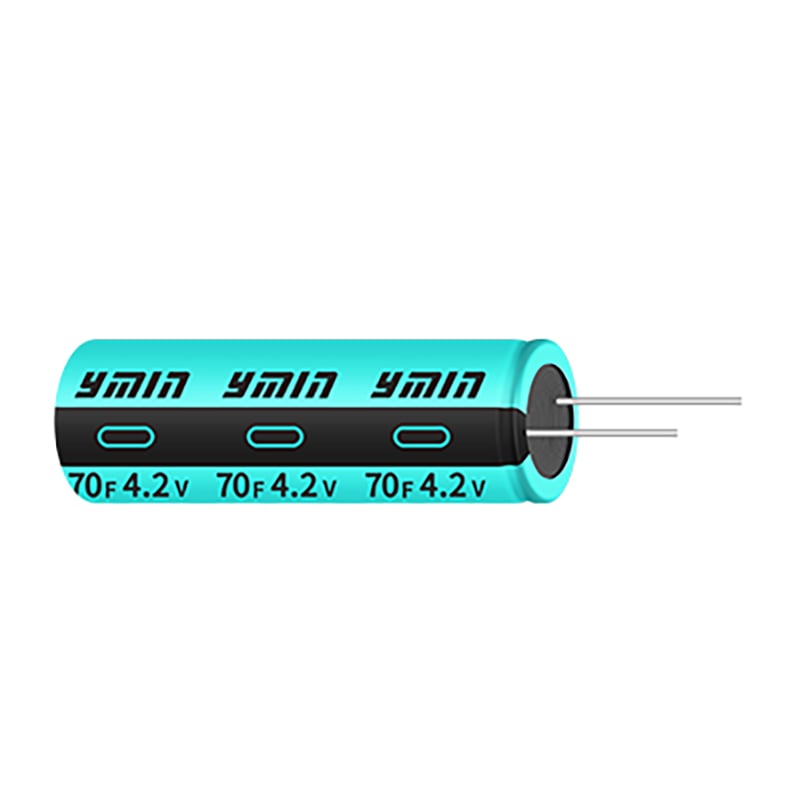
Technical solution: how does the SLD Series break through the energy density bottleneck?
The core technical approach of the SLD Series can be summarised in one sentence: introducing lithium-ion intercalation hybrid electrode technology into the framework of supercapacitors.
Specifically, YMIN’s R&D team accomplished three things.
- First, electrode material innovation. By adopting activated carbon and lithium-ion intercalation composite materials as electrodes, the SLD Series maintains the physical energy storage mechanism of electric double layers while introducing the chemical energy storage mechanism of lithium-ion intercalation and deintercalation, significantly increasing energy storage capacity per unit mass and per unit volume.
- Second, electrolyte optimisation. High-conductivity organic electrolytes are used to reduce ion migration resistance, ensuring high energy density without sacrificing power output capability.
- Third, process upgrade. A dry electrode process is introduced. Compared with traditional wet coating methods, it provides higher active material loading, lower internal resistance, and avoids the impact of solvent residue on lifespan.
It is precisely the combination of these three technologies that enables the SLD Series to achieve a breakthrough leap beyond traditional solutions in terms of high energy density.
Data verification: what makes the SLD series truly stand out?
No matter how much theory is discussed, real data speaks louder.
YMIN selected two representative models for actual testing.
Representative models
- SLD-4.2V-70F, with a size of 8×25mm. Its slim design is suitable for narrow cavities
- SLD-4.2V-1100F, with a size of 16×50mm. Its standard cylindrical structure is suitable for medium-capacity requirements
Core energy performance
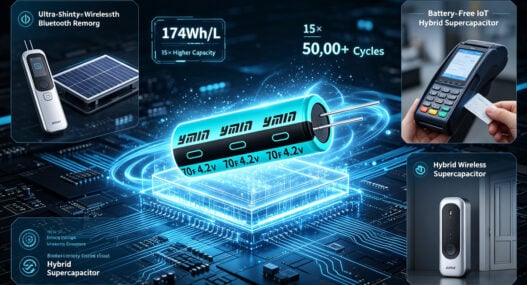
Taking the SLD 4.2V 1100F as an example, the available energy of a single cell is 1.74Wh. The cylindrical form factor has a volume of approximately 10.048cm³. Its volumetric energy density reaches 174Wh/L.
In horizontal comparison, under the same volume, the capacity advantages are as follows.
Compared with electric double-layer capacitors, the SLD Series provides 15 times the capacity, representing an approximately 1,400% increase in capacity. Under the same energy storage target, the volume can be reduced by approximately 90%.
Compared with conventional hybrid lithium-ion supercapacitors, the SLD Series provides 1.5 times the capacity, representing an approximately 50% increase in capacity. Under the same energy storage target, the volume can be reduced by approximately 40%.
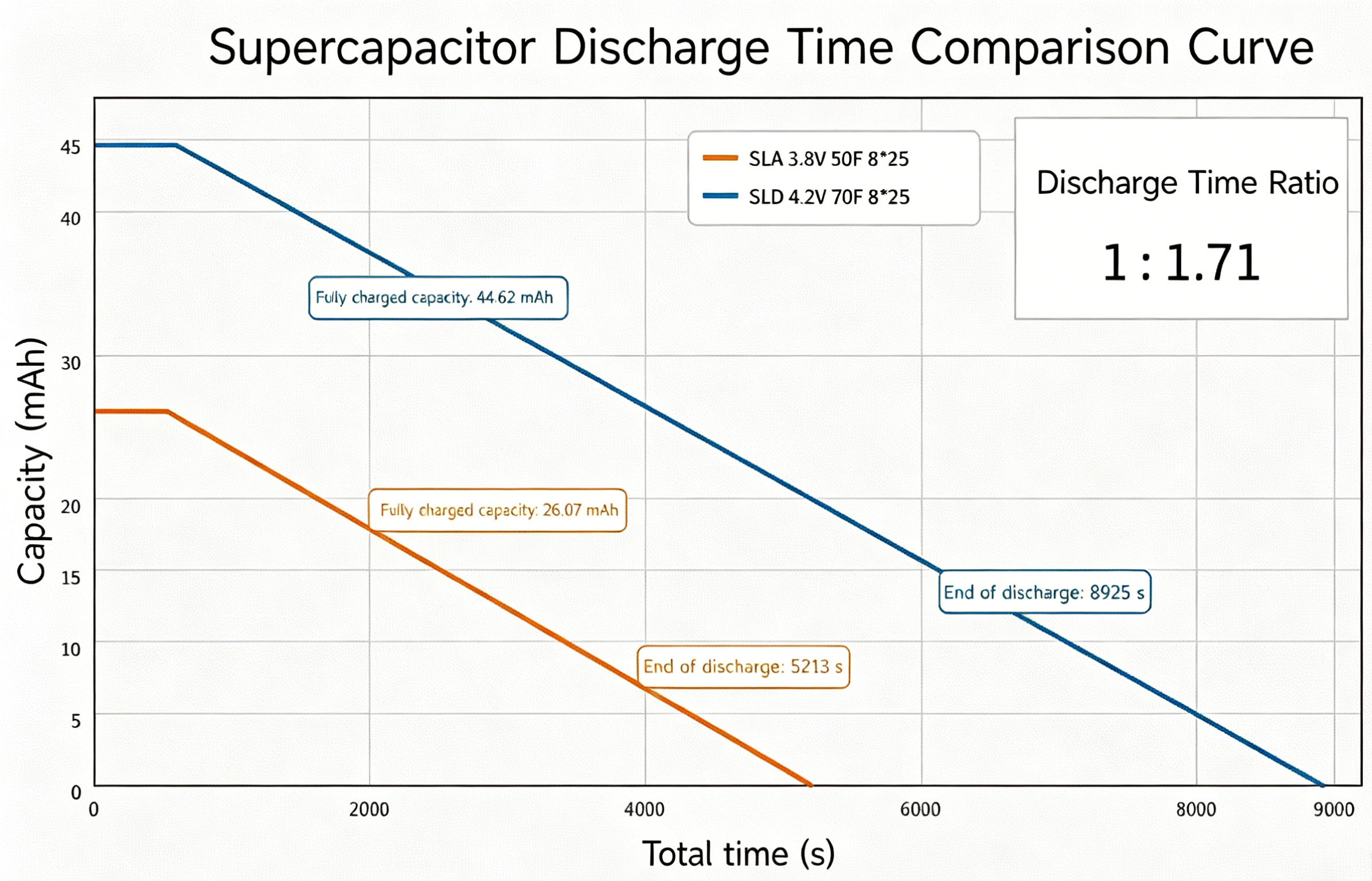
The test method involved constant-current charging to the rated voltage, followed by constant-voltage charging for 30 minutes, and then constant-current discharging to the minimum operating voltage. The results showed that the capacity of the SLD Series is 1.71 times that of the SLA.
This set of data demonstrates that, within the same size and space, the SLD Series can store 1.5 to 15 times more electrical energy than traditional solutions. Conversely, to achieve the same energy storage target, the SLD Series can be 40% to 90% smaller than competing products.
For designs that require both limited space and long battery life, this represents a fundamental breakthrough.
Scenario validation: three real-world cases showing how the SLD Series solves practical problems
The value of high energy density ultimately needs to be reflected in real products.
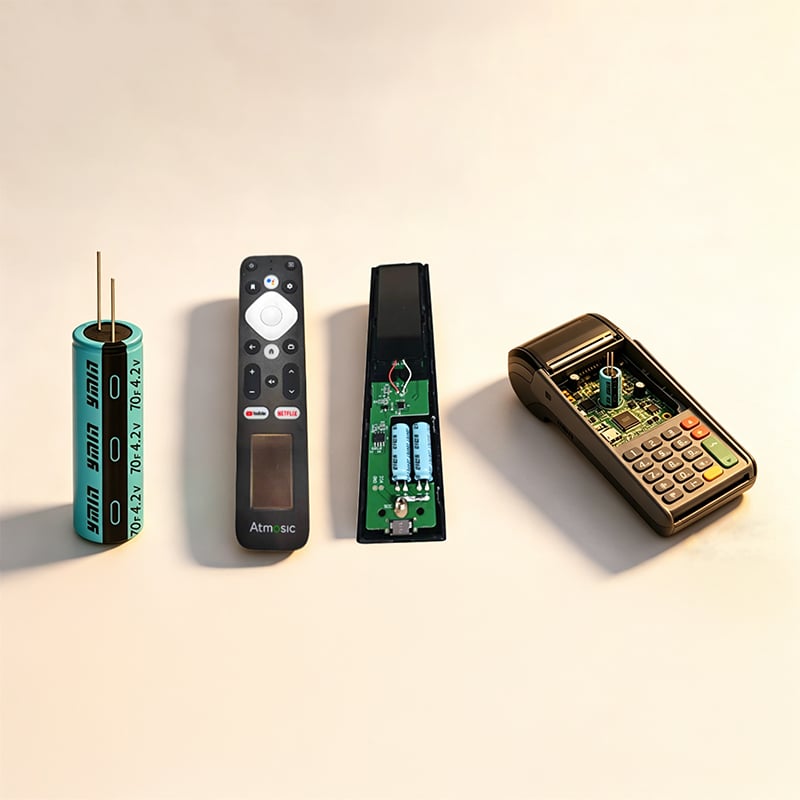
Scenario 1: Battery-Free Bluetooth voice remote control
Pain point: traditional remote controls rely on dry batteries, resulting in bulky size and frequent replacements. Ordinary supercapacitors have low energy density and, even when combined with photovoltaic energy harvesting, cannot support daily operation.
SLD solution: the SLD 4.2V 70F 8×25mm slim-type solution is adopted, combined with an energy harvesting chip, a solar photovoltaic panel, and a low-power Bluetooth chip. Under strict size constraints, it provides higher energy storage, eliminating the need for dry batteries and enabling ultra-low self-discharge, lightweight design, safety, and lifetime maintenance-free operation.
High energy density advantage: within a narrow and constrained space, the SLD 70F provides sufficient energy storage to support daily operation.
Scenario 2: Electronic doorbell or wireless doorbell auxiliary power supply
Pain point: doorbell installation locations are distributed, requiring frequent replacement of traditional dry batteries. Ordinary supercapacitors cannot provide sufficient energy storage in the same volume, and under high-frequency triggering conditions, voltage drops easily, affecting standby and response stability.
SLD solution: the SLD 4.2V 70F 8×25mm or 100F 8×30mm is used. Compared with competitors, energy density under the same size is improved by approximately 30% to 40%. Lower internal resistance makes it more suitable for pulse load conditions such as ringing and transmission. It reduces voltage drop and improves system reliability.
High energy density advantage: within the same doorbell housing volume, the SLD Series provides longer standby time and more triggering cycles.
Scenario 3: POS terminal instant peak power or backup hold-up
Pain point: POS terminals experience pulse power demand during communication and scanning operations. Internal space is limited, and high safety and long lifespan are required. Traditional batteries have limited cycle life, while ordinary supercapacitors lack sufficient energy storage.
SLD solution: The SLD 4.2V 100F 8×30mm is used as the main option, with an ultra-thin 70F 8×25mm version available. Combined with a DC/DC converter and power management system, it is used for power switching buffering, instantaneous high-current support, and short-term data retention.
High energy density advantage: within limited space, sufficient buffering energy is provided to prevent system shutdown or data loss.
Trust foundation: beyond high energy density, safety, and lifetime are equally robust
High energy density often raises concerns about whether safety or lifespan is compromised. The SLD Series from YMIN provides a clear answer: it does not.
The operating temperature range is -20°C to +85°C, ensuring stable performance across the full temperature spectrum.
The cycle life exceeds 50,000 cycles, with capacity degradation of no more than 30% under testing conditions at 25°C.
Safety certifications include UL810A component safety certification, UN38.3 lithium battery transportation safety certification (air transport compliant), RoHS environmental certification, and REACH environmental certification. IEC 62391-1 test reports can also be provided.
In terms of safety testing, the SLD Series passes overcharge, short-circuit, needle puncture, and thermal shock tests without any risk of fire or explosion.
From a regulatory perspective, the SLD Series is classified as a capacitor rather than a battery. Therefore, it is not subject to the EU Battery Regulation (EU 2023/1542), resulting in simpler export certification and lower compliance costs.
Call to action: how to access technical support and samples of the SLD Series
If you are looking for an energy storage solution for compact, long-endurance, and maintenance-free products, the SLD Series is worth serious evaluation.
YMIN provides the following support: detailed datasheet download, free sample application, one-on-one technical selection consultation with engineering support, and IEC 62391-1 test report requests.
Official website: https://www.ymin.cn/
Business email: ymin-sale@ymin.com