


Circular transmission lines

A circular waveguide is schematically depicted in Figure 5. To consider its parameters we will employ the polar coordinates with radial components ρ and angle φ.

So the corresponding electric and magnetic field components for the general case are Eρ=–jkc2 (β∂Ez∂ρ+ωμρ∂Hz∂φ),Eφ=-jkc2(βρ∂Ez∂ρ+μω∂Hz∂φ,Hρ=jkc2 (ωερ∂Ez∂φ+β∂Hz∂ρ),Hρ=-jkc2 (ωε∂Ez∂φ+βρ∂Hz∂ρ)
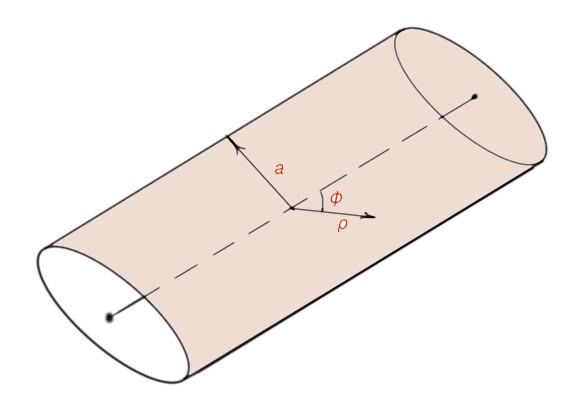
Figure 5. Schematic of the circular transmission line.

Let’s consider the TE waves, where EZ=0, HZ≠0. Considering the Hz(ρ,φ,z)=Hz(ρ,φ)e–jβz and applying the Laplace equation, we can get the magnetic field structure and the rest of the parameters of the waveguide, in a similar way we did before.

So        Hz(ρ,φ)=(Asinnφ+Bcosnφ)Jn(kc,ρ)Eφ(z,ρ,φ)=jωμkc(Asinnφ+Bcosnφ)Jn‘(kc,ρ)e–jβz, here Jn(kc,ρ) and Jn‘ (kc,ρ)  are Bessel functions. The characteristics of the waveguide will be determined by the Bessel function roots pnm. So the parameters of the TE mode transmission line are:

Cut-off wave number knm=ωμεkcnm=pnm‘a .

Propagation constant βnm=k2–pnm‘a2.
Cut-off wavelength  λcnm=2πpnm‘ aλgnm=2πβ .
Phase velocity  vpnm=ωβ.

Dielectric attenuation constant αdnm=k2tanδ2β.
Eznm=0Hznm= (Asinnφ+Bcosnφ)Jn(kc,ρ)e–jβzEρnm=-jωμkc2ρ(Acosnφ–Bsinnφ) Jn(kc,ρ)e–jβzEφnm=jωμkc(Acosnφ+Bcosnφ) Jn‘ (kc,ρ)e–jβzHρnm=–jβkc(Acosnφ+Bcosnφ) Jn‘ (kc,ρ)e–jβzHφnm= –jβkc2ρ(Acosnφ–Bsinnφ) Jn(kc,ρ)e–jβz

Impedance  ZTEnm=kηβ .

For the TM mode of the transmission line, applying the considerations and calculation above we can get the following results:

Cut-off wave number knm=ωμεkcnm=pnma .
Propagation constant βnm=k2–Pnm2a2.
Cut-off wavelength λcnm=2πapnmλgnm=2πβ.
Phase velocity vpnm=ωβ.

Dielectric attenuation constant αdnm=k2tanδ2β.
Eznm= (Asinnφ+Bcosnφ) Jn(kc,ρ)e–jβzHznm= 0Eρnm=-jβkc(Acosnφ+Bsinnφ) Jn‘ (kc,ρ)e–jβzEφnm=jβnkc2ρ(Acosnφ–Bcosnφ) Jn(kc,ρ)e–jβzHρnm=–jεωnkc2ρ(Acosnφ–Bcosnφ) Jn(kc,ρ)e–jβzHφnm= –jωεkc2ρ(Acosnφ+Bsinnφ) Jn‘ (kc,ρ)e–jβz

Impedance ZTM nm=βηk.

The cut-off frequency for the waveguide can be obtained using the cut-off wavelength. The roots for Bessel functions can be found in mathematic catalogues.

Coaxial transmission line

Keep Up to Date with the Most Important News

By pressing the Subscribe button, you confirm that you have read and are agreeing to our Privacy Policy and Terms of Use
Previous Post

How smart alerts and sensors add value to electric motors

Next Post

Wide input range DC/DC modules suitable for rail applications