





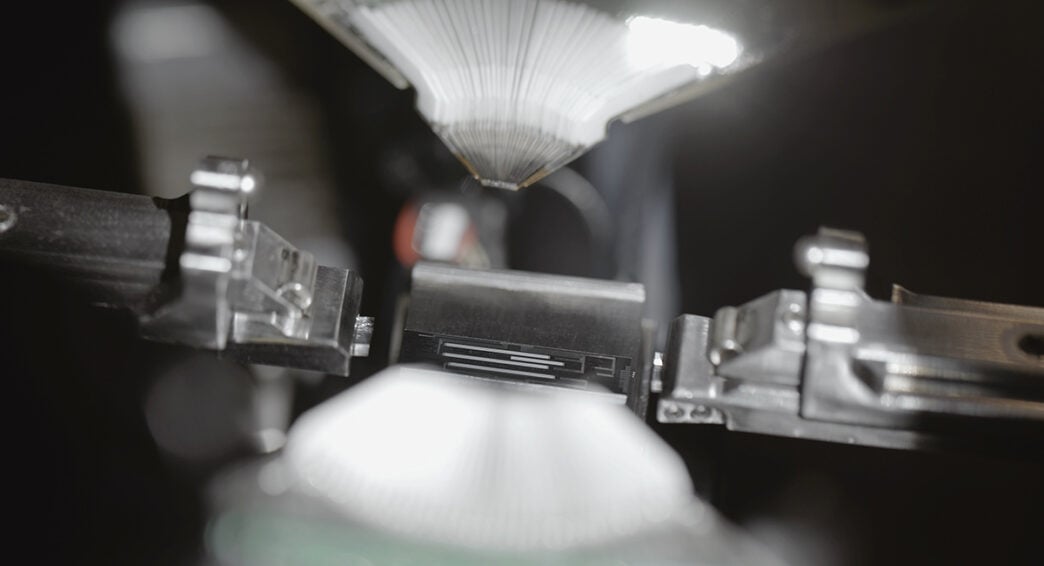
Networking giant Cisco says its Universal Switch can connect quantum computers made by different companies, preserve fragile quantum information, and slot into existing infrastructure. It is, for now, a working research prototype – but the company believes it is as important to the future quantum Internet as ordinary switches are to the Internet we use today.
Why a switch matters
Quantum computers promise to achieve big things when it comes to solving the problems that today’s machines struggle with – things like finding new medicines, modelling the climate, or optimising global supply chains. The problem, says Vijoy Pandey, SVP/GM of Outshift, Cisco’s Emerging Technologies and Incubation Group, is that current quantum machines are small. Most have between 100 and 2,000 qubits, while the hardest real-world problems may need millions.
One solution is to link many smaller quantum machines together so they act as one big machine, the same way the Internet connects millions of ordinary computers. But that requires a network, and a network requires switches. Until now, quantum connections have been strictly point-to-point: machine A talks to machine B, and that’s it.
“You could not have built the Internet through point-to-point direct connections. It would have been unmanageable. There was a big missing piece that the Internet needed, and that was the switch,” said Pandey.
What makes it quantum
Quantum information is extraordinarily delicate. Ordinary network switches, which read and re-transmit signals, cannot handle it. Cisco’s switch routes quantum information carried by individual photons (particles of light) without ever measuring or disturbing it. The company says it achieves this while adding less than 4% degradation to the quality of the quantum signal, and can redirect traffic in as little as one nanosecond. It also consumes less than 1 milliwatt of power.
Moreover, the switch works at room temperature and uses standard telecom frequencies, which means it can, in theory, be dropped into existing fibre-optic infrastructure rather than requiring entirely new facilities.
A translator between rival technologies
The challenge with quantum computers is that different companies build their machines using completely different underlying technologies. IBM uses superconducting circuits. Others use trapped ions, neutral atoms, or photonics. Each approach encodes quantum information differently, making them incompatible.
Cisco’s switch handles the four main ways of encoding quantum information in light: the orientation of light waves (polarisation), the timing of light pulses (time-bin), the colour or frequency of light (frequency-bin), and the physical path the light takes. The device has a Cisco-patented conversion engine which translates between these formats on the fly, accepting quantum information in whatever form it arrives and delivering it in the format the receiving system needs.
“You can start and build your infrastructure now without being worried about who is going to win the quantum computing race,” said Reza Nejabati, Head of Cisco’s Quantum Research.
Fully stacked
This announcement is part of a larger effort Cisco has been building in stages from its dedicated quantum labs in Santa Monica. In May last year, the company unveiled a chip that generates entangled photon pairs at a rate of 200 million pairs per second. In October, it released a set of networking protocols and three early software applications, including a quantum compiler that can split a large computation across multiple machines and stitch the results back together, along with two classical applications – Quantum Sync and Quantum Alert. The switch now completes the hardware foundation. Taken together, Cisco says these components form a full networking stack, from the physical hardware up to the software that applications can run on.
Tested in the real world
The company has already trialled parts of the technology outside the lab, with a recent experiment which ran over 17.6 kilometres of live fibre in New York, passing through one of the city’s busiest network hubs connecting Manhattan and Brooklyn. Cisco says the results were better than those previously achieved in controlled lab conditions – even accounting for the noise, vibration, and temperature changes of a working urban environment.
What’s next?
Partnerships with IBM, Atom Computing, and Qunnect to test the switch with real quantum processors have been announced. Cisco says it has no interest in picking a winner between competing quantum technologies, and wants its network to serve all of them.
Although practical quantum computing at scale may be years away, Cisco is showing that the network layer does not have to wait – and that building it now, in a way that is open to any technology and compatible with today’s infrastructure, is what gives the broader field its best chance of getting there.