




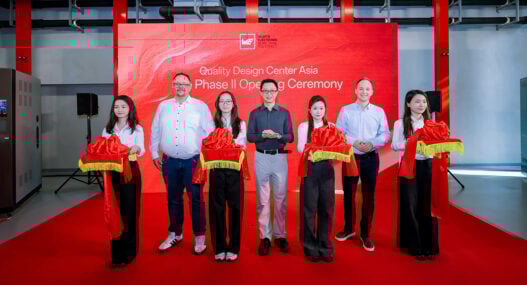
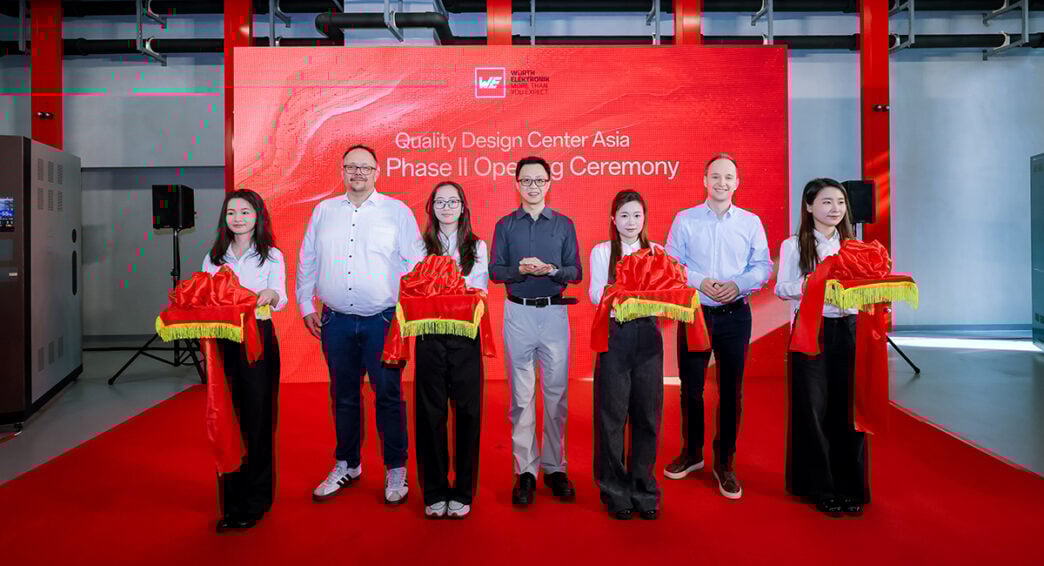
Würth Elektronik eiSos Group celebrated the official opening of the Laboratory Phase II at its Asia Quality Design Center (QDC Asia) in Shenzhen on 5th March 2026. The inauguration ceremony was marked by a ribbon-cutting event presided over by senior leadership, including the CEO, Thomas Garz, and COO, Dirk Knorr, of the Würth Elektronik eiSos Group, alongside the Head of QDC Asia, Yangyang Chen, symbolically kicking off operations in the new facility.
Established in August 2008, QDC Asia spans approximately 4,700m², with a dedicated testing area of 1,700m² housing over 300 pieces of advanced high-precision testing equipment. Operating in strict compliance with ISO/IEC 17025 and ISO/IEC 17043 standards, the centre holds accreditations as a testing laboratory, a proficiency testing provider, and a lab recognised by VDE (TDAP), UL (WTDP), and IEC (CTF2). Initially focused on pre-shipment product inspection for production, the Laboratory has evolved into a comprehensive testing centre offering a wide range of services including product incoming inspection testing, design change validation, reliability testing, product conformity judgment, material compliance, failure analysis, etc. However, with existing lab space maximised and approaching saturation, expansion became imperative to support the Group’s growing business needs.
“With the expansion of our laboratory facilities in Shenzhen, we are making targeted investments in additional testing capacities, faster validation processes, and even better service for our customers. QDC Asia is an important pillar of our global quality and development strategy and strengthens our ability to meet growing demands for reliability, speed, and technical excellence,” explains Knorr.
Future environmental testing capacity to increase by 170%
The newly added 352m² laboratory is a strategic response to this demand. Primarily designed for environmental and electrical performance testing, the facility is equipped with an energy-efficient VFD chiller featuring advanced magnetic bearing technology, as well as a scalable electrical system capable of meeting peak load demands. A total of 38 testing devices will be gradually deployed across phases to align with actual business needs: 19 units on the ground floor, followed by an additional 19 on a second level. This phased approach maximises spatial efficiency and delivers optimal cost-effectiveness.
The expansion thus lays the foundation for a significant increase in capacity: In future, throughput for environmental testing is expected to grow by 170% compared to current capacity.