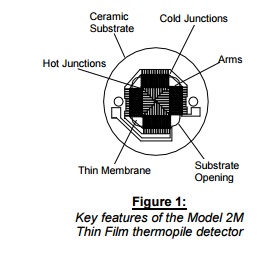





In the typical internal construction of a thermopile device produced by Dexter, the detector consists of a thermocouple array mounted on a ceramic substrate. The hot and cold junctions that form the thermocouple are connected with alternating n and p-type materials called ‘arms’. The cold junctions are thermally connected to the detector housing and are located around the perimeter of the substrate opening.
The hot junctions define the active area of the detector and are coated with an energy absorber. They are placed in the centre of the detector and are suspended on a thin membrane, thermally isolating them from the rest of the package. The voltage produced by the device is related to the temperature gradient between junctions.
Thermopiles are very low noise detectors generating no 1/f or microphonic noise. They also generate a stable output for DC radiation up to a frequency limited by the time constant of the device.
The ST60 dual is a two-channel silicon based thermopile in a TO-5 package that is widely used in gas sensing applications such as automotive exhaust monitoring. The transmission characteristics of the filters on the individual channels determine the specific gases to be targeted.