






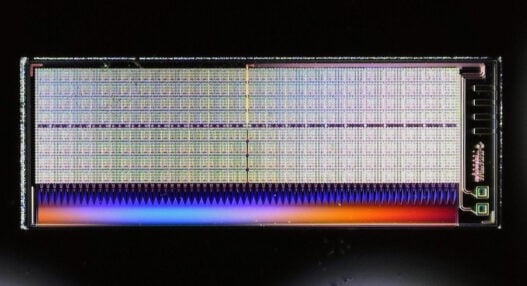
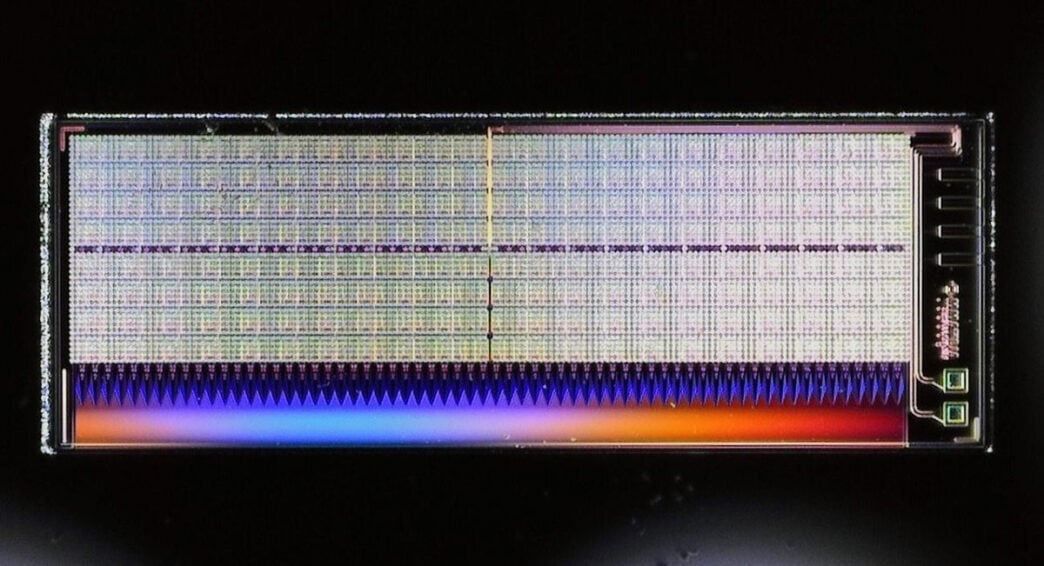
Photonic integrated circuits are often described as a path to smaller and more scalable optical systems. In measurement hardware, their more immediate value is simpler to explain: they make it possible to process multiple optical channels in parallel inside a practical instrument.
That is the idea behind Ommatidia LiDAR’s parallel Laser RADAR architecture. Instead of relying on a single sequential optical path, the system uses a PIC-enabled design to analyse many channels simultaneously. Depending on configuration, this means up to 128 measurement channels can be captured during the same event.
For electronics and photonics readers, the significance is not only the presence of a PIC. It is what the PIC unlocks at system level. In dynamic measurement work, sequential acquisition has a familiar drawback: the scene is sampled point by point, so spatial coverage and time coherence compete with each other. If the response changes during the measurement window, engineers can lose information or be forced into repeated runs.
A parallel optical architecture reduces that limitation directly. Multiple locations on the target are observed at once, which helps preserve the relationship between points during transient or operational events. The result is a more useful view of mode shapes, spatial vibration patterns, and localised response.
In Ommatidia’s case, the PIC sits inside a broader non-contact measurement platform that combines coherent detection, FMCW concepts, and Laser RADAR/LDV workflows. That lets the instrument address both geometric and dynamic tasks without the heavy sensor installation burden associated with contact instrumentation.
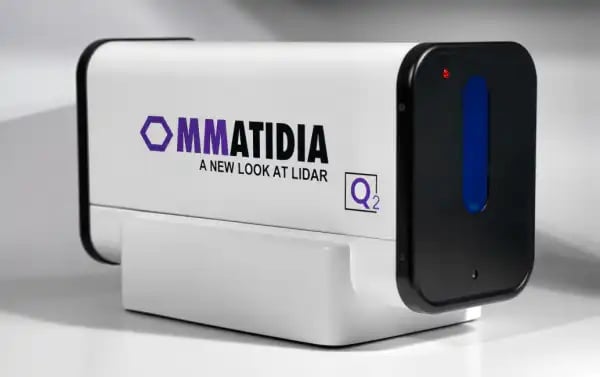
The practical effect is that photonic integration moves from component promise to workflow benefit. Engineers can collect more spatial data in one pass, shorten setup time, and reduce the number of repeated acquisitions needed to interpret a structure or machine.
That difference shows up clearly in dynamic measurements. In structural monitoring and modal testing, excitation may come from wind, rotating machinery, impact, or operational loading. These inputs are often transient and not perfectly repeatable. If an instrument samples points sequentially, the user may need multiple runs to rebuild the spatial response, which increases both test time and interpretive uncertainty. A parallel optical architecture cuts into that problem by capturing multiple locations during the same event.
The same advantage carries into industrial diagnostics. Engineers looking for stress points, localised vibration hot spots, or coupling effects do not just want a single accurate point measurement. They want to know how the response is distributed across the asset. A PIC-enabled channel architecture supports that by preserving time coherence across multiple observed locations.
This is also why the Ommatidia case is relevant from an electronics perspective. It shows that photonic integration can be the enabling layer inside a differentiated end system, not merely a route to lower bill of materials or reduced packaging volume. The PIC is part of the reason the instrument can operate as a practical, high-channel non-contact measurement platform rather than only as a sequential optical tool.
That matters in areas such as structural monitoring, industrial diagnostics, modal testing, and precision metrology. It also matters in product-development environments where teams need faster setup, cleaner data handoff, and less dependence on sensor installation logistics. Instead of treating PICs as a future-facing talking point, this architecture uses them to solve a current measurement problem: how to capture more useful optical information from a real asset during the same physical event.
In that sense, the PIC is not the story because it is small. It is the story because it enables a fundamentally more parallel instrument, and because that parallelism translates directly into engineering value.