





The theme for this year’s International Day of Light tomorrow is focused on ‘light for a sustainable future’, and it couldn’t come at a more critical time. As governments and industry grapple with the rising energy demands of AI, silicon photonics is being recognised as a solution, with recent discussions reflected in the UK government’s inquiry into low-energy computing.
Professor Andy G Sellars, Director of Strategy at CORNERSTONE, said: “Silicon photonics has emerged as a clear solution to mitigate the energy requirements of AI, with research showing that integrated photonics could significantly reduce data centre energy consumption, while accelerating Edge AI. These topics were top of the agenda for the UK government inquiry into low-energy computing, placing silicon photonics at the heart of the discussion.
“However, the industry is at a critical juncture. As momentum builds and we celebrate the International Day of Light, we must also consider the hurdles that need to be overcome to support the sector’s evolution and realise silicon photonics’ full promise.”
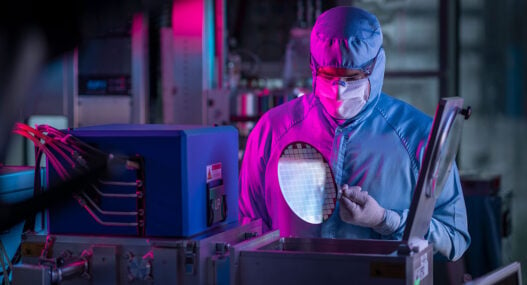
CORNERSTONE is a silicon photonics innovation centre led by the University of Southampton. It is an open-access foundry, providing the means to support the development of cutting-edge technology with applications across healthcare, AI compute, quantum, autonomous vehicles, and energy.
New market research from the CORNERSTONE paints an encouraging picture of the UK’s silicon photonics (SiPh) sector – but warns that without targeted investment, the country risks missing a critical window of opportunity.
SiPh, which embeds light-based components into silicon chips, is one of the fastest-growing areas in global technology, with projected annual growth of 25-30%. Its ability to reduce AI power consumption has drawn major industry attention, including a $6 billion investment from NVIDIA, and is driving fresh calls for government action.
CORNERSTONE surveyed 100 UK-based decision-makers currently developing or planning to deploy SiPh chips. The findings reveal a sector with genuine commercial momentum – but one held back by a lack of domestic infrastructure.
Two-thirds of respondents expressed confidence in the UK’s ability to capitalise on the SiPh opportunity. The vast majority (77%) are already developing in the UK or plan to, yet 64% are manufacturing abroad – suggesting significant value is leaking overseas. Nearly a third cited tariff costs as a concrete barrier to prototype development.
The case for a UK pilot line is a through-line in the data. Respondents said such a facility would enhance sovereign technology capabilities (79%), accelerate innovation (74%), and reduce dependence on overseas foundries (40%). More broadly, government investment in the sector could add an estimated £2.9 billion to the UK economy by 2040 and create around 2,850 jobs.
Professor Graham Reed, CORNERSTONE’s Director, noted that the UK possesses the talent and expertise to compete globally – what’s missing is the scale-up infrastructure to convert that potential into commercial output.
“Our market research … demonstrated strong industry intent and growing market demand, outlining a clear business case for investing in a silicon photonics pilot line that could add £2.9 billion to the UK’s economy by 2040. With markets such as the EU already pursuing a similar strategy, now is the time for the UK to act. In building the infrastructure to help silicon photonics companies scale, the country will strengthen its sovereign tech capabilities in this increasingly vital sector that will be instrumental in supporting a sustainable future and so much more,” said Sellers.
With the global SiPh market projected to reach at least $46.5 billion by 2035, the argument for a domestic pilot line is, as CORNERSTONE Deputy Director Callum Littlejohns put it, straightforward: translate early-stage capability into jobs, exports, and long-term technological independence.