






Infineon’s EZ-USB FX10 is a next-gen USB 3.2 Gen2 peripheral controller that enhances imaging speed and reliability. It is an ideal choice for USB cameras, industrial automation systems, and more. Learn more about this controller, USB technology, and why USB 3.2 Gen2 is highly popular.
The world of embedded vision and high-performance data acquisition is advancing rapidly – and so are the demands placed on USB peripherals. To meet them, Infineon has introduced the EZ-USB FX10, a next-generation USB 3.2 Gen2 peripheral controller that sets a new standard for speed and reliability in USB-based applications.
With a practical bandwidth of up to 8.8Gbps, FX10 delivers roughly three times the real-world throughput of its predecessor. It is an ideal choice for USB cameras, industrial automation systems, medical imaging devices, and other applications that require real-time analytics.
In this blog, e-con Systems will first take a close look at how Infineon’s EZ-USB FX10 compares to previous generations. Then, look at the USB technology and understand why USB 3.2 Gen2 is a game changer for real-world applications.
Why Infineon’s EZ-USB FX10?
USB 3.2 Gen2 is quickly becoming the interface of choice – with higher sensor resolutions, faster frame rates, and more data-rich processing. FX10 enables engineers and product developers to break free from bandwidth bottlenecks, unlock higher performance, and streamline system architecture, all while leveraging familiar USB standards. Building on the legacy of the popular FX3/CX3 series, FX10 brings significant upgrades such as:
- Double the data rate (up to 10Gbps) over USB 3.2 Gen2
- More efficient DMA engine
- Lower transfer latency and reduced CPU load
Now, let’s take a jog down memory lane to briefly explore the evolution of USB technology.
Overview of USB interface evolution
As you already know, USB technology has undergone several generational shifts. USB 2.0 improved data rates to 480Mbps, but it was USB 3.0 that introduced the concept of SuperSpeed with transfer rates up to 5Gbps. This upgrade made it a preferred choice for data-intensive applications.
Later, the USB 3.2 standard unified and renamed previous USB 3.x generations and also introduced multi-lane (dual-lane) operation for even higher transfer rates. USB 3.2 Gen 1 retained the 5Gbps limit, while USB 3.2 Gen 2 doubled the speed to 10Gbps.
Moreover, USB 3.2 Gen 2×2 can deliver up to 20Gbps by using two 10Gbps lanes in parallel over USB-C connectors. The Gen 2 standard also brought more efficient data encoding and protocol-level improvements.
These days, USB 3.2 Gen 2 is increasingly becoming the interface of choice for applications that demand fast, real-time data transmission in compact, close-range environments.
USB 3.2 Gen1 vs. Gen2 camera interfaces: a comparative analysis
USB has been a go-to interface for data transfer and device connectivity for decades. What started with USB 1.0 and its modest speeds have steadily evolved, with each new version unlocking speedier performance and more capabilities.
The jump from USB 3.2 Gen1 to Gen2 represents one of the most meaningful shifts yet, opening new possibilities for high-speed imaging applications across industries.
Technical comparison: USB 3.2 Gen1 vs. USB 3.2 Gen2
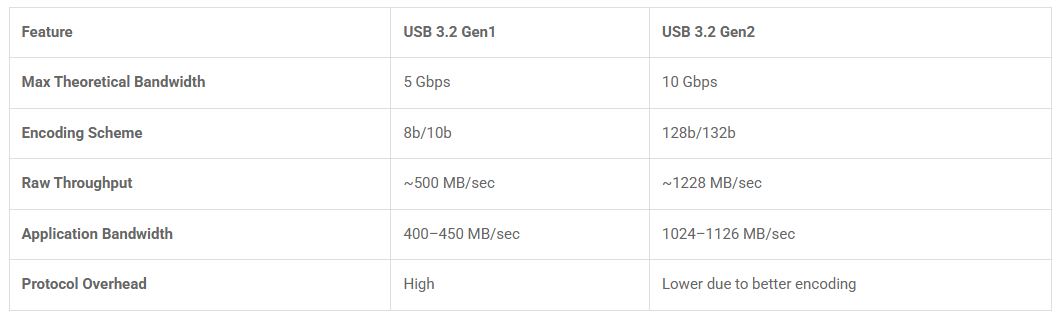
USB 3.2 Gen2’s adoption of 128b/132b encoding means less transmission overhead and higher actual throughput. For high-speed cameras and sensor systems, it directly results in faster frame delivery, reduced latency, and better real-time responsiveness.
Encoding scheme: USB 3.2 Gen1 vs. USB 3.2 Gen2
USB 3.2 Gen1 uses 8b/10b encoding, where every 8 bits of data are transmitted as 10 bits, resulting in a 20% overhead. In contrast, USB 3.2 Gen2 adopts superior 128b/132b encoding by packing 128 bits of data into just 132 bits, thereby reducing the overhead to about 3%.
This substantial improvement means more raw bandwidth is available for actual data transmission, leading to effective throughput and lower protocol overhead.
- Raw throughput: it is the maximum amount of data that can be transferred over a system (like a network, USB, or memory bus) before any overhead is removed
- Application bandwidth: it is the actual amount of data an application can send or receive per second after accounting for all protocol overheads, delays, and system limitations
- Protocol overhead: it is the extra data added during communication to manage and control the transfer, and it is not part of the actual data
To support this next-generation performance, semiconductor solutions like Infineon’s EZ-USB FX10 controller have emerged. Designed for USB 3.2 Gen2 and LVDS interfaces, the FX10 delivers up to three times more bandwidth than its predecessor.
Such an improvement boosts overall data throughput, reduces latency, and enhances responsiveness in imaging use cases such as machine vision, medical diagnostics, and industrial automation.
Real-world applications and use cases of USB 3.2 Gen2
Golf swing analysis
Capturing the details of a golf swing requires consistent frame timing and high-resolution output. USB 3.2 Gen2 supports 4K video streaming at 60fps, which equips coaching systems to analyse wrist angles, shoulder rotation, and impact dynamics in real time.
Since golf analysis systems are popularly used in studios or compact indoor spaces, USB 3.2 Gen2 can cover the full bandwidth requirement with simplistic integration.
Sports broadcasting
Sports broadcasting setups depend on capturing fast-paced action with minimal delay. USB 3.2 Gen2 supports high-frame-rate video at high resolution, making it easier to produce clean live streams, slow-motion replays, and performance analysis.
These setups are also generally fixed or mounted near local processing stations. USB 3.2 Gen2 helps reduce deployment effort and deliver the imaging quality that broadcasting demands.
Laboratory diagnostics
Laboratory environments involve imaging workflows that depend on fast data throughput. Whether digital microscopy, sample scanning, or fluorescence tracking, USB 3.2 Gen2 ensures fast and uninterrupted transfer of large image files without bottlenecks. Its compatibility with common lab computing systems also streamlines deployment.
Furthermore, USB 3.2 Gen2 eliminates the need for additional components and minimises the overall system footprint without sacrificing performance.
Digital endoscopy
Endoscopic cameras demand high video clarity and minimal transmission delay, especially during active procedures. USB 3.2 Gen2 delivers smooth 4K video at high frame rates, making it easier for clinicians to navigate internal anatomy with accuracy. The reduced lag and stable performance support confident surgical decision-making.
In clinical settings where equipment is centrally located, USB 3.2 Gen2 offers the right data rate within a plug-and-play framework.
Ophthalmic imaging
Diagnosing retinal conditions involves capturing high-speed, high-resolution images without motion distortion. USB 3.2 Gen2 supports the rapid transfer of large image files and keeps pace with real-time capture requirements, helping specialists conduct examinations with confidence and speed.
Most ophthalmic setups include compact devices that are closely connected to processing units. USB 3.2 Gen2 simplifies the imaging chain and maintains clarity across such short, interference-free connections.
Real-time object detection and tracking
Automated systems that track fast-moving parts or objects need camera interfaces that support high frame rates without losing detail. USB 3.2 Gen2 provides consistent data throughput that enables accurate tracking during robotic movement, sorting, or assembly tasks.
Hence, for localised robot vision systems, USB 3.2 Gen2 is more suitable, as it delivers the needed speed without the extra hardware.
Aerial drones
Drones used for agriculture, surveillance, or rescue operations require lightweight and high-performance camera modules. USB 3.2 Gen2 supports real-time streaming of 4K video with low latency, which improves navigation and mission accuracy.
Within a drone body, all components are tightly packed, and cable lengths are minimal. USB 3.2 Gen2 integrates better in these cases and keeps the drone more agile.
Industrial automation and quality control
Industrial automation systems rely on vision cameras to inspect products, guide robotic arms, and maintain workflow accuracy. USB 3.2 Gen2 provides the data bandwidth needed to process high-resolution images on the fly, reducing false positives and improving cycle times.
In factory environments where the camera and processing unit are located close together, USB 3.2 Gen2 supports seamless wiring and easier software compatibility. Plus, it offers enough speed to meet critical inspection demands.
Driver monitoring
Monitoring driver behaviour using RGB and IR streams helps detect fatigue, inattention, and distraction. USB 3.2 Gen2’s higher bandwidth supports dual-stream processing at a significant data rate, providing high image quality and low latency for real-time decisions.
It delivers the required accuracy using standard protocols and more straightforward wiring.
Warehouse robots
Warehouse robots rely on camera inputs for scanning barcodes, identifying items, and avoiding obstacles. USB 3.2 Gen2 supports real-time image capture and processing, helping autonomous platforms move safely and efficiently in dynamic environments.
Inside robotic platforms, where internal connections are short and space is tight, USB 3.2 Gen2 offers speed, simplicity, and minimal hardware load.