






Connectors rarely get the same attention as the larger components they support. Engineers spend time selecting valves, sensors, controllers, actuators, and other system hardware, while the connector is often treated as the final step in the electrical design. As long as it mates properly and carries the required signal or power, it can seem like the decision is finished.
In harsh industrial applications, though, that is usually where the real questions begin. A connector may be exposed to moisture, washdown, dust, vibration, oils, temperature swings, repeated handling, and the general wear that comes with operating machinery every day. A connection that works perfectly on the bench can become a weak point once it is installed in an actual machine and exposed to those conditions over time.
That is why connector design is increasingly becoming a reliability decision rather than simply an electrical one.
The limits of field-wired connections
Field-wire connectors have been used successfully for decades, and they still have a place in many applications. They give installers flexibility. They can be assembled on site. They are familiar to maintenance teams and easy to source. For general-purpose installations, those advantages can be enough.
The challenge is that every field-wired connection introduces variables. The installer has to make the termination correctly. The gasket has to be positioned properly. Cable strain relief has to be handled the right way. The wiring must be correct. The enclosure has to be closed and sealed consistently. None of those tasks is especially complicated on its own. The problem is that all of them depend on the quality of the installation.
In a controlled environment, that may not matter much. In a plant, on mobile equipment, or anywhere the connection is exposed to moisture, vibration, or repeated service, small inconsistencies can become more noticeable. A loose wire, a compromised gasket, or a poorly sealed cable entry may not create an immediate failure. It may show up weeks or months later as an intermittent fault that is much harder to diagnose.
This is one of the reasons moulded connector assemblies have become more attractive to OEMs and machine builders. They remove some of those variables before the product ever reaches the machine.
Moving from field-wired to fully moulded
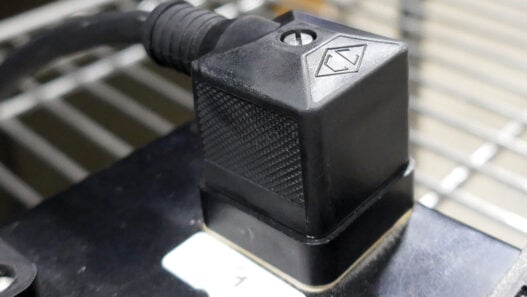
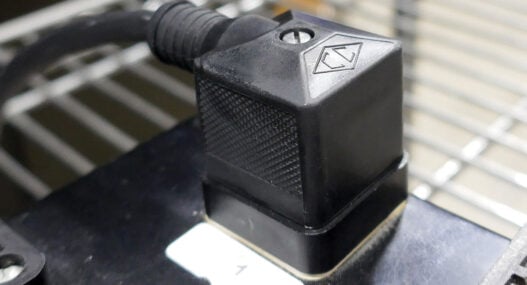
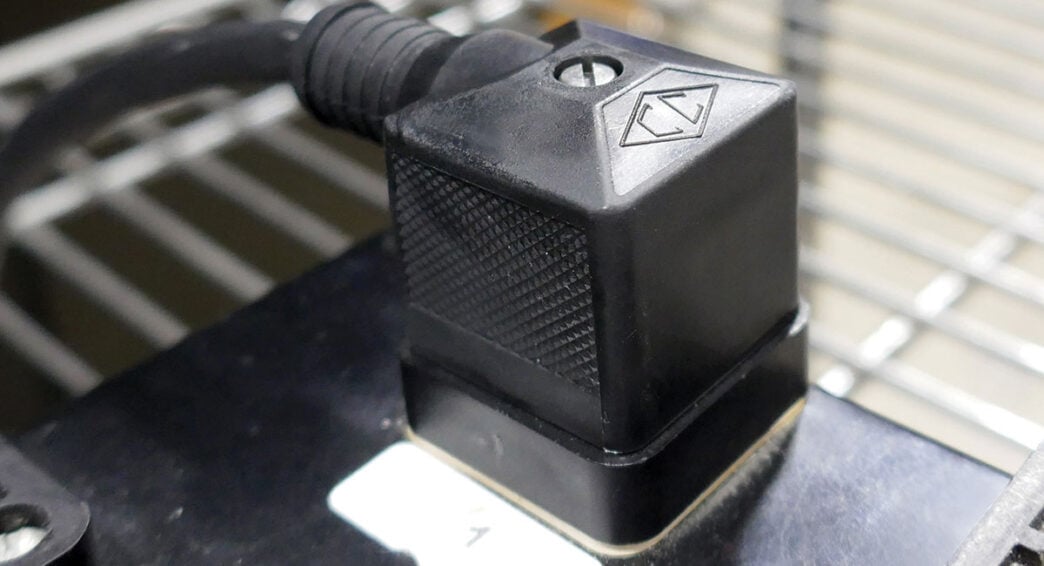
Canfield Connector had manufactured and sold field-wired DIN connectors for many years before introducing a fully moulded version of the product in 2003.
That transition was driven by more than appearance. The fully moulded design allowed the connector, cable, and sealing features to become part of a finished assembly rather than something that depended on final assembly in the field. Customers could receive a product that had already been assembled and tested, with a guaranteed environmental seal rated to NEMA 4.
That changes the nature of the connection. Instead of asking whether every technician installed the gasket correctly or whether each termination was made with the same level of care, the customer receives a repeatable assembly that was produced under controlled conditions.
The benefit is not just sealing. Moulded assemblies also allow manufacturers to improve the way the product is built. Updated assembly methods and more automated moulding processes can help create greater consistency from one connector to the next.
For OEMs, that kind of repeatability matters. When a connector is installed across hundreds or thousands of machines, a small reduction in variability can have a meaningful effect on quality, rework, and service.
Environmental integrity is part of the electrical design
One of the biggest advantages of a moulded connector is that it treats environmental protection as part of the connector itself.
In harsh applications, the electrical interface is exposed to much more than voltage and current. It may be mounted near hydraulic systems, washdown areas, outdoor equipment, or machinery that runs continuously in dusty environments. It may see temperature changes throughout the day. It may be disconnected and reconnected during service. Those conditions do not always cause a dramatic failure. More often, they create gradual problems. Moisture can enter around an improperly sealed interface. Contaminants can work their way into a connection. Vibration can stress wires or terminals. A connection that was initially stable can become intermittent.
These are difficult failures because they may appear to be something else. A valve may stop responding. A sensor may report inconsistently. A machine may generate a fault that disappears before a technician can reproduce it.
The connector is not always the first thing anyone suspects. A fully moulded design helps reduce the number of places where environmental exposure can affect the connection. The cable and connector interface are integrated into the assembly, which removes some of the field-installed sealing points that can vary from one installation to another.
That does not make the connector invulnerable. It does, however, give engineers a more controlled starting point.
Consistency matters in OEM production
For an OEM, connector selection is not just about whether one connector works. It is about whether the same connector can be installed repeatedly, across production, with predictable results.
That is where moulded products can provide another advantage.
A fully tested moulded connector reduces the amount of assembly work that has to happen on the production floor. Instead of terminating wires and assembling connector hardware at each machine, the installer receives a completed assembly.
That can simplify production and reduce opportunities for error. It can also make troubleshooting more straightforward. When the cable, connector, and sealing features are already part of one tested unit, there are fewer individual assembly steps to inspect if a problem occurs.
Canfield Connector produces its moulded connector products under ISO 9001:2015 with Design quality processes. The products are fully tested before shipment and manufactured in the United States. For customers building equipment at scale, those details become part of the reliability equation. The goal is not simply to make a connector that works once. It is to make the same connector work the same way again and again.
The moulded approach expands beyond DIN
Once moulded DIN connectors proved successful, the same basic design philosophy could be applied to other connector families.
Canfield expanded its moulded connector offerings with the CANFast line of M8 and M12 connectors as well as the GT Series of fully moulded Deutsch-style connectors.
The CANFast M8 line is available in three- and four-pin configurations, while the M12 line is available in three-, four-, and five-pin versions. The GT Series is produced in two-, three-, four-, and six-pin configurations. These formats serve different applications, but the engineering idea is similar. The connector should not just complete the circuit. It should be designed around the environment, installation method, and service conditions it will experience.
That broader product development also reflects how industrial equipment has changed. Machine designs now rely on more sensors, more distributed control, more electronics, and more communication between devices. As the number of connection points increases, the reliability of each one becomes more important. A connector failure is rarely isolated to the connector itself. It affects whatever function depends on that connection.
Adding functionality inside the connector
Moulded connector design also creates opportunities to integrate functionality that would otherwise require separate components. In Canfield’s DIN and GT moulded products, internal indicator LEDs and multiple forms of surge suppression can be incorporated into the assembly.
The value of an indicator light is straightforward. A technician can quickly see whether power is present at the connection. That kind of visibility can save time during troubleshooting, especially in crowded machinery where tracing a wiring issue can otherwise take much longer.
Surge suppression serves a different purpose. In electrically actuated applications, switching can create transients that may affect connected components. Integrating suppression into the connector gives engineers another way to address those conditions without adding a separate device elsewhere in the circuit.
These features are not required in every application. That is part of the point. A moulded connector platform gives designers more flexibility to select the level of functionality that matches the machine.
Why this matters to machine builders
The value of an overmoulded connector is easiest to understand when it is viewed as part of the machine rather than as a standalone component.
- For the machine builder, it may reduce assembly work
- For the maintenance technician, it may simplify troubleshooting
- For the controls engineer, it may provide a more consistent electrical interface
- For the OEM, it may help reduce installation variability across production
- For the end user, it may reduce the chance that a small connection issue turns into an unexpected machine fault
None of those benefits is dramatic by itself. Together, they can have a meaningful effect on reliability.
This is especially important in applications involving industrial automation, sensors, solenoid valves, mobile equipment, process control, and instrumentation. These systems often operate in environments where a weak connection can become a recurring problem. A connector that is designed for those conditions from the beginning can help remove one uncertainty from the system.
Connector design is no longer an afterthought
The move from field-wired to fully moulded connectors is really part of a broader change in machine design. Engineers are looking more closely at the small components that influence reliability over time. A connector may occupy very little space on a machine, but it sits at a critical point between electrical control and physical operation. If that connection becomes unreliable, the rest of the system cannot perform consistently. That is why environmental sealing, repeatable manufacturing, integrated functionality, and factory testing are becoming more important considerations in connector selection.
Canfield Connector’s own progression from field-wire DIN connectors to fully moulded DIN assemblies, CANFast M8 and M12 connectors, and GT Deutsch-style products reflects that shift. The electrical connection still has to do the same basic job it always has. The difference is that engineers are now asking it to do that job reliably in more demanding environments, with less room for installation variation and more pressure on overall machine uptime.
The connector may still be one of the smallest components in the system. It just should not be one of the least considered.