






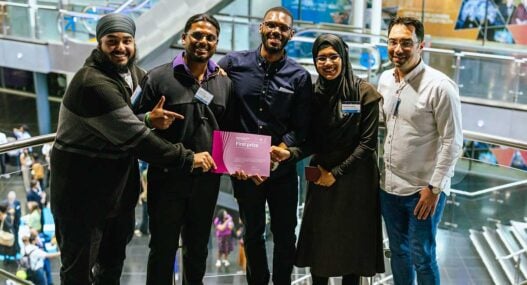
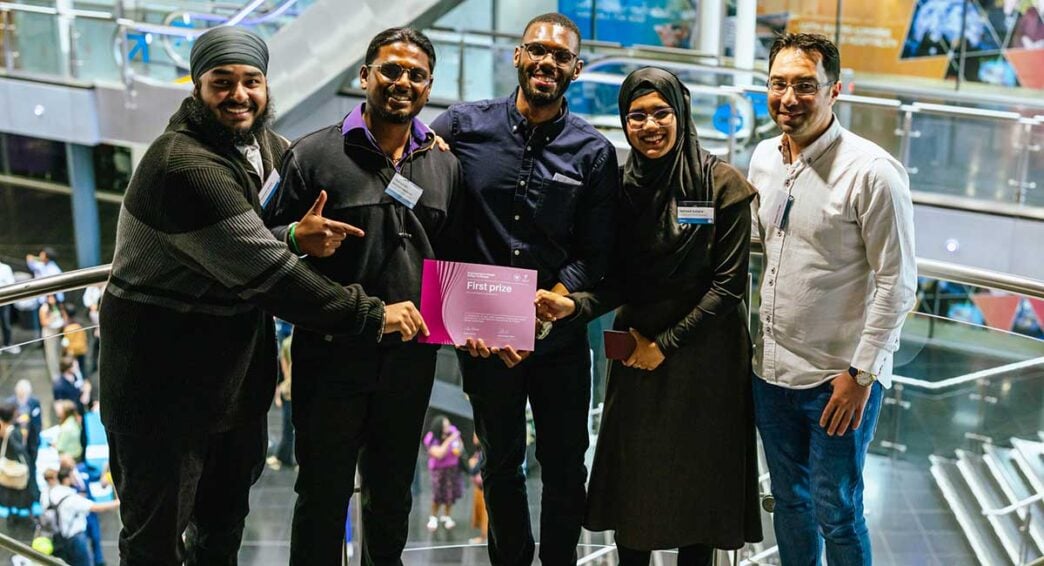
Students from London Southbank University were victorious at this year’s Engineering for People Design Challenge, held at Millennium Point in Birmingham on 19th June.
Joined by 100 of their fellow future engineers, the team’s design for Canal-Side Floating Infrastructure Pods to create vital third spaces took home first prize. In second place was Liverpool John Moores with an innovative solution to food insecurity with Heriott Watt University claiming the publicly voted People’s Prize with their design for a flood-resilient drainage system.
Delivered by Engineers Without Borders UK in partnership with Engineers Without Borders South Africa, the Engineering for People Design Challenge invites university students to rethink the role of engineering in society and develop solutions that place people and planet at the heart of decision-making.
This year’s challenge focused on Ladywood, Birmingham – a neighbourhood characterised by creativity, resilience and strong community leadership, while also facing challenges linked to economic inequality, ageing infrastructure, and the escalating climate and ecological emergency.
Through immersive learning materials, interviews, and community stories developed alongside this year’s community partner, CIVIC SQUARE, students explored how engineering can contribute to thriving neighbourhoods and regenerative futures.
Imandeep Kaur, Co-Founder and Director of CIVIC SQUARE, shared: “We’re delighted that the Engineering for People Design Challenge focused on Ladywood this year. At CIVIC SQUARE, we believe that neighbourhoods like ours hold incredible knowledge, skills, and creativity when it comes to shaping regenerative futures.
“Inviting the knowledge and expertise from the students into the heart of neighbourhoods creates a powerful opportunity to reimagine how engineering can contribute to thriving places and people. And we’re excited to reflect on how this shapes their practice as they move through their education and beyond.”
Now in its fifteenth year, the award-winning programme has reached more than 120,000 students across eight countries, helping transform how engineering is taught and practised worldwide. With 11,000 taking place in the 2026 cycle.
The top 36 teams progressed to the UK Grand Finals, where they pitched their ideas to a panel of industry experts and community representatives, networked with peers and professionals, and explored what globally responsible engineering looks like in practice.
Tom Whitehead, Education and Skills Lead at Engineers Without Borders UK, said: “This year’s finalists showed exactly why the future of engineering must be globally responsible. Their projects combined technical creativity with a real understanding of people, place and long-term impact – demonstrating the kind of thinking our sector urgently needs.”
Winning designs
First Place: London Southbank University – Canal-Side Floating Infrastructure Pods
The Ladywood Brook Pods are modular 2x 6m floating platforms built on the Birmingham Canal to unlock public space without using scarce land. Linked by hidden rubber joints, they absorb boat wakes to keep walkways completely flat and safe for wheelchairs. Special modules use solar roofs and battery banks to keep public lights and charging docks active across the network. Built by local apprentices to create jobs, they feature metal firebreaks and quick-release pins to detach in 30 seconds.
“We wanted to make them adaptive for anything the community needed. To be a place where people could gather. It feels amazing to win. The fact that we made it to the finals was an achievement already. We were staying up until 2-3 in the morning trying to prepare the pitch and I think what we came up with really resonated with the judges,” said Junior Ismael Lake Humphrey, London Southbank University student.
The judges said: “By combining vigorous risk analysis with a willingness to embrace external feedback, they created a scalable and adaptable solution that delivers vital third spaces for young people and exemplifies engineering at its best.”
Second Place: Liverpool John Moores University – Solar Powered Hydroponic System
This project proposes a community-run, solar-powered hydroponic system that grows fresh produce, built from recycled materials, harvest rainwater through a sedum roof filter. Ladywood faces food insecurity, limited green space, contaminated soils and cost-of-living pressures that restrict local growing and weaken community dignity. Our project addresses these issues with the ability to grow fresh produce year-round, boost biodiversity and strengthen local resilience and community cohesion.
The judges said: “The way they addressed the problem with their iterative approach to their design and the emphasis they placed on the community stewardship model, giving agency on food production to the community, won us over.”
People’s Prize: Heriott Watt University – HydroGuard: Adaptive Flood-Resilient Drainage System
Ladywood faces recurring flooding due to an ageing sewer network and blocked drains, putting 10% of residents at risk. HydroGuard is a retrofittable drain unit that uses passive hydraulics to automatically elevate the grill during heavy rainfall, while a debris basket prevents sewer blockages. No power or structural changes needed. Built from polypropylene and GRP, with a QR code leading to an app for community reporting. 600-unit pilot costs £82,000 with a payback period under one year.
You can view all of the finalist solutions on CrowdSolve.
Registration for the 2026/27 Engineering for People Design Challenge now still open.
For those considering entering, Thanushan Saravannapavan, part of the winning team at London Southbank University, offered this advice: “Enjoy the process, be confident in putting yourself out there.”
To learn more, visit: https://www.ewb-uk.org/upskill/design-challenges/engineering-for-people-design-challenge/