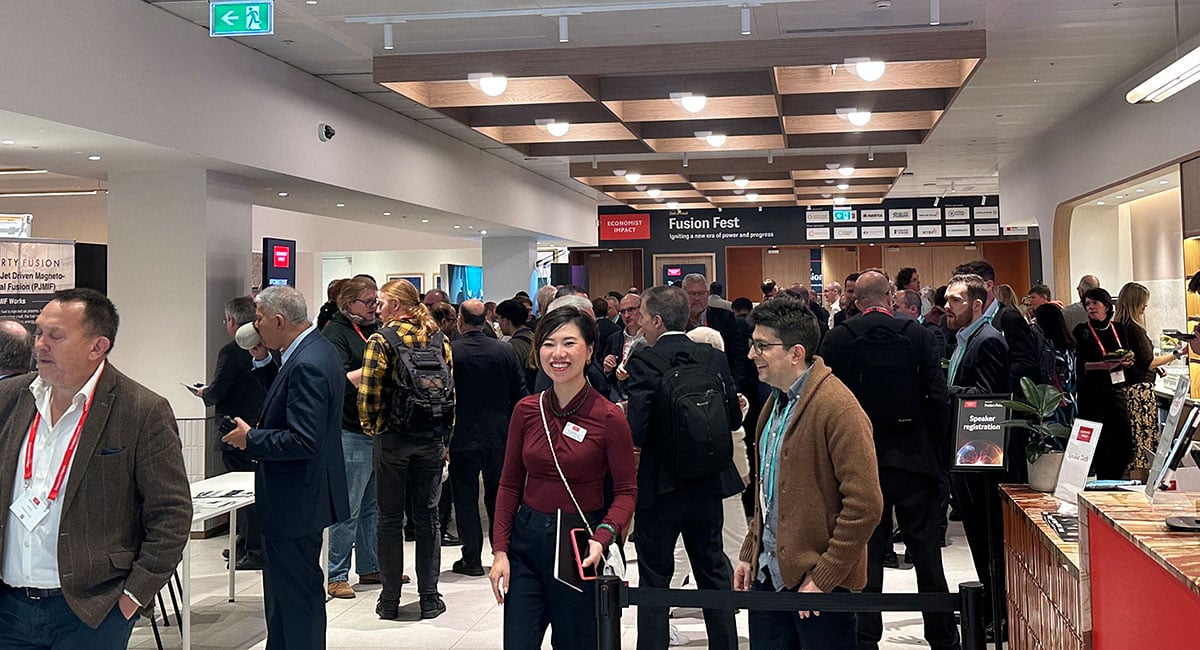







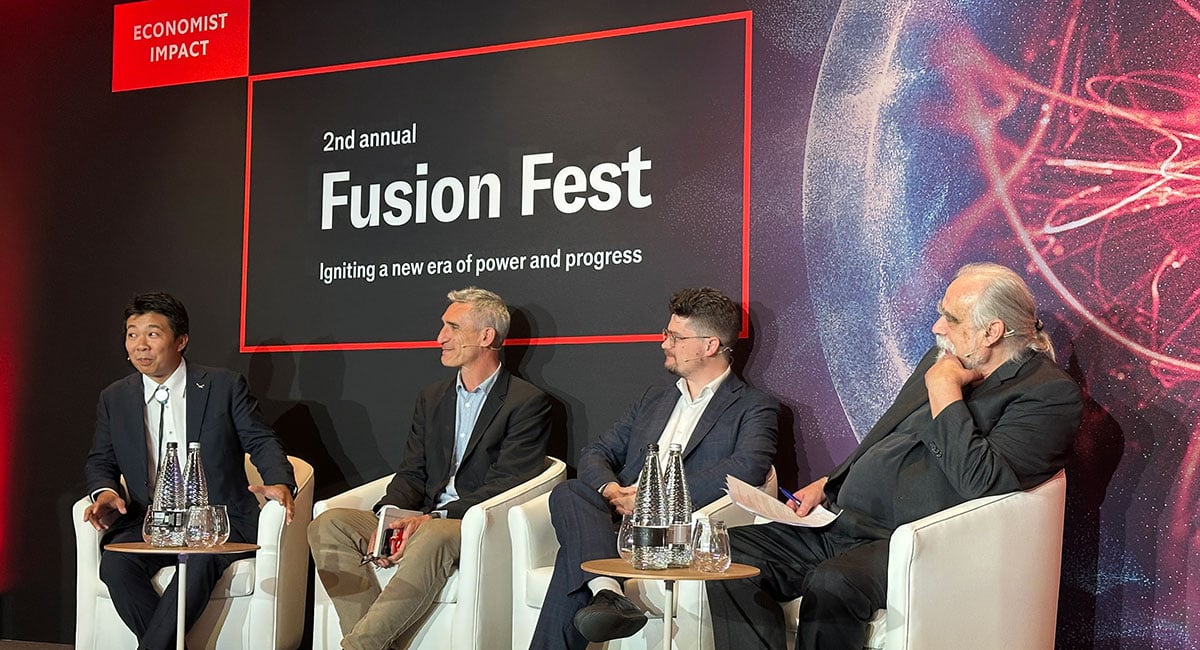
If you thought fusion energy was still the stuff of science fiction, always 10, 20, 30 years away, then Fusion Fest 2026 might just change your mind.
Fusion Fest is The Economist’s second annual gathering, bringing together policymakers, investors, technologists, and industry leaders to assess the commercial path for fusion and bringing to light a potential future of generating near-limitless clean energy by fusing atomic nuclei, just like the sun does.
Fusion Fest takes place one day before The Economist’s Nuclear Summit, giving delegates a chance to fully immerse themselves in the conversation on both fission and fusion and what they mean for the future of energy.
The UK has a plan – and it’s getting physical
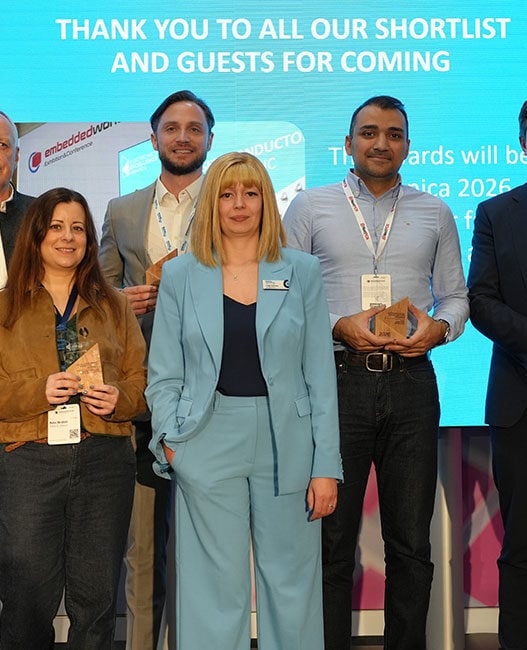
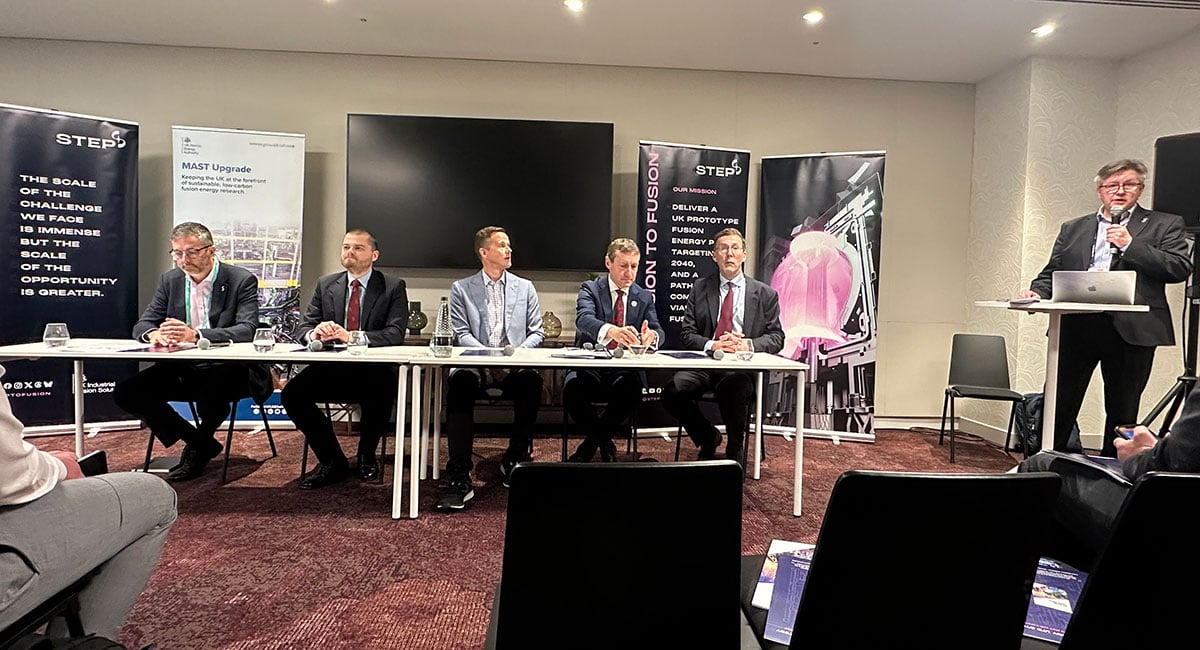
A media briefing took place at the event, which welcomed the senior figures driving Britain’s fusion mission. The takeaway from the session was that the UK isn’t just theorising about fusion anymore; it’s building things.
Part of the UK’s strategy is based on the STEP programme (Spherical Tokamak for Energy Production), a prototype fusion power plant that is set to be constructed at the site of the former West Burton coal-fired power station in Nottinghamshire. The fact that a retired fossil fuel plant is becoming the birthplace of tomorrow’s clean energy – a very literal power transition – is a sentiment I appreciate. Though, whether it was intended or not, I don’t know.
During the briefing, Dr Tim Bestwick, CEO of the UK Atomic Energy Authority, outlined the twin-track structure behind the national mission. On one side, the national laboratory network is developing and commercialising cutting-edge fusion technologies. On the other side is UK Fusion Energy, a dedicated company set up to integrate those technologies and actually build the plant. “It’s one mission through two different mechanisms, two different flavours and strategies.”
A £70 million spark
As part of the UK government’s five-year plan to invest £2.5 billion in nuclear fusion, UK Fusion Energy announced a £70 million contract with Tokamak Energy. Tokamak Energy originally spun out of the UK Atomic Energy Authority 17 years ago with the goal of developing the magnet systems at the core of the STEP reactor. Warwick Matthews, Tokamak Energy’s CEO, described it as something that had “come full circle” – pardon the pun.
High-temperature superconducting magnets are essential to the compact fusion design, and Tokamak Energy has spent years mastering what others gave up on by listing all the problems of “why this technology would fail”, and then overcoming them. And the proof is in the pudding after the company’s Demo4 – a high-temperature superconducting (HTS) system – successfully replicated fusion power plant fields, leading the way to clean, limitless energy.
Also announced was the appointment of the ILIOS consortium as construction partner for the West Burton site redevelopment. ILIOS is a consortium led by Kier and Nuvia and has been appointed by UK Fusion Energy to deliver the first three-year, £200 million share of the STEP programme. Simon Matthews, ILIOS’s programme director, said that success in fusion isn’t just about achieving “first plasma” – it’s about building something that can be safely operated and maintained for decades. Early involvement in design decisions is what protects safety, cost, and schedule in the long run.
Small companies, big stakes
Dr Tom Davies, Co-Founder of Oxford Sigma, a 25-person advanced materials company based at Culham, spoke about the ecosystem of specialist SMEs that underpin the UK fusion programme. His firm supplies tritium breeding and radiation shielding components, with much of the underlying IP being developed through UK government grant funding. That investment has since enabled Oxford Sigma to export its technology to the US and Europe – proof that public investment in fusion can generate private, international returns.
The road ahead
Government funding isn’t replacing private capital. It’s designed to de-risk the landscape enough to attract it. The strategy is to create compelling opportunities, spin out companies, and build a track record that speaks louder than any PowerPoint.
As for international collaboration, the UK’s post-Brexit position means it’s no longer part of ITER, the massive multinational fusion experiment. But bilateral partnerships – particularly with the US – continue to develop, covering both laboratory research and commercial projects. The consensus was that while another ITER-scale multinational effort is unlikely, targeted collaboration on specific technologies and supply chains makes strong sense.
The overall takeaway from the briefing is that the UK’s fusion programme has a clear strategy, world-class expertise, and real contracts, real sites, and real momentum. The reaction may be slow to start, but it’s very much underway.