




I’m on the judging panel for this year’s Electronics Excellence Awards, run by Electronic Specifier at electronica in Munich, this November.
The panel changes shape every year, and this time round I’ve moved from the embedded world edition, which I judged twice previously, onto the electronica one.
Here’s what I’ve picked up along the way, and what it’s taught me about spotting a genuinely strong product entry.
What actually stands out in a submission
The entries to avoid fall into two extremes:
- Bland AI-generated submissions with no real factual backing behind them
- Entries so packed with technical waffle you can’t actually work out what the product does better than anything else on the market
For me, you need to explain the benefit to the end user and do it in a way that’s technical without being fluffy. Bear in mind the judges are mostly engineers, so there’s no need to dumb anything down. What you do need is to get across what’s innovative or disruptive about the product, and how it measures up against the competition – particularly given we’re often judging wildly different things against one another.
An antenna against a microcontroller isn’t an unusual pairing on the scoresheet.
Winners aren’t always the exciting ones
The winner of last year’s Passive category was Kyocera AVX with their innovative S-band antenna, which could be mounted anywhere on the PCB, rather than needing to sit near the board edge. It may sound straightforward, but if you’ve ever had to lay out a board around awkward antenna placement, you’ll know exactly what headache that solves.
That’s usually how it goes. A category can sound unglamorous, such as connectors, and still produce a genuine winner – for example, a connector that’s both high power and genuinely small is hard to engineer well.
Flavour-of-the-month categories, like AI, grab attention, but plenty of the products actually moving the market forward are the ones quietly solving a real technical problem underneath.
This year’s panel
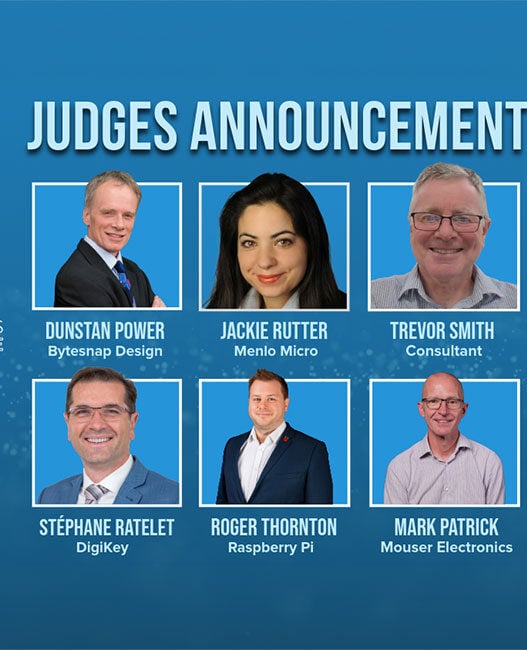
Alongside myself, the 2026 judging panel comprises:
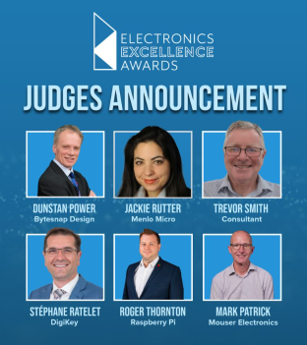
🏆Jackie Rutter, Vice President of Corporate Marketing at Menlo Micro
🏆Mark Patrick B.Eng MIET, Director of Technical Content for EMEA at Mouser Electronics
🏆Roger Thornton, Director of Applications Engineering at Raspberry Pi
🏆Stéphane Ratelet, Director of Sales and Support/Digital Solutions – EMEA at DigiKey
🏆Trevor Smith, a veteran of the electronics and test & measurement industry
It’s a genuinely useful spread of backgrounds, because on a panel like this, someone will usually say “this one’s my area” and take the lead on it, and you’ll find yourself doing the same on a category you know well, while picking up plenty from theirs on the ones you don’t.
That’s the real value of judging as a group, rather than alone. And I genuinely enjoy learning from other industry experts.
The most avoidable mistake
Presentation quality across entries has gone up generally, and most submissions now read as though they’ve had some AI involvement, which is fine in itself.
The real risk is hallucination, claims that simply aren’t true. Given the judges have engineering backgrounds, you can be as technical as you like. Just be honest about what genuinely makes your product different, and don’t oversell disruption that isn’t really there.
Sometimes the honest answer is, it’s good for a quieter reason, and that’s a perfectly fine thing to say.
Why electronica is worth visiting
electronica only comes round every two years, spreading 18 exhibition halls, within Munich. Worth noting, is it’s built around specifying components and doing deals rather than being a consultancy-facing show, so if you’re hunting for a specific part, or want to meet the team behind it directly, rather than going through distribution, there’s nowhere better.
It’s also a decent reminder that walking the floor still beats an Internet or AI search for finding what’s genuinely out there. Search results, AI or otherwise, tend to only scratch the surface of what’s actually available.
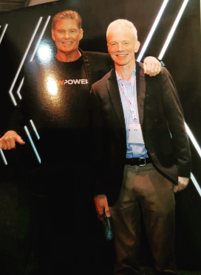
A few years back I ended up with a selfie with The Hoff on one of the stands, which tells you the scale of effort and spend companies put into being there.
Key takeaways
A few things stuck with me from last year’s judging:
- Clarity wins over cleverness. The entries that score well explain their benefit plainly, not the ones trying hardest to sound impressive
- The unglamorous categories often hide the strongest engineering. Don’t judge a product’s worth by how exciting its category sounds
- Judging in a group is genuinely more useful than judging alone, everyone brings a different lens to entries outside their own specialism
- electronica remains one of the best reasons to get away from the search bar and actually walk a show floor
And this isn’t just for awards entries. The same can be applied whenever you’re weighing up a claim, a spec, or a pitch: does it explain the actual benefit, or is it just dressed up to sound like one?