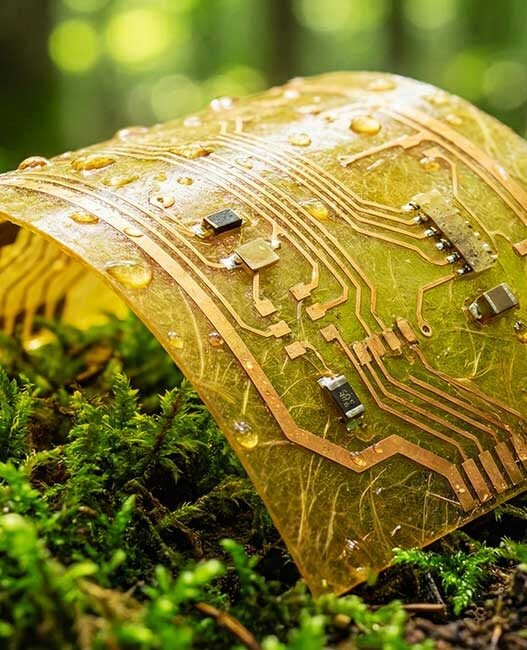






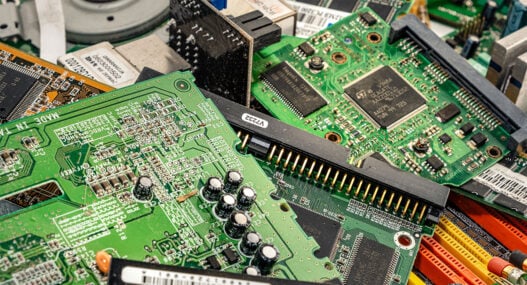
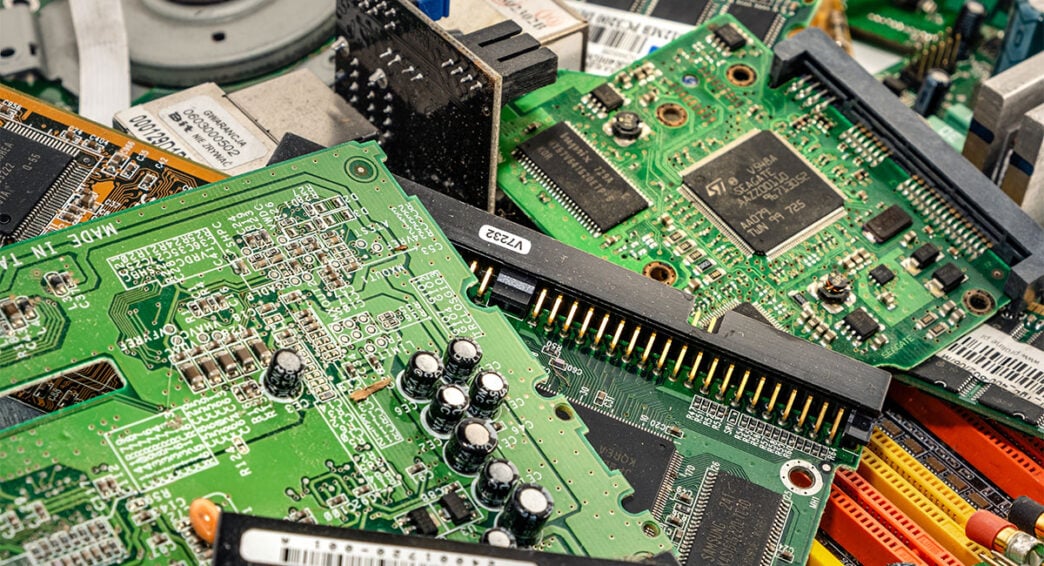
With an ever more connected society and new technologies and electronics released at an increasing pace, e-waste is an ever-growing issue. According to the UN’s fourth Global E-waste Monitor, e-waste is rising five times faster than documented e-waste recycling. A record 62 million tonnes of e-waste was produced in 2022, up 82% from 2010, and is on track to rise another 32% to 82 million tonnes in 2030.
e-waste itself is a problem as landfill sites across the world are being filled. But there is an economic problem at the heart of the matter. Billions of dollars worth of valuable resources are dumped, estimated to be worth $62 billion worth of recoverable natural resources unaccounted for.
At PCIM 2026, Ole Gerkensmeyer, Chief Strategy Officer at Nexperia, discussed the growing issue of e-waste, why the electronics industry needs to take a proactive approach, rather than its current reactive approach, and why circular design will lead to a more sustainable future.
Recycling isn’t the answer
The UN’s statistics show that e-waste recycling rates are already low, and are actually decreasing, rather than increasing.
“The European Union has the WEEE, Waste Electrical and Electronic Equipment Regulation, which asks any creator of electronic devices to take them back and to properly recycle the parts, but proper recycling unfortunately means these things end up in Africa,” explained Gerkensmeyer. Referencing the UN’s The Global e-waste Monitor 2024, “they analysed the waste streams of electronic waste and discussed how e-waste from North America and Europe ends up in Africa, in particular in countries like Nigeria and Ghana.”
The Basel Convention, which was adopted in 1989 and has been in force since 1992, is an environmental agreement that reflects and guides global government efforts to control transboundary movements of hazardous waste (including e-waste). As of 2024, The Basel Convention had been signed by 191 countries. However, countries have found loopholes around the convention, and still hazardous waste is being exported to African countries.
But the reason why recycling isn’t the answer is also about how the products themselves are recycled.
“When you recycle cell phones for example, they are crushed, burned, and the metal is caught, but the rest is landfill. That means semiconductors, which have a lifetime of 10, 20, 30 years are gone,” Gerkensmeyer explained. “So much for longevity, sustainability, and responsible use of products. This is what is called urban mining.”
“The risks are obvious. We have a large economic loss, around $50 billion per year from destroying semiconductors, passive compounds, and other electronic materials which are not further used. And unfortunately, e-waste is globally the largest and fastest growing waste stream of society, predicted to exceed 80 million tonnes in 2030.”
After further research, Gerkensmeyer found that this e-waste statistic does not include electric vehicle batteries, renewable energy hardware, and large energy storage systems, meaning that this number is a conservative estimate of the larger issue at hand.
Sustainability and the circular economy
This is where designing with circularity in mind is essential. The 10 R-Strategies can guide how circular design and manufacturing can keep resources in use, and minimise the amount of waste produced. The 10 R’s are: Refuse, Rethink, Reduce, Reuse, Repair, Refurbish, Remanufacture, Repurpose, Recycle, and Recover.
Before even designing a product, a company should consider all the Rs. “You start with refuse, I don’t design a new product, and I take something existing, that is the first level of circular economy. Then you rethink and reduce what you’re designing to maximise secondary use cases … This is what is called a short loop: prevent and simplify. Then you move into the lifecycle. This is the medium loops: extend life and value. So you go to reuse, you go to repair, refurbish, remanufacture, and repurpose.”
Recycle is one of the last possible stages that should be considered.
Gerkensmeyer used the example of an electric car engine with 250 horsepower. These electric engines’ inverter systems have waterproof IP 68 as a specific requirement, and temperature requirements for -40 up to 100 degrees Celsius. “Now, any reuse in later life needs to look into reduced parameters,” he explained. While these engines may not be able to be reused in automotive applications, there could be other use cases for them in other industries. He explained how these engines could be used in “sewer stations, pumping the wastewater. They have room temperature and 350 horsepower and waterproof systems,” all specifications that the engines are already built for.
Another example given is server cards. Replaced after around three years, Gerkensmeyer asked a server firm what happens to them once replaced, and heard that they are just thrown away. “People throwing away $10,000 server cards and replacing with new ones. I’m pretty sure these $10,000 server card can maybe operate a stream or air conditioning or something else.”
The wastage in the electronics space is prevalent across the entire ecosystem, and Gerkensmeyer argued: “It’s up to us as a society to demand reuse and challenge reuse before we go towards recycling, so the medium loop means extending life and development.”
What can be done
We know that recycling should be the last thought, but how can companies actually put the circular mindset into motion in their design process?
“We’re throwing away a lot of electronic components way before they have reached the end of life,” he explained. “How can we reuse these things? The short answer is, don’t reuse chips themselves, reuse systems.”
With $50 billion dollars worth of waste accumulated through e-waste, changes need to be made, not just for sustainability, but for economic factors.
The cost of extraction for a single electronic component may be high, and when components cost mere pennies to produce, the value may not be worthwhile. And once extracted, components need to be tested again, which could impact the lifetime of those components. So if extraction of singular components isn’t valuable, and could actually harm the lifecycle of components, what should be done?
“It just makes sense to extract systems or components which are easy to extract at low cost and don’t have a penalty when testing, and the answer is don’t extract semiconductors or passives, extract boards,” Gerkensmeyer said. “This is where it makes sense that we, as an industry, start thinking of standardisation, education, and how can we reuse what we have in other industries.”
Rather than extracting and reusing old components in the same systems as new ones, making tracking the aging of these components more difficult, reusing full systems in new applications allows for balanced ageing.
“Different elements of a hardware design system and power electronics have different stress elements. When you design for balanced ageing, you don’t have a problem that maybe one component has reached end of life and another one is still fresh, but you have the whole system ageing gradually in harmony, so that when you extract this for a second life, you have a good system where all components are of similar age or state of health.
“That is the call to action: with electronics that stay in the loop, not in the landfill.”
Getting used to new methods of designing will be a big leap for the industry, which has been built on a model that accounts for wastage. However, not only can companies save money in the long run, but can help save the planet and its finite resources, by just taking a bit more time at the design stage to consider the second, third, or fourth stages of life for components.