





With the introduction of the DCES600 and DCES1500, LEM enables DC charging infrastructure manufacturers to accelerate time-to-market for both fast and megawatt charging solutions, with kilowatt-hour (kWh) billing services. The new meters offer enhanced performance, flexibility, and system optimisation, making them particularly well suited for applications such as e-truck charging.
The DCES600 and DCES1500 meters address a wide range of DC current-sensing requirements. They are designed to achieve class B accuracy at charger level with currents of up to 1500A, at operating temperatures from –40°C to +85°C without derating. Their high accuracy is maintained across the entire current range, ensuring precise measurements throughout the full charging cycle, from high currents at the start to low currents near completion.
The new meters comply with international legal metrology certifications and calibration standards, ensuring accuracy and traceability for kWh billing and regulatory compliance in EV charging applications. This, combined with the full-cycle sensing accuracy discussed above, is important when charging electric trucks, where the cost of transportation directly depends on the precise reporting of the amount of energy delivered during charging.
Designers can access the DCES meters over an RS485 communication interface that offers cybersecurity features. These features include authentication of measurements using digital signatures, and facilities that enable secure remote maintenance and firmware updates. These facilities are designed to help reduce the operating costs of EV chargers built using the DCES meters. In addition, LEM is offering a comprehensive set of application programming interfaces (APIs) to enable quick and easy software integration, and other software tools to ease testing and product integration.
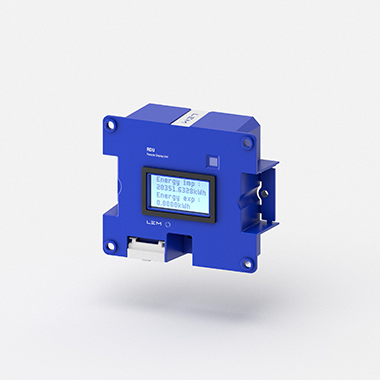
The DCES meters are available with an optional remote display unit, the RDU, which provides OEMs and systems integrators with greater flexibility in the design of the human/machine interface compared with solutions with an integrated display. The RDU can be mounted on a front panel, DIN rail, or base plate, has a slim form factor, and doesn’t need additional connections, such as communications lines or power sources, other than its link to the DCES meters.
Both DCES meters have a robust mechanical design, with a glass-fibre reinforced case, which offers insulation resistance at up to 1000V DC for the DCES600, and up to 1500V DC for the DCES1500. They also offer large power terminals with large current contact areas. The DCES600 has two M10 studs that enable busbar termination to be screwed down onto a contact area of 33 x 36mm. In the DCES1500, there are four M12 studs in two pairs, with each pair offering a combined contact area of 45 x 100mm. The busbars for both meters are specified to operate at up to 110°C. Both meters are supplied with a protective cover and seals.
The DCES meters offer real-time reporting of voltage, current, temperature and energy. These values can be used for both direct energy measurement, for example for billing purposes, and as part of a system management strategy for ensuring the end equipment is kept within safe operating limits through remote system diagnostics.
Applications for the DCES modules include:
- DC fast charging stations: the DCES600 is ideal for public and commercial fast-charging stations, enabling high throughput and rapid vehicle turnaround
- Megawatt charging hubs: the DCES1500 is purpose-built for megawatt-class charging, supporting heavy-duty vehicles, buses, and future high-capacity EVs
- Fleet and depot charging: both meters can be integrated into fleet charging depots, providing accurate energy tracking for operational cost management and regulatory compliance
- OEM Integration: the modularity and advanced communication interfaces make the DCES family suitable for integration into OEM charging platforms and custom solutions, for control and monitoring of any DC applications such as battery storage