
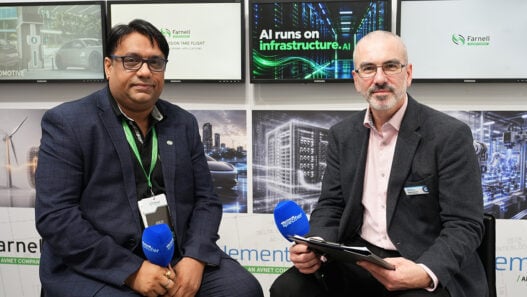

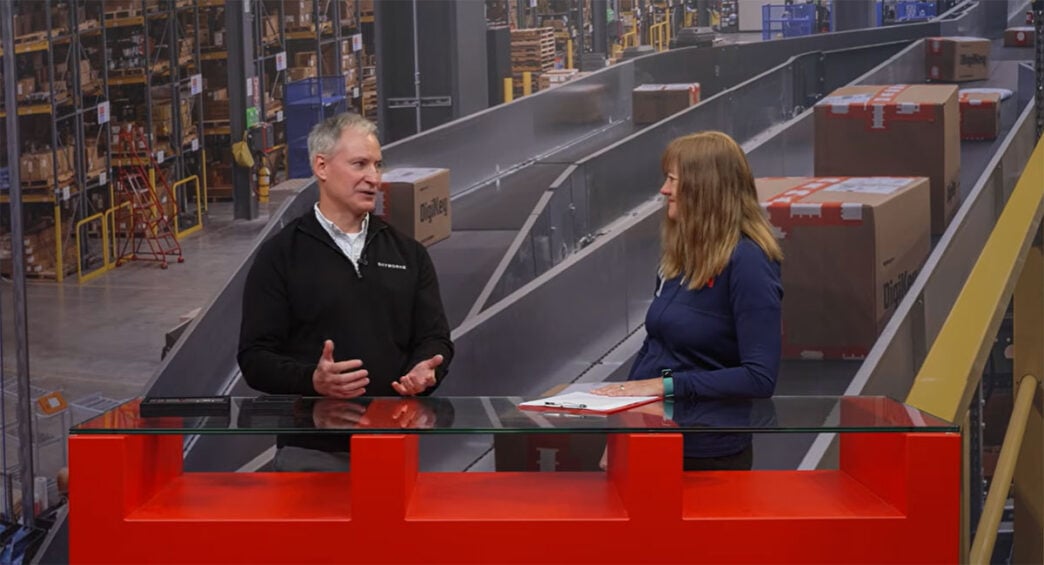
At electronica 2026, Editor Lucy Barnard spoke with Steve Belletete, Applications Director at Skyworks Solutions, about how LoRa, sub-gigahertz, 2.4GHz, and cellular technologies are improving connectivity for IoT devices.
Skyworks is best known as a connectivity supplier for “everything from handsets to base stations”. In IoT, its focus is largely metering, alongside hearing aids and smartwatches.
Taking LoRa to the streets
Belletete’s LoRa demo shows what happens when a Skyworks RF FEM is added to an SoC. Skyworks worked with the SoC supplier and handled the RF layout for the power amplifier.
To test it, Belletete and colleague Eric Austin drove around Woburn, where he is based, taking RSSI measurements with and without the FEM – attracting a few curious residents along the way.
The results showed the FEM “more than doubled” the range, to almost two and a half times that of the SoC alone. For utilities, that means fewer aggregation points, bringing cost and maintenance savings. “By adding the Skyworks content to the meter readers, it saves the utility money,” he said.
More power, less current
A FEM combines a power amplifier, transmit/receive switches, and a low-noise amplifier on the receive path, with options for antenna diversity switching and coexistence filtering.
The headline benefit is range. Belletete credits SoC vendors for improving “every year”, but said they cannot yet transmit at half a watt, 27dBm or 30dBm, “which is where our FEMs really excel”.
Even at lower power, the more efficient amplifier technology means “you can generate the power without burning as much current”. In battery-operated applications, he said, “the amount of current is key”.
Where LoRa meets cellular
LoRa is “probably the most dominant connectivity method” for meters, Belletete said. Meter data comes in short, low-data-rate bursts: how much water, gas, or electricity was used, and how much to bill.
That data travels to an aggregation point. But while LoRa can cover a mile or a mile and a half, the utility itself may be many miles away, so the backhaul can run over cellular. Skyworks has built a product for exactly this: LoRa transmit and receive with main and diversity antennas, plus an LTE pass-through so the same antennas can be reused without adding to the bill of materials.
“LTE is ubiquitous. It’s everywhere. It’s what your cell phone runs on,” he said. “So why not use the combination of the two?”
Small devices, long battery life
The 2.4GHz segment is very different, Belletete explained: much lower power and lower energy, with healthcare customers such as hearing aid makers leading the way. Hearing aids that once sat outside the ear now fit inside the ear canal, leaving “not a lot of space there for a battery”.
Skyworks’ newer wafer-level chip-scale parts, introduced last year, are optimised for 2.4 or 1.8V operation, with receive down to 1.2V. Lowering the voltage increases the power amplifier’s power-added efficiency and extends battery life, so “you can get the whole day with one charge on your hearing aids”.
With a portfolio spanning 10 to 26dBm, Belletete also sees openings in continuous glucose monitoring and remote health monitoring as populations age, citing a colleague’s figure that within 20 years half the population will be over 60.
Higher-power 2.4GHz is also finding a home in asset tracking. “A lot of tools on a job site might grow legs and walk away,” he said, and Bluetooth Channel Sounding can help locate lost items.
RedCap, eRedCap, and the road ahead
Belletete sees the industry moving from LTE-M (Cat-M) to RedCap and eRedCap. All three run on the same cell towers and meet the same 3GPP specifications, but at much lower data rates, dropping features such as carrier aggregation. “The portion that makes cellular connectivity so powerful – streaming 4K video – you don’t need that all the time,” he said.
The goal is lower cost, which opens up new use cases such as e-bikes that report their location and handle payments.
Asked which technologies engineers should watch, he answered: “All of them.” eRedCap “is definitely going to be big” thanks to the coverage of the cellular network. But “anything that can be connected wirelessly is an opportunity”, from Bluetooth helmet-to-helmet links for motorcyclists to the wireless bicycle derailleur on Skyworks’ booth.
“The opportunities are just endless,” he said.