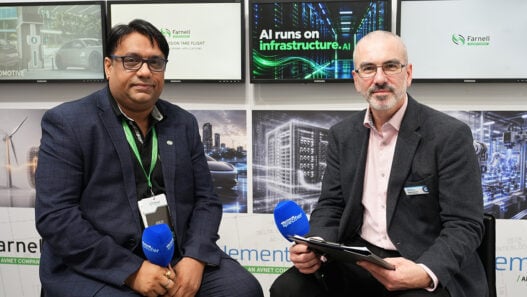






Humanoid robots are drawing crowds wherever they appear, but behind every fluid step and precise grip sits a complex web of power, data, and signal connections. At electronica 2026, Electronic Specifier’s Lucy Barnard spoke to Aravindhan Ramachandran, Manager, R&D Product Development Engineering at TE Connectivity, about why humanoids demand a fresh approach to interconnect design, and the miniaturised solutions TE is developing to meet that challenge.
From automotive to physical AI
Ramachandran works predominantly on connectors, cable assemblies, and interconnect solutions. His background spans automotive and industrial applications, and he now sits within TE’s Digital Data Networks business unit, which focuses on data centres, power solutions, and edge and IoT systems. From that edge and IoT base, the team is expanding its expertise into physical AI, and humanoids in particular.
So why all the excitement around humanoids? For Ramachandran, it comes down to what a humanoid represents. The kind of compute that has traditionally lived in stationary machines is now being packed into a compact, mobile form that can see, plan, and act.
Six design priorities
TE’s work began not with a connector, but with architecture studies alongside multiple customers. The team gathered the voice of the customer, turned it into requirements and specifications, and only then began designing. From that process came six design priorities: miniaturisation, modularity, hybridisation, integration, wireless connectivity, and serviceability.
Miniaturisation tops the list. “Every space is valuable. Every mm is valuable. Every gram is valuable,” he says.
Modularity follows closely, because a humanoid is made up of many distinct subsystems. “You cannot use every connector everywhere. You should have subsystem-based connectors.” Hybridisation matters because power and signal run in tandem throughout the robot, across hundreds of connections, while serviceability calls for interfaces that are quick to attach, detach, mate, and unmate.
Three core challenges
Ramachandran groups the main interconnect challenges into three areas. The first is what he calls “intelligent density”: humanoids need ever more computing power and AI capability, yet all of it has to fit inside a machine that is itself becoming more compact. The second is motion. “All the connectors what we have now are designed for static environments,” he explains, whereas connectors for humanoids must keep performing in a constantly moving, dynamic one. The third is modularity, since humanoids must be serviceable and their connectors replaceable.
Each is a problem in its own right. The real difficulty, he notes, is solving all three at once inside a compact humanoid.
Solutions across four subsystems
TE already has a broad commercial portfolio, from wire-to-board and board-to-board connectors to antennas, and wireless solutions. Ramachandran described new developments for four humanoid subsystems:
- Vision and sensing: Alongside existing options such as floating board-to-board connectors, shielded FPCs, coax and miniaturised FAKRA, TE has developed an ultra-miniaturised wire-to-board connector supporting FPD-Link and GMSL protocols at up to 7.4 Gbps. It offers a choice of latching, cable, and orientation options and is 40% smaller than the miniaturised FAKRA connectors commonly used in this area.
- Power: A miniaturised hybrid high-current solution carries 26 A alongside eight signal pins, which can be customised for 1 Gbps Single Pair Ethernet (SPE), auxiliary or I/O signals.
- Actuation: This is where static assumptions begin to fail. TE’s ultra-miniaturised 1 Gbps wire-to-board connector measures just 5.5 mm × 4 mm and offers multiple orientations and flexible strain relief.
- Compute: Where bandwidth demands are highest, an ultra-miniature 112 Gbps solution fits a footprint of around 6.5 mm × 4.5 mm on the PCB, with side and top latching, and right-angle or vertical orientations.
Reliability by design
Shrinking connectors while keeping them robust is no small task, and Ramachandran is clear that “… miniaturisation is not just like you are taking an existing connector and miniaturising it.” TE is working on new materials and cable arrangements, treating the cable, and the way it integrates with the connector as central to reliability.
Testing needs to evolve too, as today’s methods were designed for static environments. “So what we are doing now is that we are establishing a setup where we are replicating the exact humanoid, how it works,” he says, with rigs that mimic how a humanoid hand or leg actually performs.
From board-level testing to market
These solutions aren’t just concepts. TE is working with ecosystem, imaging, chip-level, and humanoid partners, with samples already being evaluated in board-level testing and some progressing to assembly-level integration. Commercial launches are expected soon, and Ramachandran is clearly enthusiastic: “… I’m very much excited to show these solutions as well.” Details will be available at te.com.
The technology isn’t limited to humanoids, either. Configurable options can link the new ultra-miniaturised interconnects with established interfaces such as OSFP and FAKRA, helping engineers bridge today’s edge and IoT systems with the next generation.
Thinking at system level
Looking ahead to 2027, Ramachandran believes engineers’ focus is shifting. “So engineers now are looking beyond the chipsets, are looking beyond the semiconductors. They are looking at the system level.” That system-level approach, starting with architecture, defining the problems, and making the right trade-offs, is exactly how TE has approached the humanoid challenge, and it’s what has brought the company to the point of delivering solutions.
Watch the full interview
To hear more from Aravindhan Ramachandran, watch the full video interview: DigiKey at electronica 2026 with TE Connectivity