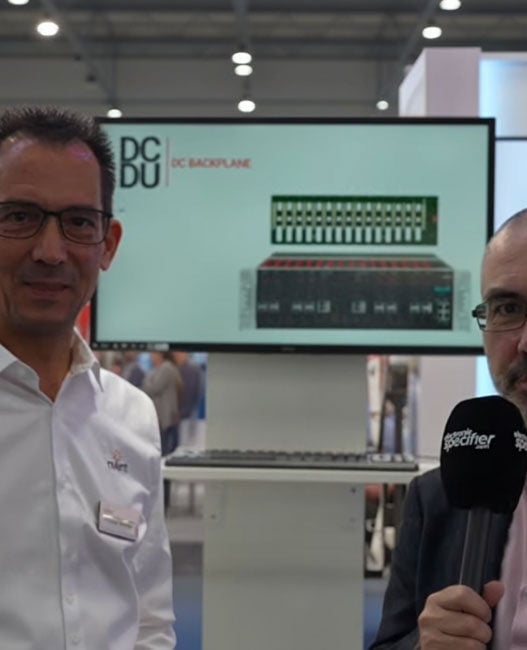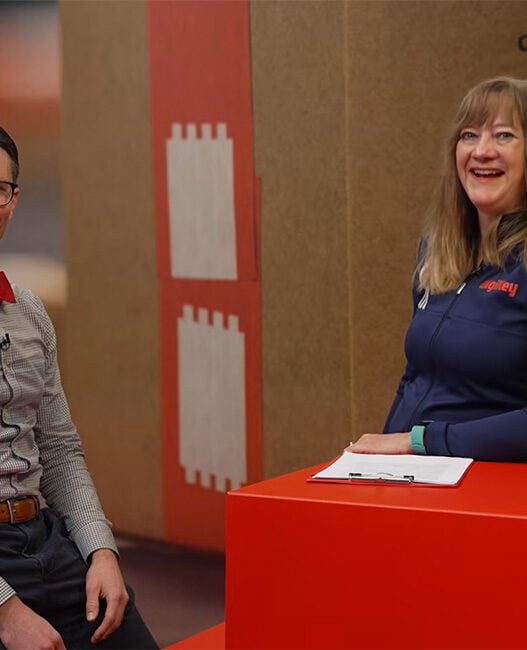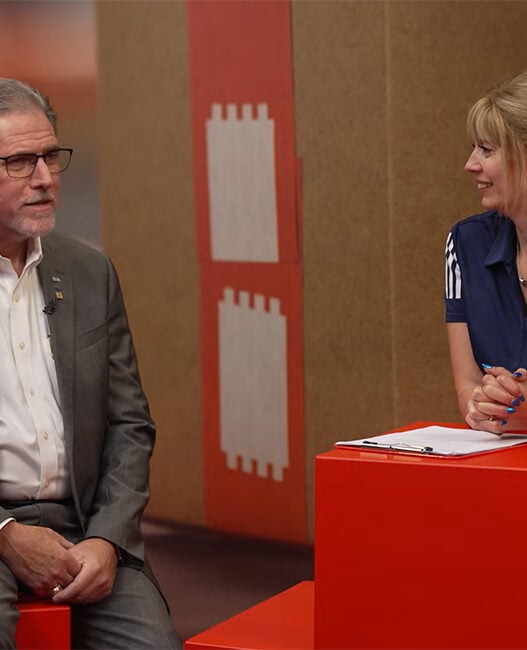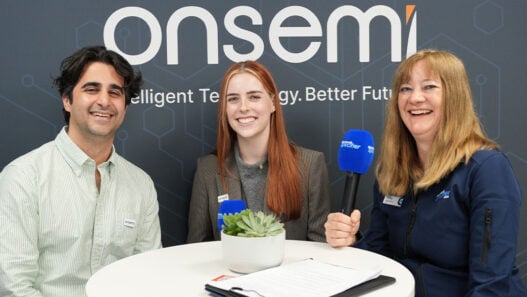


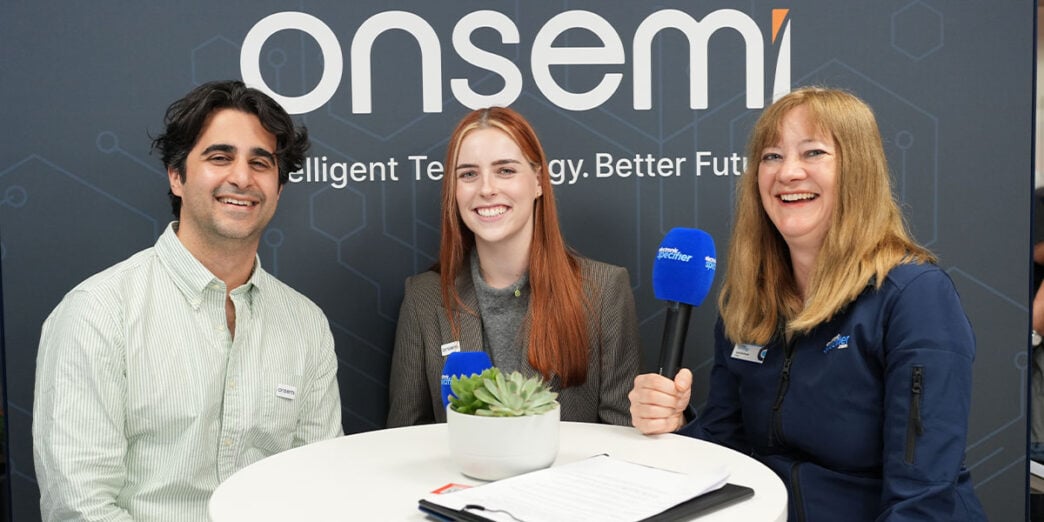
At electronica 2026 in Munich, Electronic Specifier’s Lucy Barnard spoke with two members of the onsemi team: Matthew Salmanpour, Senior Director of Marketing for Analog and Mixed-Signal Group, and Rachael Wecker, Senior Product Marketing Engineer in the Power Solutions Group. They talked about AI data centres, software-defined vehicles, humanoid robots, and the company’s newest silicon carbide platform.
Intelligent power and sensing
Salmanpour sums up onsemi as “the leader in intelligent power and sensing.” Its broad portfolio serves three key markets: automotive, industrial, and AI data centres. At electronica, the company showcased silicon carbide solutions, 10BASE-T1S Ethernet and power management devices, among many other products.
From silicon to systems
The booth’s theme, “from silicon to systems,” reflects a big shift in how onsemi works. “So onsemi has, over the last couple of years, really reformed into not just a component supplier, but also a system solutions provider,” Wecker explains.
That means covering the full journey, from the substrate to the chip to the finished customer solution, so customers get the best possible options and everything they need.
Powering AI data centres
For AI data centres, the biggest challenge is clear. “Clearly the biggest power challenge is efficiency,” says Salmanpour. onsemi’s answer is highly efficient power management FETs, power discretes, and power solutions at every stage of the power tree, “whether it’s… at the grid or all the way vCore in the GPU.”
The company’s power wall at electronica shows that journey. Wecker explains that it starts with high-voltage, high-power applications at the grid, such as uninterruptible power supplies and solid-state transformers. It then moves through high-power modules, FETs, and lower-power devices, down to the XPU inside the rack and tray. In short, it covers “high voltage to low voltage and everything in between.”
Salmanpour adds that onsemi is committed to raising the bar on innovation every year to serve this fast-growing market.
Connecting the software-defined vehicle
In automotive, onsemi is responding to the shift towards software-defined vehicles, which carry more software and spread intelligence throughout the car. As a result, many customers are moving to zonal architectures with more electronics in each zone.
Each zone needs power devices, protection devices such as eFuses, and connectivity. onsemi’s 10BASE-T1S Ethernet solution links those zones to the vehicle’s “main brain” and enables intelligence at the edge. Salmanpour says the same trend is now spreading to industrial applications and physical AI.
Giving humanoids movement and sight
Humanoid robots are another major area. Wecker explains that onsemi’s portfolio covers both how a robot moves and how it thinks. Motor control in the limbs and power devices such as MOSFETs and switches drive movement. On the intelligence side, power management and image sensors play a central role. “How does the robot see where it’s going? What is in the brain of the robot?” she asks. onsemi’s full portfolio helps enable these smart physical AI applications.
What’s next: physical AI and EliteSiC M4
Looking ahead, Salmanpour sees physical AI as the next frontier. onsemi is developing more intelligent power solutions, image sensors that help robots see better, ultrasonic sensing for proximity, and inductive sensing for position control. All of these appeared in a real-world humanoid on the booth. “And for us, it’s about raising the bar on intelligence in those devices, helping better serve our customers and partners,” he says.
On the power side, Wecker says the focus stays on improving power density, efficiency, and reducing switching losses. The latest proof point is the newly announced M4 silicon carbide platform, “first trench generation for onsemi,” which boosts power density for customers in automotive and AI data centres.
Her final message sums up onsemi’s goal: giving customers “the best, most efficient, most power dense solutions that we can enable them with.”
Watch the full interview
To hear more from Matthew Salmanpour and Rachel Wecker, watch the full video interview: