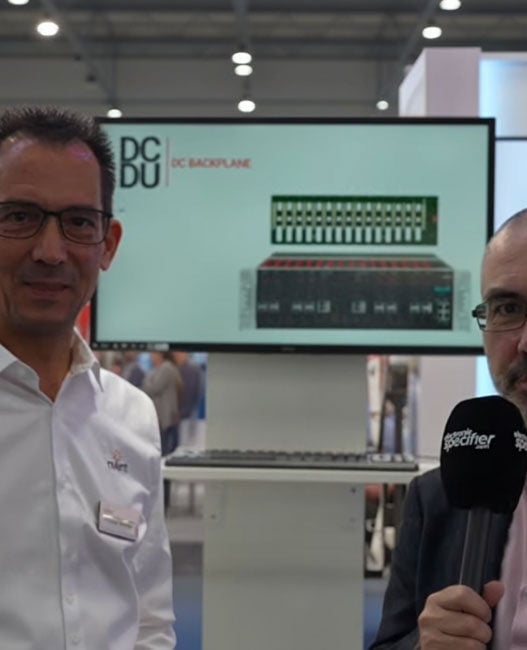





At electronica 2026 in Munich, Electronic Specifier’s Paige Hookway met Tim Kindermann, Senior Specialist, Single Pair Ethernet, Field Connectivity at Phoenix Contact, on the DigiKey booth. They discussed a unified connector standard, a newly merged industry association, and why SPE is ready to move into the mainstream.
Tim Kindermann has been at Phoenix Contact for more than 15 years and has worked with Single Pair Ethernet (SPE) since the very first products appeared. Phoenix Contact, founded in 1923, supplies far more than connectors: it covers electrification, networking, and automation for industrial facilities, renewable energy and, increasingly, data centres.
What is SPE, and why should engineers care?
“As the name already says, it’s a single pair,” Kindermann explains. Classic Ethernet uses four or eight wires, while SPE carries Ethernet communication over just two. That means less copper, less installation space, and smaller, more flexible cables, all of which save money.
It also enables smaller devices. Because SPE connectors are much more compact than the classic RJ45, “you can double the packing density size… on a device like this,” Kindermann says, pointing to a switch on the booth. Distance is the other big advantage: SPE can reach up to 1 km, compared with 100 m for conventional copper Ethernet. “So this is 10 times the distance that you can go with normal Ethernet.”
One association, one goal
Two SPE groups, the Single Pair Ethernet System Alliance and the SPE Industrial Partner Network, recently merged to form the Single Pair Ethernet Association. Both had been working towards the same goal, but others belonged to just one, which split the community’s efforts. “We want to push SPE as a new communication standard of the future,” Kindermann says, and the merger means the whole community now pulls in the same direction.
The new association has more than 130 member companies worldwide and brings together engineers, standardisation experts, and managers to drive the technology forward, including through trade shows such as SPS in Nuremberg.
A unified connector interface
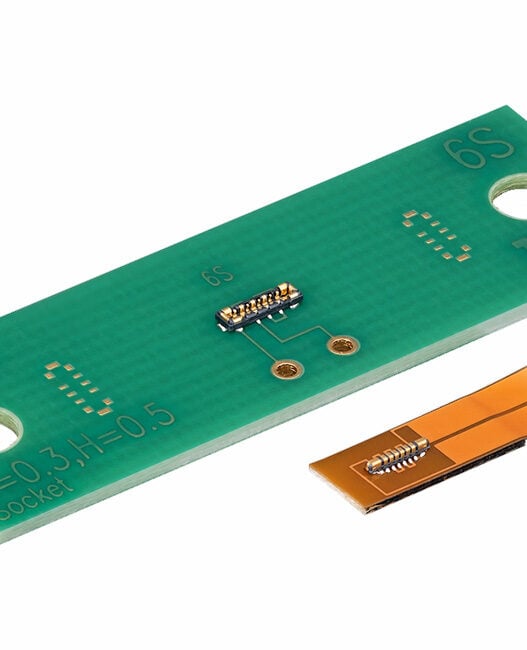
The second edition of IEC 63171-7 tackles another long-standing problem. In the past, SPE had several connector types for the same application. Interfaces such as IEC 63171-2 and IEC 63171-6 weren’t compatible with each other, so end customers were often unsure which one to choose. To end that uncertainty, connector manufacturers worked with user organisations including PROFIBUS & PROFINET International (PI) and ODVA, which advise end customers on connectors, cables, and standards. Together, they agreed on a single interface based on IEC 63171-7.
The -7 standard was originally only for the M12 hybrid connector, which combines SPE with extra power contacts. Edition 2 adds IP20, M8 and M12 versions. “The biggest benefit is that it’s a unified connector interface which is… used for the whole industry,” says Kindermann. “It doesn’t matter which connector manufacturer you will ask or which user organisation you will ask, every one is on the same page.”
Which one should designers choose? It depends on the application:
- IP20: for protected environments, such as inside a cabinet.
- M12: for waterproof and dustproof connections outdoors.
- M8: for very small interfaces such as compact sensors.
- M12: hybrid when extra power is needed.
Powering devices over the data line
SPE’s equivalent of Power over Ethernet is Power over Data Line (PoDL). It has 15 power classes delivering up to 50 W over a single twisted pair. There is a trade-off, though: “The higher the power class is, the higher the complexity needs to be in your device.” Many small sensors need only 1 to 3 W, which keeps things simple.
For more power, the M12 hybrid connector adds separate power contacts rated at 60 V and 8 A, for a total of up to 1 kW. That makes it suitable for actuators and smaller robotics without adding complexity to the powered device.
Faster speeds over longer distances
The 10BASE-T1L standard already allows 10 Mbit/s over 1 km. The new 100BASE-T1L standard offers 100 Mbit/s over up to 500 m. “From my point of view it’s a big change,” says Kindermann.
The process industry stands to gain the most, because devices can be spread across very large sites. Depending on cable quality, SPE can even run over existing PROFIBUS PA cabling. In factory automation, PROFINET links that were limited to 100 m can stretch to 500 m without changing the whole system.
Where SPE will make its mark
The process industry is an early adopter. It is moving away from older 4–20 mA, HART, and PROFIBUS PA communication towards Ethernet, which also meets security requirements such as those in the Cyber Resilience Act. Until now, that meant expensive, hard-to-install fibre or copper Ethernet limited to 100 m.
Factory automation, with its robots, sensors, and actuators, is another strong fit. So is building automation, where SPE’s multidrop capability removes the need for switching in every device and cuts component costs.
What to do now
Phoenix Contact’s M12 hybrid connectors and cables are already available. The IP20 connectors (in 90° and 180° PCB versions) are due early next year, and the M12 connectors are expected in the second or third quarter of 2027. In the meantime, Kindermann’s team is working with customers on their applications and designs, providing 3D, and technical data so they’re ready when the parts arrive.
The next five years
Kindermann is optimistic. Major user organisations such as PI and ODVA have committed to SPE, and their guidelines will soon describe the connectors, cables, and standards to use. That will give many companies the starting point they need. “It does not only need connectors, it needs real applications,” he says, and Phoenix Contact is itself working on a new switch design with the new connector interface.
His outlook: “What I believe is in five years we have a complete ecosystem for SPE and more and more industries and applications will adopt to this new technology.”
Watch the full interview
To hear more from Tim Kindermann, watch the full video interview: