
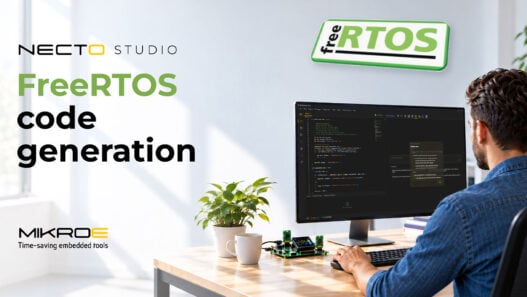


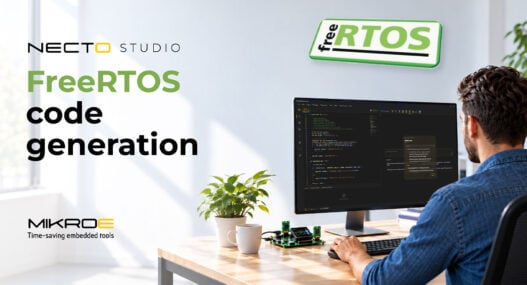
MIKROE has released version 7.5.2 of its NECTO Studio integrated development environment (IDE), introducing code generation for FreeRTOS, the widely used open-source real-time operating system for embedded devices.
The update enables developers to create, generate, and debug FreeRTOS-based projects directly within the IDE, simplifying the process of getting embedded applications up and running.
FreeRTOS support is available across 14 processor cores, including Arm Cortex-M, PIC32 and RISC-V, covering microcontrollers from 19 manufacturers. These include Infineon, STMicroelectronics, Renesas, NXP, Microchip, Texas Instruments, and Analog Devices.
“FreeRTOS is known for its small memory footprint, fast execution, and a rich set of kernel features and libraries. The whole flow is now covered in NECTO Studio: creating a project, generating code, and debugging it,” said Neb Matic, CEO and Founder of MIKROE.
The release also extends the capabilities of NECTO Assistant, the AI-powered assistant integrated into NECTO Studio. Developers can use it to generate a working FreeRTOS project that reads data from selected Click sensor boards and displays the results in real time. During debugging, a dedicated FreeRTOS tab provides visibility into task and queue activity, as well as heap memory usage.
Alongside FreeRTOS integration, NECTO Studio 7.5.2 introduces several enhancements aimed at improving embedded development workflows.
The IDE now supports Renesas E2 and E2 Lite programmers and debuggers for RA, RX and RL78 microcontrollers. Users can select either device directly in project configuration and access the same debugging capabilities available with other supported probes. The update also includes dual-core debugging for RA8 devices.
A new Memory view has been added to the debugger, allowing developers to inspect memory contents at specific addresses or through variables during an active debugging session. The view automatically updates whenever program execution stops, making it easier to monitor changes without switching tools.
Remote board farm status is also now integrated into active projects. Developers can check which remote boards are online, secure, and compatible with their project before establishing a connection.
In addition, MIKROE has expanded CODEGRIP programmer and debugger support with 376 additional microcontrollers, extending hardware coverage across multiple architectures.
NECTO Studio is a C++-developed IDE available for Windows, macOS, and Linux. It integrates 12 compilers, supports eight architectures and provides access to thousands of microcontrollers through the NECTO SDK’s unified codebase.
The platform also offers regularly updated libraries, thousands of ready-to-use examples covering hundreds of embedded development topics, and round-the-clock access to a remote board farm powered by CODEGRIP.
With FreeRTOS code generation, AI-assisted project creation and expanded debugging, and hardware support, version 7.5.2 aims to reduce development time and simplify the process of prototyping and building embedded applications.