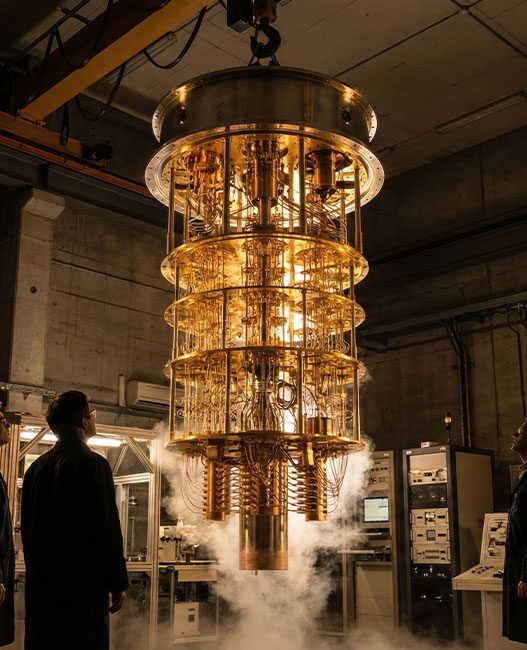







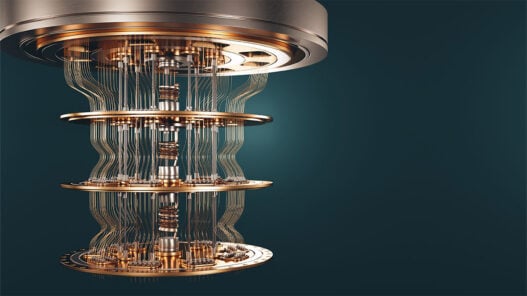

What was once a theoretical concern is now becoming a practical one, with quantum computers developing day-on-day to bring ‘Q-day’ ever closer. While we are some way off seeing quantum computers being commonplace, mainly due to the unpredictable nature of qubits, the technology is quickly becoming an important consideration for future broadband networks.
The telecommunications industry is just one of those. Underpinning global connectivity and vast volumes of sensitive data, telecom providers are uniquely exposed to the security implications quantum computing is set to have.
How will quantum computing impact the telecoms sector?
The next step in quantum computing is reaching a common consensus on how it can be used in the future of telecoms. Quantum computing is expected to enable greater optimisation and spectrum use in the long term, as well as reshape network architectures and security frameworks. However, a serious threat is also expected to be posed by quantum computing too. Up to 95% of public key cryptography that telecom networks depend on, including Rivest-Shamir-Adleman (RSA) and Elliptic Curve Cryptography (ECC), will be vulnerable to quantum computers.
The cryptographic foundations now in place are directly in the crosshairs of future quantum threats, but that has still not stopped adversaries from storing currently encrypted data for decryption later down the line. Known as ‘Harvest Now, Decrypt Later’, future generations are set to exploit this data once quantum computing capabilities are sufficient to break today’s encryption.
Cross-industry collaboration is vital
On the first day of Broadband Forum’s Fall Member Meeting, six experts came together to talk on quantum computing and how this will impact tomorrow’s broadband networks. A common theme from all the panellists was that while the post-quantum era promises many opportunities for service providers, it is laden with security threats.
During the Town Hall Innovation Series (THIS) presentations, it was wholly obvious that multiple standards development organisations (SDOs), including the likes of Trusted Computing Group (TCG) and ATIS, are already considering what needs to be done. These bodies are building frameworks and developing guidance for quantum-safe solutions to address this future threat.
Today’s systems not primed for quantum attacks
ATIS Principal Technologist Ian Deakin forewarned that the quantum threat timeline may be as early as 2030 due to the rate at which quantum technologies are maturing. Deakin did stress the importance of planning ahead with phased migration rather than a wholesale transition, as well as understanding where cryptography should be embedded across the networks.
Chunghwa Telecom Laboratories Researcher Chong-You Hong reiterated that if a quantum computer existed today, then the current encryption systems used to protect our broadband networks would be vulnerable. Advanced Encryption Standard (AES-128) would require larger key sizes, as its effective strength would drop from 128-bit to 64-bit, Hong pointed out.
QKD and PQC up to the task?
Quantum Key Distribution (QKD) and Post-Quantum Cryptography (PQC) have been mooted as security measures to keep data safe. The former distributes encryption keys using single-photon quantum states, meaning that any eavesdropping disturbs the states and can be detected.
FiberCop researchers Elisa Redolfi and Annachiara Pagano highlighted that despite QKD being well suited to optical networks, it also presents significant challenges owing to scalability, cost, and Raman Noise challenges. Whereas Hong suggested that PQC is the resource-efficient solution for P2MP (Point to Multi-Point) networks as it can run on existing PON (Passive Optical Network) systems. Chunghwa Telecom’s Hong did point out that if the challenges of Raman Noise and deployment complexity were addressed, QKD could be a potential option to consider.
While QKD can handle the key exchange function, PQC can provide certificate-based authentication. Implementing a hybrid approach of QKD and PQC to protect keys could potentially deliver greater flexibility.
Working together
Alignment across multiple SDOs is key to delivering greater security for our future broadband networks. Trusted Computing Group (TCG) representative and NVIDIA Systems Principal Architect Thorsten Stremlau stressed that security standards developed over the past 25 years can be updated for PQC.
Stremlau explained that the industry did not need to begin from scratch, with hardware-anchored security standards from TCG applicable to many broadband environments.
Survey data from the TCG State of PQC Readiness 2025 report further underscored the challenge, with 91% of enterprises lacking a formal PQC roadmap, even though many acknowledged the looming impact.
Next steps?
In the years ahead, our broadband networks must be able to withstand the most modern security threats in the post-quantum era. The blueprint for quantum-safe broadband includes strong collaboration, layered security, and PQC and QKD. No individual method, specification, or technology can help achieve this.
From the Broadband Forum’s Town Hall Innovation Series presentations, a clear, joint conclusion shone through. The unified work done today will help build trust, robustness, and future-proof broadband networks.
This article originally appeared in the May’26 magazine issue of Electronic Specifier Design – see ES’s Magazine Archives for more featured publications.