

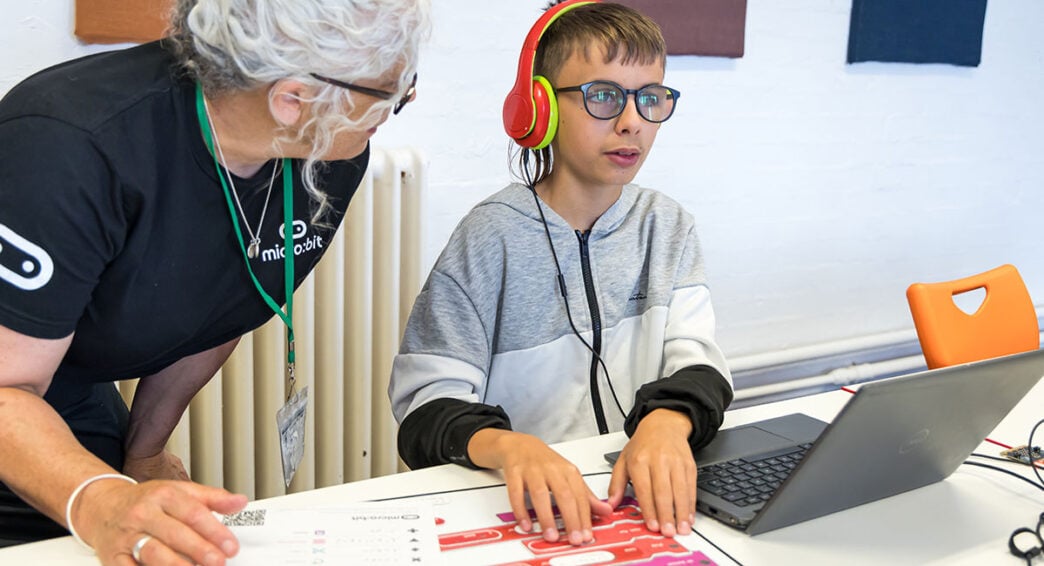
For the first time, an estimated 41,506 blind and visually impaired children in the UK could benefit from a breakthrough that makes block-based coding accessible to them.
New screen reader compatibility has launched in Microsoft MakeCode, removing barriers that have long prevented many blind and low vision pupils from taking part in block-based coding alongside their classmates. Developed in partnership with the Micro:bit Educational Foundation and the Blockly team at the Raspberry Pi Foundation, the functionality is supported by classroom resources to help teachers bring coding to more children.
Speaking exclusively to Electronic Specifier, Lucy Gill, Head of Product at the Micro:bit Educational Foundation, explained the thinking behind the project. “The Micro:bit is designed to lower barriers to children learning to code, and learning digital skills more broadly,” she said. “One of the issues we discovered a while ago was that it was designed originally using block-based coding that was very visual. That’s fantastic for a lot of children, but it meant that if you have no vision or low vision and rely on a screen reader, you can’t access that at all.”
For Gill, the case for fixing that goes beyond fairness in the classroom. “These children can often end up struggling to get jobs. This is a job they can do,” she said. “We also know that different perspectives can be what causes a breakthrough in thinking on a topic, so by encouraging people with these lived experiences to work in technology, they may well be the ones who come up with incredible inventions in the future.”
The technology was co-designed with children and young adults aged 8 to 18 who are blind or have low vision, alongside their teachers and accessibility experts, with input gathered across the UK, Europe, and the United States.
MakeCode for micro:bit was originally built specifically for the micro:bit on top of Blockly. According to Gill, some of the hardest technical barriers had to be worked through by the Blockly team itself, given the scale of platforms depending on it, but her own team faced a more fundamental design problem: working out what a screen reader should actually say.
“We had to develop a whole new language structure and figure out how to make it informative but really simple – how to make it intuitive, what buttons to press, what keyboard inputs made sense, how to explain the hierarchy. We kept prototyping, testing with people who couldn’t see what we were trying to convey and adapting.”
“You could see that inspiration coming back”
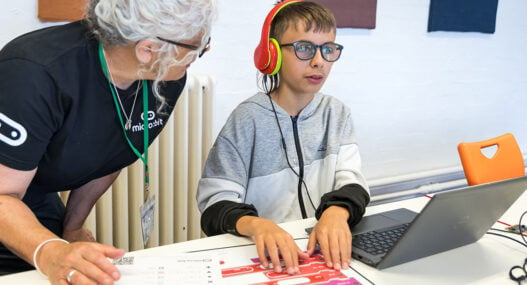
Two of the pupils who have already benefited are Zac, 14, and Thomas, 12, both at New Worcester College in Worcester. Zac, who was excluded from computer science lessons before Year 7, said: “It’s great to have something that you’ve done. You haven’t had to rely on another person to help you do it – you haven’t had to rely on a sighted person to do it. It’s your work. It’s your masterpiece.” Thomas, who previously contributed ideas to Scratch projects run by friends rather than coding himself, said: “If I didn’t have the screen reader, I wouldn’t be able to use micro:bit.”
Gill said watching that shift land in classrooms has affected the wider team. “I think genuinely quite a lot of people have been quite emotional …. Historically it wasn’t that these children had a slightly harder routine – they were genuinely removed from coding lessons. They just didn’t get to experience it at all.” What struck her, she said, was less the moment of access itself than what followed it. “They weren’t only saying they could do it – they were going, ‘can I go off and do this next project?’ You could see that inspiration coming back for them, and you feel like you’ve opened a door to their future.”
Live now, and built to evolve
The feature is live for every MakeCode user today. Because it is embedded in the most recent Blockly branch, any platform that upgrades to that branch inherits the same capability – Code.org has already begun similar work, Gill said, and platforms such as Scratch could adopt it in the same way. Keyboard control support has shipped alongside it, addressing both fine motor and dexterity needs and the basic fact that a screen reader cannot be operated by pointing a mouse. Much of the current experience is in English, with translation work ongoing.
Gill was clear that the MakeCode launch is a milestone rather than an endpoint. Translation and international rollout are immediate priorities, alongside separate accessibility work already under way with the deaf and hard of hearing community, and early-stage interest in supporting children with cognitive impairments and neurodiversity. On the hardware side, the Foundation is working with a Spanish company on an accessory called Diversi:bit, designed to enlarge buttons and screens for children who need it.
Continuing that work depends on funding: “We’re now pretty much at the end of our funding, which will slow us down a little bit, but our ambitions are certainly not limited,” Gill said. “We really do value the input and advice from the community – that will help steer what we do next and what the priorities are.”
Used by more than 70 million children across 85 countries, the BBC micro:bit is one of the world’s most widely adopted educational technologies. Gill concluded by saying: “Every child deserves the opportunity to create with technology, regardless of their ability. By working directly with the young people most affected, we’ve helped remove some of those barriers and created a solution that gives many more children the opportunity to learn, create, and build confidence through computing. We hope this is just the beginning of a much bigger shift towards making coding accessible for future generations of learners around the world.”
Jacqueline Russell, Product Manager at Microsoft, added: “This has really been a super collaborative project between the Micro:bit Educational Foundation, Blockly, and our team, with user input and feedback driving our progress all along the way. I feel so proud of this milestone – taking what was a purely visual, mouse-heavy user interface and transforming it into a fully accessible tool for all students to learn computing.”