


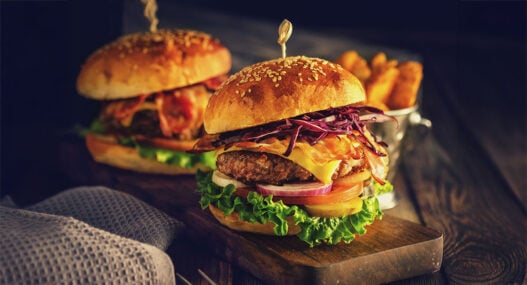
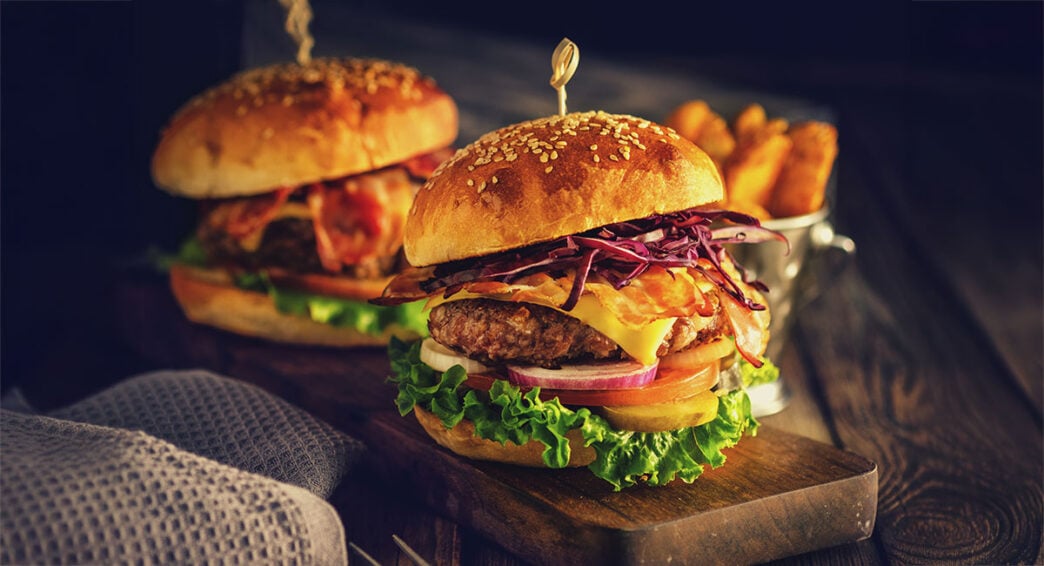
Researchers at Stanford University have used AI to design burgers that meet criteria such as age, taste, sustainability, and health benefits. The ultimate goal, however, isn’t just about food. It’s about the broader spectrum of AI and what it can do next.
The burgers
The objective for the team, though not the endgame, was to use AI as a forward-thinking machine – one that doesn’t just recombine what already exists, but one that designs what could be, drawing on a large database of ingredients and cross-profiling them to create burgers that are tasty, healthy, and eco-conscious.
The reason burgers were chosen was simply because of the sheer range of ingredient choices available – the team built their dataset from Food.com’s recipe archive, distilling it down to 2,216 real burger recipes made from 146 distinct ingredients – and because assembling those ingredients well means juggling many outcomes and objectives at once.
The thinking behind it was that if AI could produce a burger that met all of its objectives, then it could achieve far more than its current capabilities suggest.
The AI system got cracking, and it created burgers (you can find the BurgerAI tool at ai4burgers.com). Those burgers met the goals of being sustainable and health-conscious, but were they tasty? The real challenge was yet to come – what would the people think? How would AI-created burgers hold up under human scrutiny?
In a blind taste test in a San Francisco restaurant, five of the AI’s creations sat alongside a classic reference burger and were served to over 100 diners – ready and waiting to be judged. The AI burgers proved to be a hit. They compared equally, if not better in some cases, than their traditional counterpart.
Now that the team has proved the concept can work, they believe its potential is vast.
What potential does an AI burger prove?
The burger project was never really about the burger. Ellen Kuhl, professor of mechanical engineering in the School of Engineering who now directs Stanford Bio-X, and her colleague Vahidullah Tac, Schmidt Science postdoctoral fellow in Kuhl’s lab, followed up their taste-test paper with a second one, and this one, called ‘Generative AI for material design: A mechanics perspective from burgers to matter‘, focuses on the actual machinery. And that was the project’s whole point.
When you get underneath the bun and the patty, you realise that the AI isn’t doing anything specific to food. What it is doing is running a process called diffusion, which is when you take something orderly and gradually turn it into noise. It then learns to reverse that process, pulling structure back out of the noise. For example, how pixels become a picture. Same thing with ingredients, use the process of diffusion with ingredients, and you get a burger.
What Kuhl and Tac show is that this same mathematical process is, underneath it all, the same mathematics engineers already use to describe how materials behave – how metals deform, how stresses spread, how structures settle into stable shapes. It just so happens that burgers are a simple and tasty way to prove the idea, because everyone can taste-test the result. At the end of the day, the maths doesn’t care whether it’s shuffling ketchup and beef patties or shuffling atoms and alloys.
To get to this point, the team started small, using just three ingredients, then scaled up to the full 146-ingredient design space – a space with more than 10⁴³ possible combinations. As they built out their menu of burgers, what they were showing was that the AI wasn’t just memorising recipes – it was learning the underlying ‘shape’ of what makes a good burger, well enough to independently rediscover a classic recipe it had never been shown. Then, to be able to build brand new ones that people rated just as highly.
If a system can learn that kind of structure for food, the same approach could, in principle, be used for anything with a comparable design problem. Instead of starting from what already exists and tweaking it, an AI could start from nothing and design toward a target. The burger was only the proof of concept. What comes next is matter itself.