


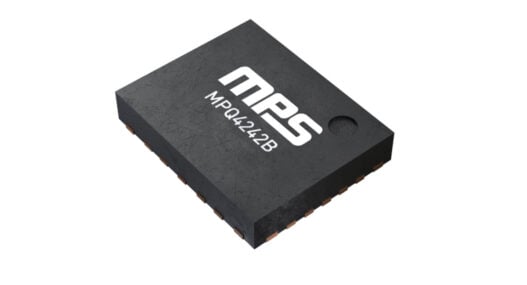
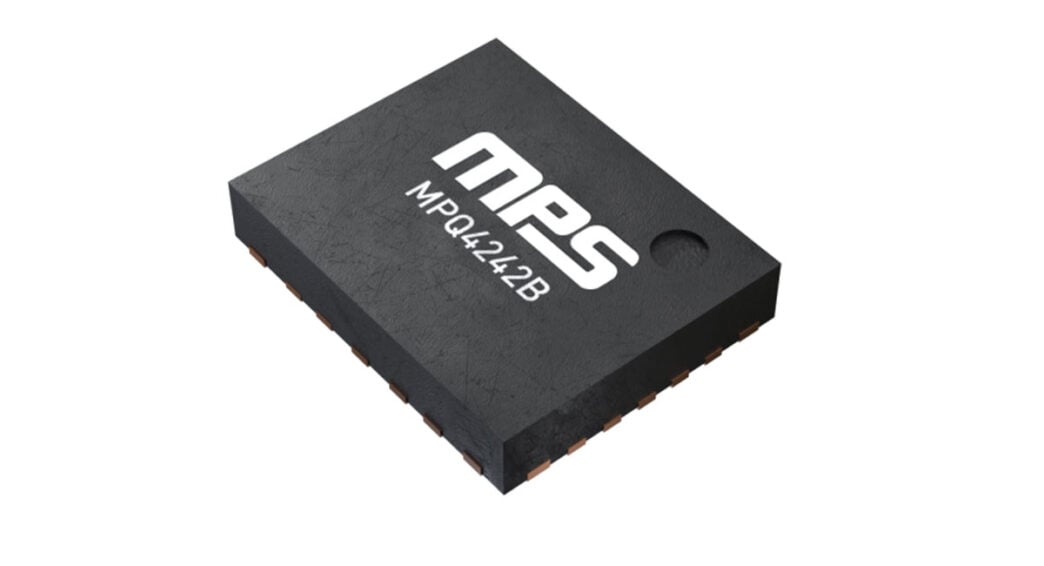
The MPQ4242B-AEC1 features an integrated buck-boost converter with four power switches and a USB PD controller. It is AEC-Q100 Grade 1 qualified and designed for USB Type-C sourcing ports in automotive applications.
This IC supports up to 5-amps of continuous output current (IOUT) over the specified input supply range.
It features a USB Type-C port that supports USB PD revision 3.1 with a programmable power supply (PPS). The MPQ4242B-AEC1 is backward-compatible with dedicated charging port (DCP) schemes for battery charging specification (BC1.2), 3A divider mode, and 1.2V/1.2V mode.
In addition, the device supports QC 2.0/3.0 and the Huawei Fast Charge Protocol (FCP) mode. When battery voltage (VBATT) is low or in the event of over-temperature (OT), the MPQ4242B-AEC1 provides a configurable PD power management state machine.
The MPQ4242B-AEC1 also includes fault condition protections, including input/output (I/O) pin short protection for the BUS and VIN pins, CC overcurrent protection (OCP), current limiting with hiccup mode, output overvoltage protection (OVP), and thermal shutdown.
It is delivered in a QFN-22 (4 x 5 mm2) package and requires readily available, standard external components.
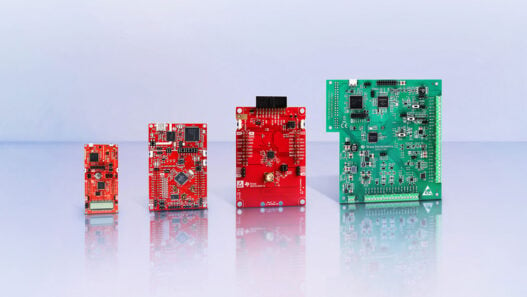
The MPS EVQ4242B-VE-00A evaluation board, also available from Mouser, provides a demonstration and development platform for the MPQ4242B-AEC1. The evaluation board features a pre-mounted MPQ4242B-AEC1, along with the required components and headers enabling access to key signals. The EVQ4242B-VE-00A evaluation board provides an example application circuit, allowing rapid prototyping when incorporated into existing designs.