





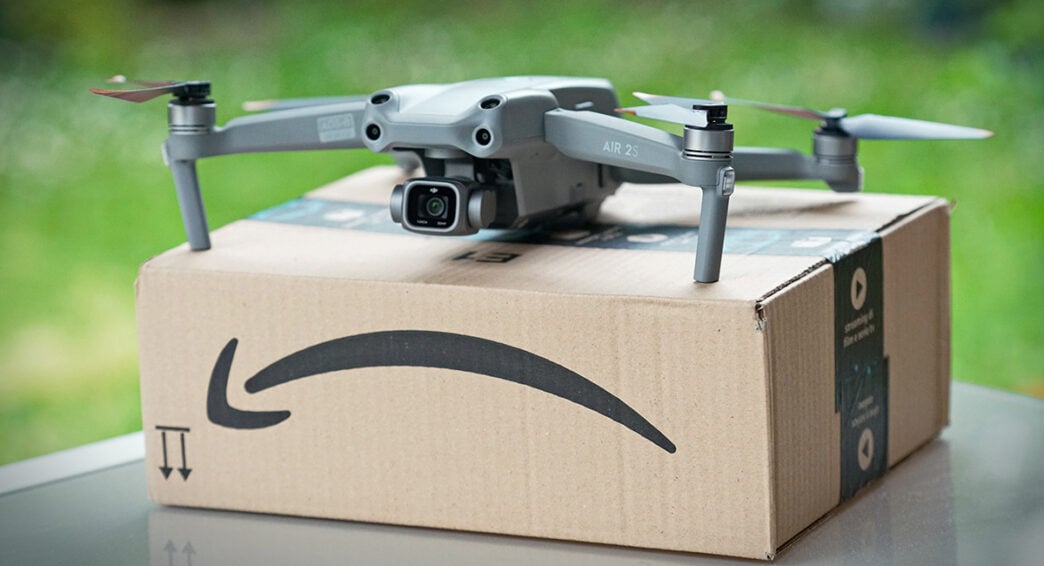
In a UK first, Amazon is using its most advanced drone to trial the delivery of everyday items to Darlington residents. It is the only location outside the US where the company is currently operating drone deliveries.
Prime Air
Amazon’s Prime Air drone delivery service is already available across five US states, offering customers in eligible areas delivery of their Prime packages within two hours of ordering, though in practice, the average delivery time in the US is around 36 minutes. The UK trial currently estimates the full two hours, with room to improve as operations mature.
There are some caveats to the service, however. It is only available to Prime members, it is limited to small everyday goods weighing 2.2kg (5lb) or less, and it can only deliver to properties with gardens to enable the drop from the bottom of the drone from a height of 12ft. The trial is capped at 10 flights per hour and 100 deliveries per day on weekdays, and it operates within a 7.5-mile radius of Amazon’s Darlington fulfilment centre – a deliberately small footprint while the technology and regulatory frameworks are stress-tested.
The drone
The MK30 is an electric vertical take-off and landing (eVTOL) drone which transitions to wing-borne flight by tilting its wings after take-off. Powered by a rechargeable lithium-ion battery, it uses refined propellers for noise reduction, bringing its sound levels down to something comparable to a passing delivery van. CAA-approved, the MK30 carries multiple sensors for object avoidance and built-in GPS for location targeting, designed to navigate around obstacles such as trampolines, washing lines, pedestrians, and other aircraft.
Though the drones fly autonomously, they are remotely monitored by operators on standby, ready to liaise with air traffic control at nearby Teesside Airport if required. The CAA has approved a trial running to the end of the year, with temporary protected airspace – a regulatory prerequisite for autonomous beyond-visual-line-of-sight flight under current rules – secured and expected to be extended.
As advanced as the drone is, however, it hasn’t been all plain sailing. In October 2025, two MK30s struck the same construction crane in Tolleson, Arizona within minutes of each other, prompting FAA and NTSB investigations. Three weeks later, a drone clipped an internet cable in Waco, Texas. Then, in February 2026, an MK30 drifted off course after losing GPS signal in a Dallas suburb, clipping an apartment building’s guttering and falling to the ground. Nobody was hurt, and Amazon has since paused deliveries to similar properties. Prime Air VP David Carbon describes these as things the company “learns as we go along,” and points out that 170,000 flights have been completed without serious injury.
Why Darlington?
The choice of using Darlington as its location is because it offers a handy mix of residential streets, major roads, and an airport, all in close proximity to each other. This enables Amazon to stress-test its kit across multiple environments without travelling far. It also sits beside an Amazon hub that can support the service.
However, not everyone has welcomed the arrival. The CAA’s airspace ring-fence around the launch area means that other aircraft within roughly an eight-mile radius need to be restricted. This has brought opposition from the Teesside Model Flying Club and the UK Ministry of Defence, both of whom have legitimate prior claim to the same airspace. Also, some residents simply told the BBC that they would prefer a human handing them a parcel.
A robotics retailer
Since acquiring Kiva Systems in 2012, Amazon has developed, produced, and deployed more than a million robots across its operations network. Prime Air is just the latest, and most visible, extension of its robotic capabilities.
As much as everyday goods being delivered by drones in two hours is a novelty, drones are not entirely new to British skies. The NHS is trialling them to ferry blood supplies across London, and Royal Mail is using them to reach remote communities in Orkney.
Enthusiasm for Prime Air in the UK currently remains split, and it also raises broader questions about how we consume goods. The appeal of receiving medication in an emergency, or something urgently needed, is real. But a drop into a garden still requires adequate packaging, which compounds an ongoing sustainability problem the industry is only beginning to address. There’s also the exclusion problem of: no garden, no service. University of Reading associate professor of geography Dr Anna Jackman has noted that drone deliveries are particularly difficult to scale in dense urban areas. If Prime Air is to ever move beyond a well-funded experiment into something that fundamentally changes how Britons shop, then it will need to resolve this issue. I’m sure it will – probably with robotics.