


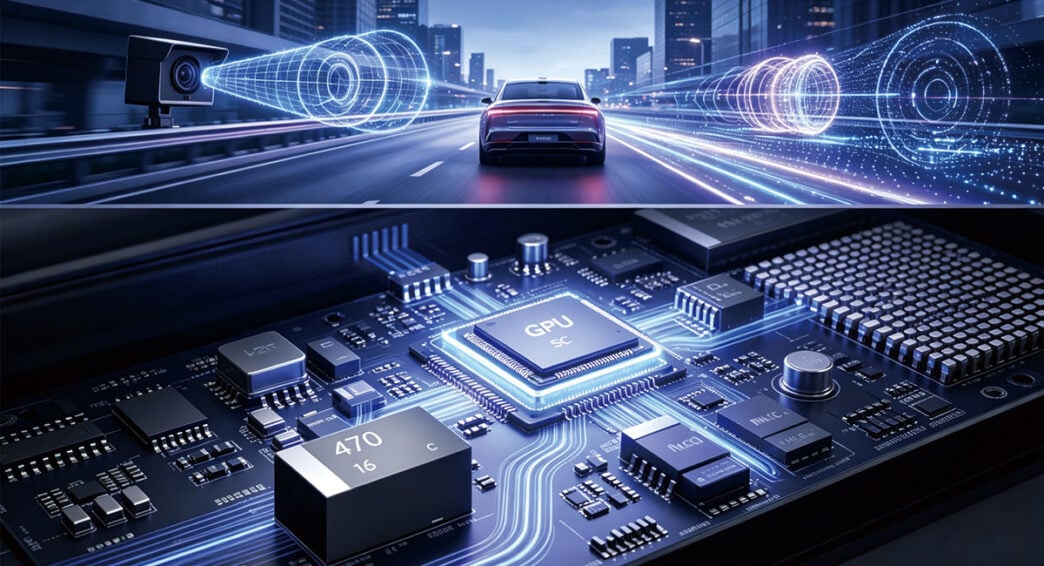
As ADAS (Advanced Driver Assistance Systems) evolve toward L2+ and even L3 autonomy, domain controllers – serving as the central decision-making units – are facing unprecedented design challenges.
On one hand, the rapid increase in computing demand drives higher GPU/SoC power consumption; on the other hand, vehicle space constraints and functional safety requirements are becoming increasingly stringent. In this continuous struggle against physical limits, the miniaturisation and stability of power architecture have become critical factors determining product success.
Shanghai Yongming Electronic Co. Ltd (hereinafter referred to as YMIN), in close collaboration with leading autonomous driving solution providers and top-tier new energy vehicle manufacturers, has participated in a mass-produced vehicle project for a Highway Navigation Assist (NOA) system domain controller. Through high-performance polymer tantalum capacitors, YMIN has systematically addressed three critical pain points in current ADAS power supply design.
Pain point 1: limited PCB space makes traditional MLCC parallel configurations increasingly unsustainable
In ADAS domain controllers, the 1.1V core power rail for GPUs/SoCs is traditionally supported by a design using 6-8 pieces of 22µF MLCCs in 0805 package sizes connected in parallel. This approach not only consumes valuable PCB area – leading to routing difficulties and increased layer count – but also introduces significant BOM management and supply chain risks due to MLCC shortages and price volatility.
Root cause analysis: the apparent ‘large size’ requirement of MLCC solutions is not due to insufficient nominal capacitance, but rather the DC bias effect. When the rated voltage is applied, the effective capacitance of MLCCs can drop to less than 50% of their nominal value. To achieve the required effective capacitance in circuit design, engineers are forced to adopt redundant multi-capacitor parallel configurations.
Pain point 2: 12V power loss protection failure threatens ASIL-D functional safety
Under collision or extreme operating conditions, the 12V battery may experience an instantaneous voltage drop. Conventional aluminium electrolytic capacitors, due to their high ESR and bulky size, cannot provide sufficient energy buffering within limited space. As a result, the SoC is unable to save context and execute a safe shutdown in time, directly violating the robustness requirements of ASIL-D functional safety.
Root cause analysis: aluminium electrolytic capacitors have poor volumetric efficiency and low capacitance density per unit volume. Traditional MnO₂ tantalum capacitors exhibit ESR in the hundreds of milliohms and carry a risk of thermal runaway failure with potential ignition. Both are unsuitable for fast energy storage and release under high-frequency, high-current conditions.
Pain point 3: MLCC acoustic noise and capacitance derating affect signal integrity
ADAS cameras and radar systems are highly sensitive to power supply noise. The audible noise (acoustic ‘singing’) caused by the piezoelectric effect of MLCCs, along with capacitance derating under DC bias, can directly degrade image signal integrity and reduce radar signal-to-noise ratio. In severe cases, this may even impair the accuracy of perception algorithms.
Root cause analysis: this behaviour is inherent to the physical properties of MLCC materials. The piezoelectric ceramic dielectric undergoes mechanical vibration under alternating electric fields, generating audible noise. Meanwhile, its dielectric constant decreases significantly as DC bias increases, leading to substantial capacitance loss.
YMIN solution: targeted approach to fundamentally redefine ADAS power design
To address the above challenges, YMIN provides a comprehensive solution based on automotive-grade polymer tantalum capacitors, enabling ‘one-for-many replacement’ and significant performance improvements.
- Extreme miniaturisation, releasing PCB space
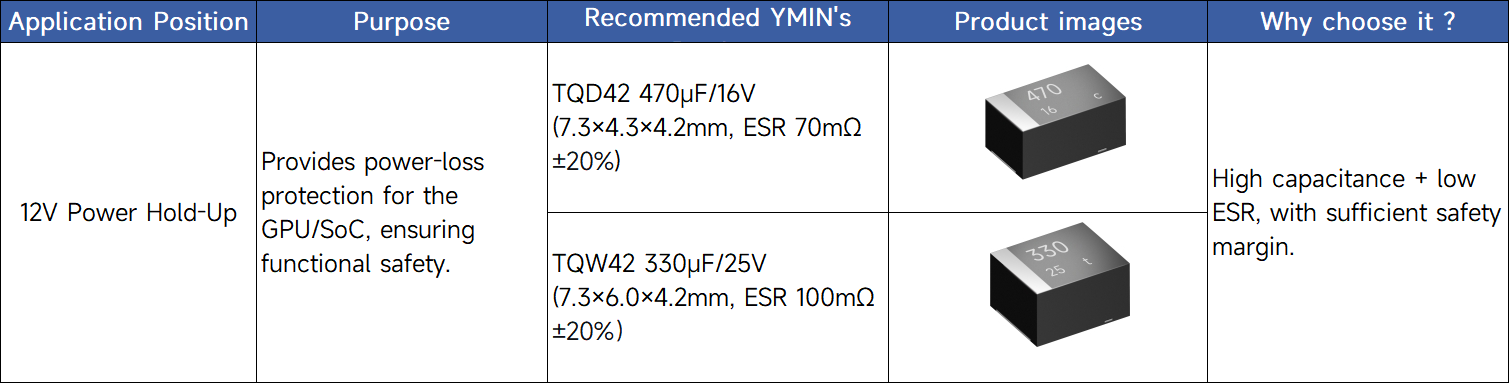
Solution: in the 12V power hold-up circuit, a single TQD42 470µF/16V (7.3 × 4.3 × 4.2mm) or TQW42 330µF/25V polymer tantalum capacitor is used.
Result: directly replaces 6-8 MLCCs in 0805/1206 packages connected in parallel, saving up to 80% of PCB area. This allows more flexible routing and higher integration in domain controllers.
- Low ESR and high capacitance for power loss protection and clean power supply
Solution: leverage the ultra-low ESR (typical 70mΩ for TQD42) and high capacitance density of polymer tantalum capacitors.
Result: power hold-up: provides 7-10ms of energy buffering on the 12V rail in real measurements, exceeding the 5ms requirement and allowing sufficient time for the system to execute a safe shutdown.
Ripple Suppression: Ultra-low ESR effectively filters switching power ripple, ensuring stable power delivery to GPU/SoC cores and preventing data errors caused by power noise.
- No acoustic noise, no DC bias effect, improved signal integrity
Solution: utilise a polymer cathode material, completely eliminating the piezoelectric effect and DC bias issues inherent in MLCCs.
Result: capacitance remains stable across the full operating voltage range, with no mechanical noise generated. This ensures clean power for ADAS cameras and radar systems, improving overall signal integrity at the source.
Application scenario and recommended models
1) 12V power hold-up:
In ADAS domain controllers, when the vehicle’s 12V battery experiences an instantaneous voltage drop due to a collision or extreme operating conditions, sufficient energy buffering is required to support the GPU/SoC and ensure a safe system shutdown. YMIN‘s polymer tantalum capacitors, with their high capacitance density and low ESR characteristics, are an ideal choice for this application.
2)48V to 12V step-down output filtering:
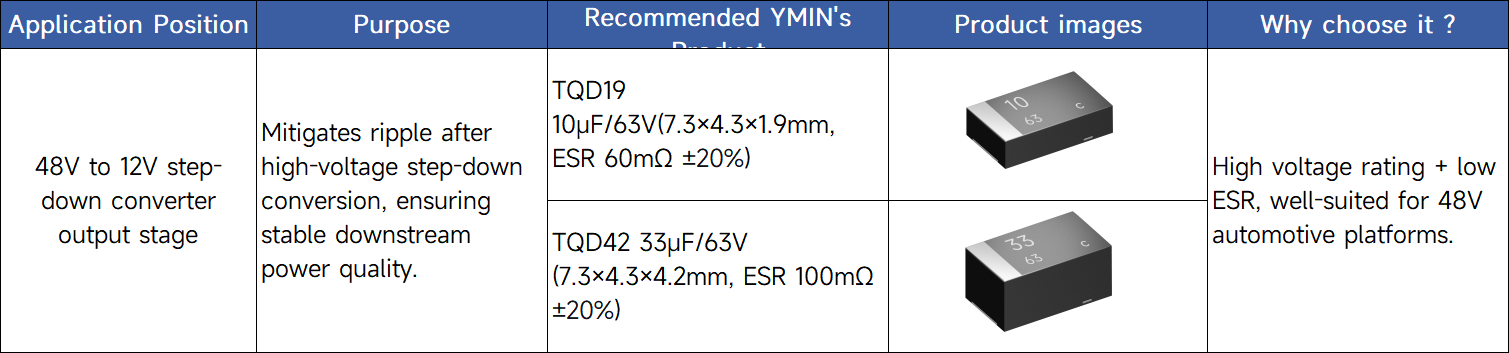
All recommended models are AEC-Q200 automotive qualified and comply with RoHS and REACH regulations. They use a conductive polymer cathode, eliminating the risk of electrolyte drying out. This fundamentally removes the combustion failure mode associated with traditional MnO₂ tantalum capacitors and supports system-level FMEA design requirements.
Conclusion
As ADAS design advances into millimetre-level precision and millisecond-level critical decision-making, the selection of every component becomes essential. YMIN polymer tantalum capacitors, with their advantages of miniaturisation, low ESR, and no acoustic noise, are becoming a key enabler in overcoming power design bottlenecks in ADAS domain controllers. For engineers facing challenges in PCB space constraints, power-loss hold-up, and signal integrity, this represents a solution worth in-depth evaluation.
If you are currently working on ADAS domain controller or in-vehicle power system design, you are welcome to further explore YMIN polymer tantalum capacitor solutions.
Website: https://www.ymin.cn/
Business inquiry: ymin-sale@ymin.com.