







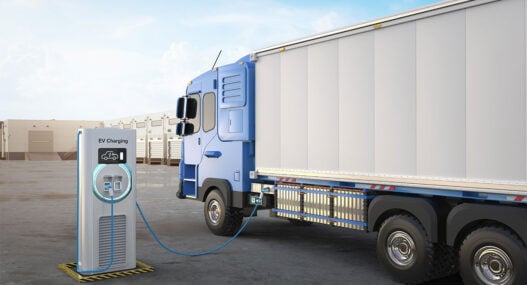
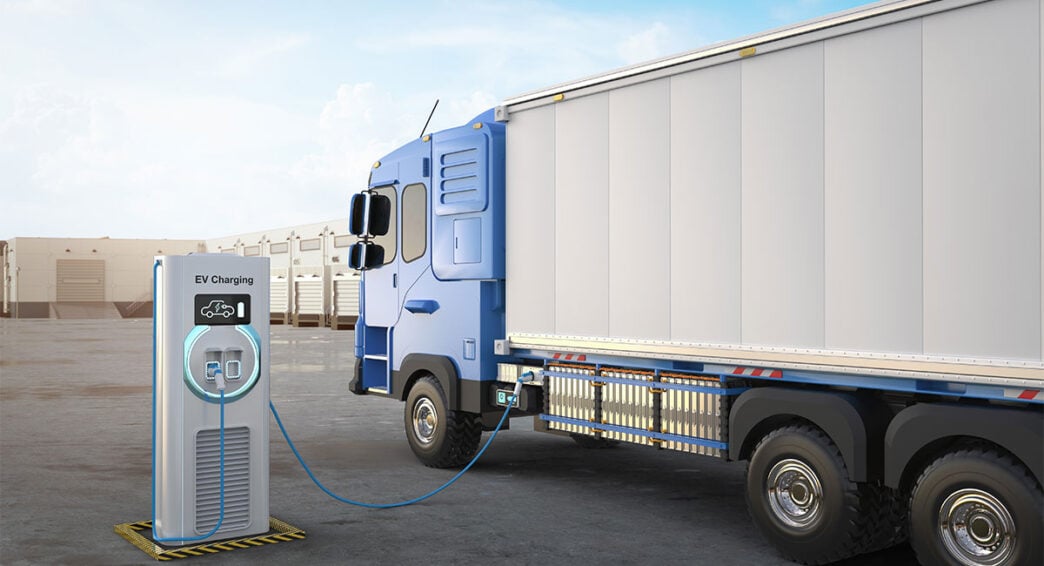
When industrial operators talk about electrification, the conversation often starts with vehicles and regulation. But once projects move beyond pilots, attention quickly shifts to something more practical: uptime. In ports, logistics hubs, and industrial sites, electric vehicles only deliver value if they are available when operations need them most. That reality is quickly pushing charging infrastructure from an operational detail into a board-level concern.
Manual charging has played an important role in early electrification efforts. It is familiar, relatively simple, and workable at small scale. But its limits become visible as fleets grow and utilisation increases. Industrial environments are inherently variable. Vehicles rarely stop in exactly the same place. Fixed and predictable charging solutions assume a level of consistency that real yards and terminals do not provide.
Industry research suggests this pressure is already being felt by operators. McKinsey has identified that scaling electric truck deployments will depend as much on the availability and robustness of charging infrastructure as on the vehicles themselves. In other words, charging has to scale at the same pace as the fleet.
This is where hands-free charging enters the picture. Not as a convenience, but as a necessity to modern fleet operations. At its core, hands-free charging removes the bottleneck, caused by excessive human intervention, at the point where electrification is stalled.
For executives, the value proposition is straightforward. Fewer delays, more predictable operations, and reduced exposure to safety risk. For engineers, achieving this requires rethinking how charging systems interact with vehicles in uncontrolled environments.
The central challenge is reliability. Industrial vehicles do not arrive at chargers with millimetre precision. Small differences in stopping position, suspension height, or surface conditions can shift the location of a charging inlet from one session to the next. As charging power increases, tolerances shrink. Connectors become larger and heavier, and misalignment leads not only to wear, but to downtime. At scale, those small issues add up fast.
Hands-free charging solutions address this challenge by combining robotics and AI-based computer vision to drive the physical connection between vehicle and charger, without relying on precise vehicle positioning. Instead of expecting the vehicle to be in the ‘right’ place, this system identifies the vehicle and its inlet dynamically. Here, AI-based computer vision interprets the environment and guides the connector in real time. The shift from static positioning to adaptive connection, is what makes automation viable in real industrial conditions.
Precision alone, however, is not enough. High-power charging demands a strong safety framework. When large electrical loads are managed without direct human involvement, systems must continuously verify that conditions are safe before and during energy transfer. Alignment, contact quality, and electrical behaviour all need to be monitored in real time.
From an engineering perspective, this brings robotics, electronics, and charging hardware into a single, tightly integrated system. Sensors confirm physical positioning. Power electronics track current and voltage behaviour. Control software manages engagement and disengagement and defines how the system responds when conditions change. The real question is not how the system performs in a demo, but how it behaves day after day, in environments that cannot be scripted.
Charging also has to fit into the wider operational picture. In modern ports and industrial sites, vehicles are increasingly dispatched, routed and scheduled by digital systems. If charging operates outside those workflows, it becomes a source of friction instead of a support function.
Hands-free charging systems are therefore being designed to integrate directly with fleet and yard management platforms. Through open interfaces, chargers can share availability, status, and system alerts automatically. Vehicles can be routed to chargers as part of normal task planning, rather than through manual coordination. This allows charging to behave like any other managed asset in the operation.
Finally, there is the question of continuous operation. Industrial fleets often run 24/7, with limited tolerance for downtime. Charging infrastructure must cope with temperature swings and environmental exposure while delivering predictable performance. Taken together, these factors show that charging is no longer just an electrical challenge. It is an operational and strategic one and hands-free charging sits at the intersection of these demands.
As electrification accelerates across ports and industrial sites, charging is becoming part of the operational control stack itself. Its performance increasingly determines how confidently organisations can deploy electric and autonomous vehicles at scale and how resilient those operations will be in the real world. For EV fleets operating at scale, hands-free charging directly supports higher vehicle uptime, safer working conditions, lower operational costs, and more efficient use of assets. Without it, charging remains a constraint on performance, resilience, and the ability to scale electrified and autonomous operations with confidence.
This article originally appeared in the February’26 magazine issue of Electronic Specifier Design – see ES’s Magazine Archives for more featured publications.