






Ohm’s Law can be applied to a piece of a circuit with a source, and we can draw a Volt-Ampere characteristic for this piece of a circuit.
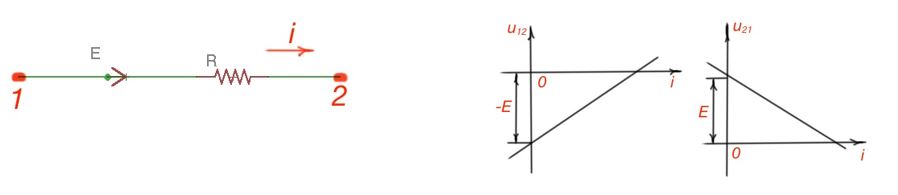
Let’s consider piece of a circuit with a resistor and voltage source in parallel are shown. Current i flows from terminal 1 to terminal 2. Basically the current direction depends not only on the voltage source, but from the other part of a circuit, but we will assume that current direction is considered. The potentials difference in this way is:
The potentials difference in the direction from terminal 2 to 1 is:
Voltage between terminals 1 and 2 is the following:
If current has a negative sign (it flows in the opposite direction):
There is a piece of a circuit with resistance and current source in parallel between terminals 1 and 2 (see figures in the previous post). As before, the current direction depends not only on the considered currents source, but also on other current sources in the circuit. With the mentioned current directions, current from terminal 2 to terminal 1 is , then voltage:
Potentials difference in the direction from terminal 2 to terminal 1 is:
Volt-ampere characteristics of this piece of circuit are shown on the figure below.
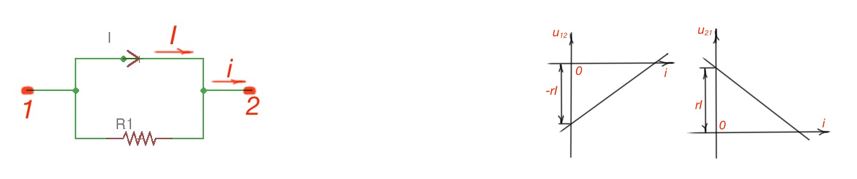
Comparing these volt-ampere-characteristics we can say that resistor circuits with voltage source in series or current source in parallel are interchangable.