







Efficiency and power density are persistent challenges in high-current applications, particularly as systems become more compact. High-current isolated sensing has traditionally relied on bulky discrete implementations or relatively large integrated packages, creating trade-offs between size, thermal performance, and accuracy.
Matt Hein, Business Line Director of Current Sensors at Allegro MicroSystems, said that while earlier integrated approaches helped address this constraint, further innovation was required as power density continued to rise.
“As system power density continues to increase across applications such as xEV power conversion, robotics, and data centre infrastructure, Allegro developed the ACS37200, a galvanically isolated current sensor, in its new LX package to further reduce size and losses,” said Hein.
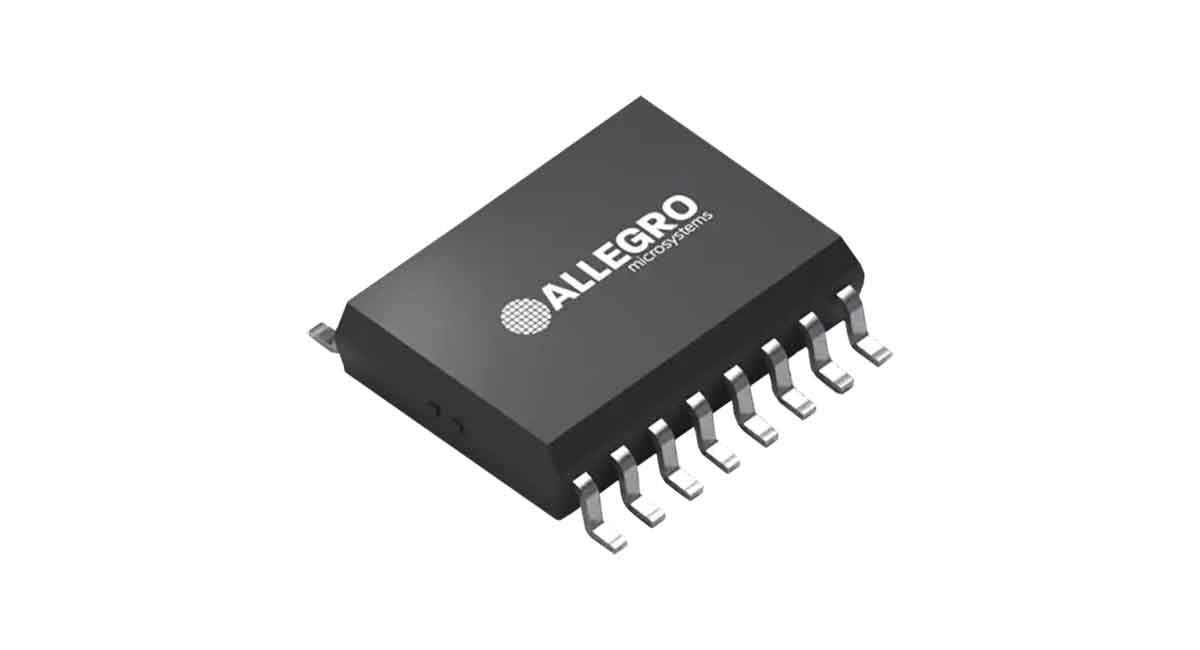
The ACS37200 integrates a 50µΩ current path with reinforced isolation rated at 500VRMS, while reducing the package footprint to approximately 100mm². This is around one-third of the size of earlier high-power solutions.
“The ACS37200 is even smaller than widely used SOIC-16 wide-body isolated current sensors, while offering comparable isolation performance and approximately 94% lower conductor resistance. This directly supports higher efficiency, reduced thermal dissipation, and more compact system designs.”
Reducing heat to reclaim usable power
As engineers design increasingly compact systems for hybrid and battery electric vehicles, industrial automation, AI data centres, and solar inverters, heat dissipation from current sensing has become a limiting factor. Traditional shunt resistors introduce resistive losses that scale directly with current, turning valuable electrical power into unwanted heat.
In a typical 100A design using a 0.5mΩ shunt resistor, up to 5W can be dissipated as heat, often requiring additional heatsinking. By contrast, the ACS37200’s 50µΩ conductor resistance reduces this loss to around 0.5W, which is a 90% reduction. This means that more of the system’s power budget can be used for propulsion, computation, or energy conversion, while also easing thermal design constraints.
Accuracy and thermal stability are closely linked in these environments, particularly where control algorithms depend on precise current feedback.
“Accuracy in current sensing directly impacts system efficiency and control performance, as any measurement error propagates into power conversion and motor control algorithms. As a result, stability over temperature and operating lifetime is as important as nominal accuracy,” explained Hein. “The ACS37200 is designed for stable and repeatable current measurement across the full automotive temperature range. Final accuracy specifications will be published with the production datasheet following completion of standard qualification and reliability testing.”
Enabling higher power density
Allegro’s earlier integrated sensors already delivered substantial size reductions compared with discrete shunt-based solutions. The ACS37200 extends this approach through its compact PSOF package, which occupies around 100mm².
The device is nearly 70% smaller than the ACS772 CB package and delivers a total footprint around 20 times smaller than a traditional shunt-based implementation. This equates to a 95% reduction in board space. Reduced heat generation allows designers to remove heatsinks, while the integrated isolation architecture eliminates the need for external isolation components, supporting higher power density at the system level.
“Our customers consistently tell us that power is a major bottleneck. Systems need to monitor, convert and deliver more power than ever before in the same or even smaller form factors,” said Hein. “By drastically cutting power loss and offering a 95% reduction in footprint, we are giving our customers more design freedom, higher power density, and a faster path to building smaller, more efficient systems for the future of e-Mobility, industrial automation, and clean energy.”
Bandwidth and transient performance
Response time and bandwidth are also critical for applications such as motor control and power conversion, where fast-changing currents must be measured accurately.
“The ACS37200 offers a bandwidth of 150kHz with a typical response time of approximately 4µs. This makes it well-suited for motor control, power monitoring, and DC or line-frequency AC sensing applications where efficiency, isolation, and low power loss are key design priorities.
“The LX package architecture provides a scalable foundation for current sensing solutions that address a broad range of performance requirements.”
Simplifying design and improving safety
The ACS37200 is supplied as a factory-calibrated component certified to UL 62368-1. By integrating the current conductor, isolation, and signal conditioning into a single device, it replaces multiple discrete parts, including a shunt resistor, isolation amplifier, and associated passive components. This reduces the bill of materials, simplifies sourcing, and removes the need for complex high-voltage isolation design at the board level.
A further architectural change is the move to a core-less design. Earlier high-current solutions relied on magnetic cores to concentrate the field, which can limit performance at higher switching speeds and contribute to self-heating. Removing the core improves thermal behaviour and supports higher-frequency operation, while also providing flexibility for future variants.
The LX package also supports a higher pin count than earlier high-current packages, enabling the integration of additional functions such as voltage references and overcurrent indicators. These features reflect growing demand from system designers for higher levels of integration within current sensing devices.
The ACS37200 is also qualified to AEC-Q100 Grade 0, supporting operation from -40°C to +150°C. “This makes it suitable for demanding automotive environments, including inverter, powertrain, and onboard power conversion applications,” said Hein.
ACS37200 features and benefits
- Ultra-low power loss: 50µΩ conductor resistance reduces power loss by 90% compared to a typical 0.5mΩ shunt
- High power density: a 95% smaller footprint than discrete shunt solutions enables more compact system designs
- Certified isolation: provides 1,000VRMS / 1,414VDC of galvanic basic isolation in a single surface-mount package, certified to UL 62368-1
- Simplified implementation: replaces multiple discrete components with a single factory-calibrated IC in an 8-pin PSOF package