





In order to build a large-scale quantum computer that works, scientists and engineers need to overcome the spontaneous errors that quantum bits – or qubits – create as they operate.
Scientists encode these building blocks of quantum information to suppress errors in other qubits so that a minority can operate to produce useful outcomes.
However, as the number of useful (or logical) qubits grows, so does the number of physical qubits required. As this scales, the number of qubits required to create a useful quantum computer becomes a significant engineering challenge.
For the first time, quantum scientists at the Quantum Control Laboratory at the University of Sydney Nano Institute have demonstrated a type of quantum logic gate that reduces the number of physical qubits needed for its operation.
To achive this, they built an entangling logic quate on a single atom using an error-correcting code nicknamed the ‘Rosetta stone’ of quantum computing. It earned that name because it translates smooth, continuous quantum oscillations into clean, digital-like discrete states, subsequently making errors easier to spot and fix and important, enabling a compact way to encode logical qubits.
A Rosetta Stone for quantum computing
This curiously named Gottesman-Kitaev-Preskill (GKP) code has for many years offered a theoretical possibility for significantly reducing the physical number of qubits needed to produce a functioning ‘logical qubit’. Albeit this is done by trading efficiency for complexity, making the codes very difficult to control.
Research published in Nature Physics demonstrates this as a physical reality, tapping into the natural oscillations of a trapped ion (a charged atom of ytterbium) to store GKP codes and, for the first time, realising quantum entangling gates between them.
Led by Sydney Horizon Fellow Dr Tingrei Tan at the University of Sydney Nano Institute, scientists have used their exquisite control over the harmonic motion of a trapped ion to bridge the coding complexity of GKP qubits, allowing a demonstration of their entanglement.
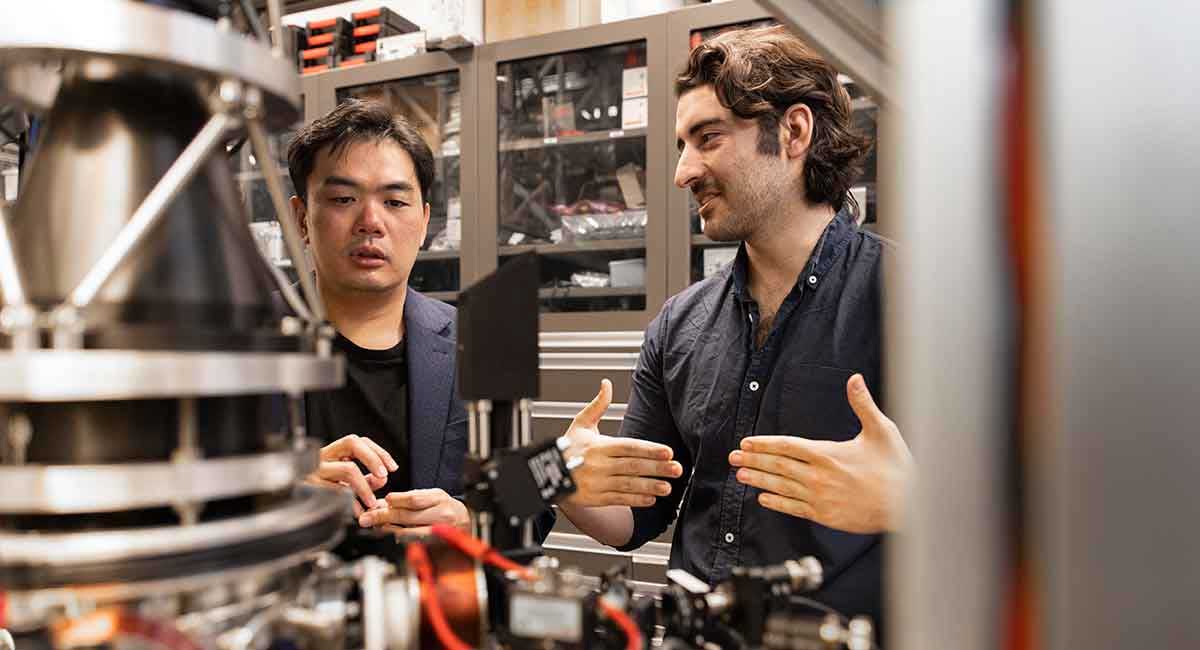
“Our experiments have shown the first realisation of a universal logical gate set for GKP qubits,” said Dr Tan. “We did this by precisely controlling the natural vibrations, or harmonic oscillations, of a trapped ion in such a way that we can manipulate individual GKP qubits or entangle them as a pair.”
Quantum logic gate
A logic gate is an information switch that allows computers – both quantum and classical – to be programmable to perform logical operations. Quantum logic gates use the entanglement of qubits to produce a completely different sort of operational system to that used in classical computing, underpinning the great promise of quantum computers.
First author Vassili Matsos is a PhD student in the School of Physics and Sydney Nano. He explained: “Effectively, we store two error-correctable logical qubits in a single trapped ion and demonstrate entanglement between them.
“We did this using quantum control software developed by Q-CTRL, a spin-off start-up company from the Quantum Control Laboratory, with a physics-based model to design quantum gates that minimise the distortion of GKP logical qubits, so they maintain the delicate structure of the GKP code while processing quantum information.”
A milestone in quantum technology
Wffectively, what Matsos did is entangle two ‘quantum vibrations’ of a single atom. The trapped atom vibrates in three dimensions. Movement in each dimension is described by quantum mechanics and each is considered a ‘quantum state’. By entangling two of these quantum states realised as qubits, Matsos created a logic gate using just a single atom, a major milestone in quantum technology.
This result reduces the quantum hardware required to create these logic gates, which enable quantum machines to be programmed.
“GKP error correction codes have long promised a reduction in hardware demands to address the resource overhead challenge for scaling quantum computers. Our experiments achieved a key milestone, demonstrating that these high-quality quantum controls provide a key tool to manipulate more than just one logical qubit,” said Dr Tan. “By demonstrating universal quantum gates using these qubits, we have a foundation to work towards large-scale quantum-information processing in a highly hardware-efficient fashion.”
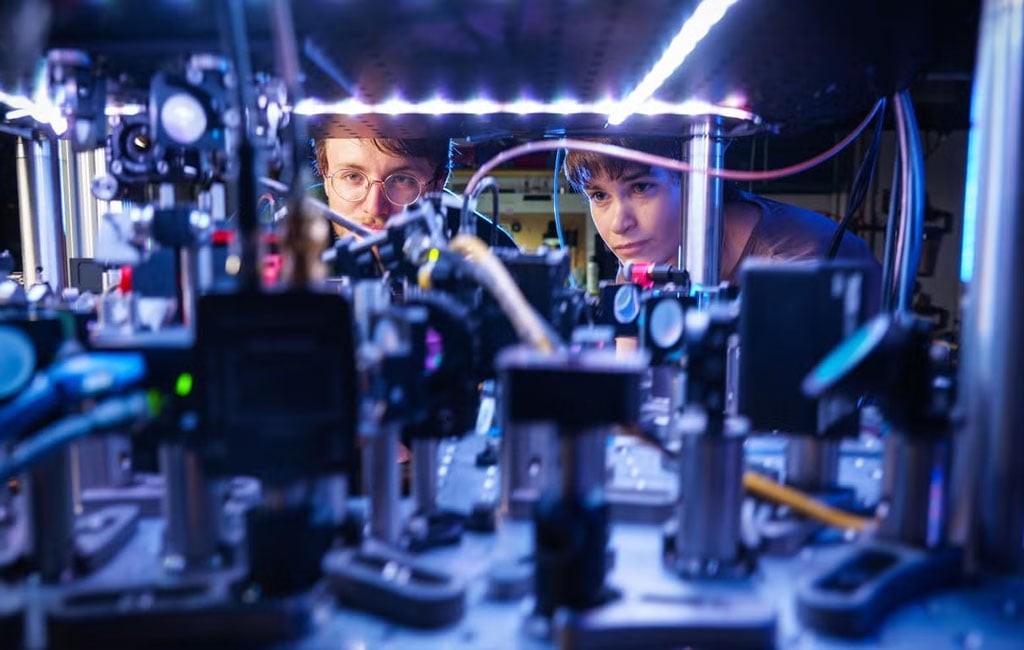
Across three experiments laid out in the paper, Dr Tan’s team used a single ytterbium ion contained in what is known as a Paul trap. This uses a complex array of lasers at room temperature to hold the single atom in the trap, allowing its natural vibrations to be controlled and utilised to produce complex GKP codes.