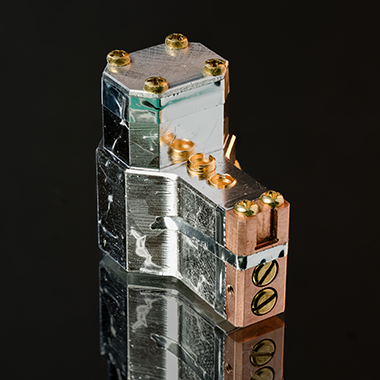










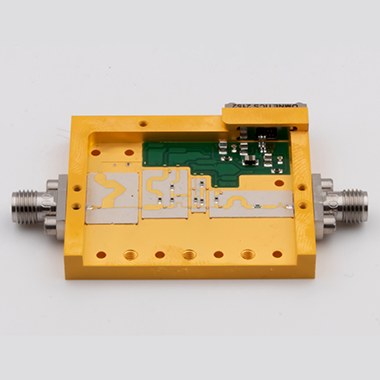
Due to its smart design, it consumes one-tenth of the power consumed by the best amplifiers today, subsequently reducing qubit decoherence and laying the foundation for more powerful quantum computers with more qubits and improved performance.
Bits, which are the building blocks of a computer, can only ever have the value of 1 or 0. This is why the building blocks of a quantum computer, qubits, can exist in states having the value 1 and 0 simultaneously and all states in between any combination – this phenomenon, known as superposition, is why quantum computers can solve complex problems beyond the capabilities of conventional supercomputers.
To be able to use a quantum computer’s computational power, qubits have to be measured and converted into interpretable information. This process requires extremely sensitive microwave amplifiers to ensure these weak signals are accurately detected and read.
But reading quantum information is a delicate business, and any fluctuation in temperature, noise, or electromagnetic interference can result in qubits losing their integrity, their quantum state, and render the information unusable. Amplifiers generate output in the form of heat and can consequently cause decoherence.
As a result, researchers operating in this field are in pursuit of more efficient qubit amplifiers. Researchers from Chalmers have taken a key step forward with the development of their new, highly efficient amplifier.
“This is the most sensitive amplifier that can be built today using transistors. We’ve now managed to reduce its power consumption to just one-tenth of that required by today’s best amplifiers – without compromising performance. We hope and believe that this breakthrough will enable more accurate readout of qubits in the future,” said Yin Zeng, a doctoral student in terahertz and millimetre wave technology at Chalmers, and the first author of the study published in the journal ‘IEEE Transactions on Microwave Theory and Techniques’.
An essential breakthrough
This advance could be significant in scaling up quantum computers to accommodate more qubits than today. Chalmers has been engaged in this field for many years through a national research programme, the Wallenberg Centre for Quantum Technology.
“This study offers a solution in future upscaling of quantum computers where the heat generated by these qubit amplifiers poses a major limiting factor,” said Jan Grahn, professor of microwave electronics at Chalmers and Yin Zeng’s principal supervisor.
Unlike other low-noise amplifiers, the new amplifier is pulse-operated, meaning it is only activated when needed for qubit amplification as opposed to being always switched on.
“This is the first demonstration of low-noise semiconductor amplifiers for quantum readout in pulsed operation that does not affect performance and with drastically reduced power consumption compared to the current state of the art,” explained Jan Grahn.
As quantum information is transmitted in pulses, one of the key challenges was to ensure it was activated rapidly enough to keep up with the qubit readout. The Chalmers researchers addressed this by designing a smart amplifier using an algorithm that improves the operation of the amplifier.
To validate their approach, they also developed a novel technique for measuring the noise and amplification of a pulse-operated low-noise microwave amplifier.
“We used genetic programming to enable smart control of the amplifier. As a result, it responded much faster to the incoming qubit pulse, in just 35 nanoseconds,” said Yin Zeng.