


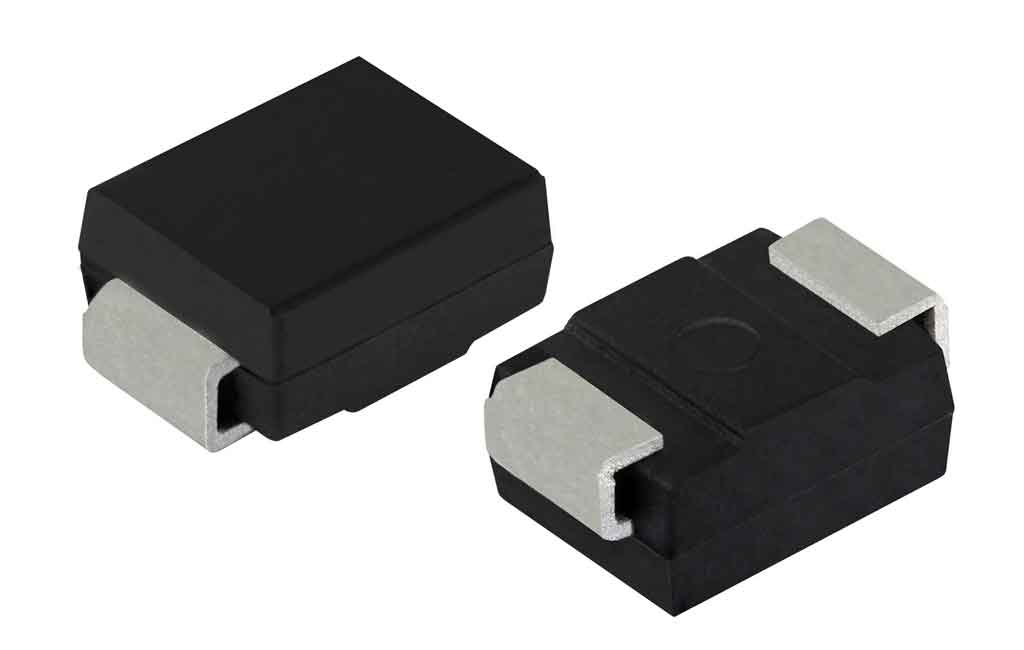
Vishay Intertechnology recently introduced a new series of uni/bidirectional 1500 W surface-mount PAR transient voltage suppressors (TVS) in the SMB (DO-214AA) package. To meet the requirements of automotive applications, the Vishay General Semiconductor T15BxxA and T15BxxCA series are AEC-Q101 qualified and offer high temperature operation to +185 °C.
Compared with TVS in the SMC (DO-214AB) package, the automotive grade devices recently released offer a 58% smaller footprint to save board space and lower system costs. The unidirectional T15BxxA series offers extremely stable breakdown voltages from 12V to 51V, while the bidirectional T15BxxCA series provides breakdown voltages from 12V to 100V. The devices deliver excellent clamping capability — 17.0V to 70.1V for the T15BxxA and 17.0V to 137V for the T15BxxCA — and very fast response times.
The TVS are engineered to protect sensitive electronics against voltage transients induced by inductive load switching and lightning. Typical applications include lighting, electro-mechanical brake (EMB), and fuel pump control; 48V DC/DC converters and inverters; integrated starter generators, BMS, vehicle control units (VCU), and on-board chargers; and telematics control units (TCU) for audio, electronic stability control (ESC), and radar sensors.
The devices meet MSL level 1 standards per J-STD-020 and are RoHS-compliant and halogen-free.