





Published in Advanced Materials, the study details how researchers have fabricated a new kind of ultra-thin metalens using lithium niobate, a crystal widely employed in the telecommunications sector. The device not only focuses light like a conventional lens but simultaneously alters its wavelength – for example, turning infrared light at 800 nanometres into visible violet light at 400 nanometres.
This development stems from a broader trend in optics to replace bulky, curved glass lenses with nanoscale flat lenses known as metalenses. These metasurfaces are made up of precisely engineered structures only a few hundred nanometres in width and height – far thinner than a human hair. Despite their size, they can bend and manipulate light in much the same way as traditional lenses.
ETH Zurich’s innovation adds a new dimension to this technology by combining metalens design with the nonlinear optical properties of lithium niobate.
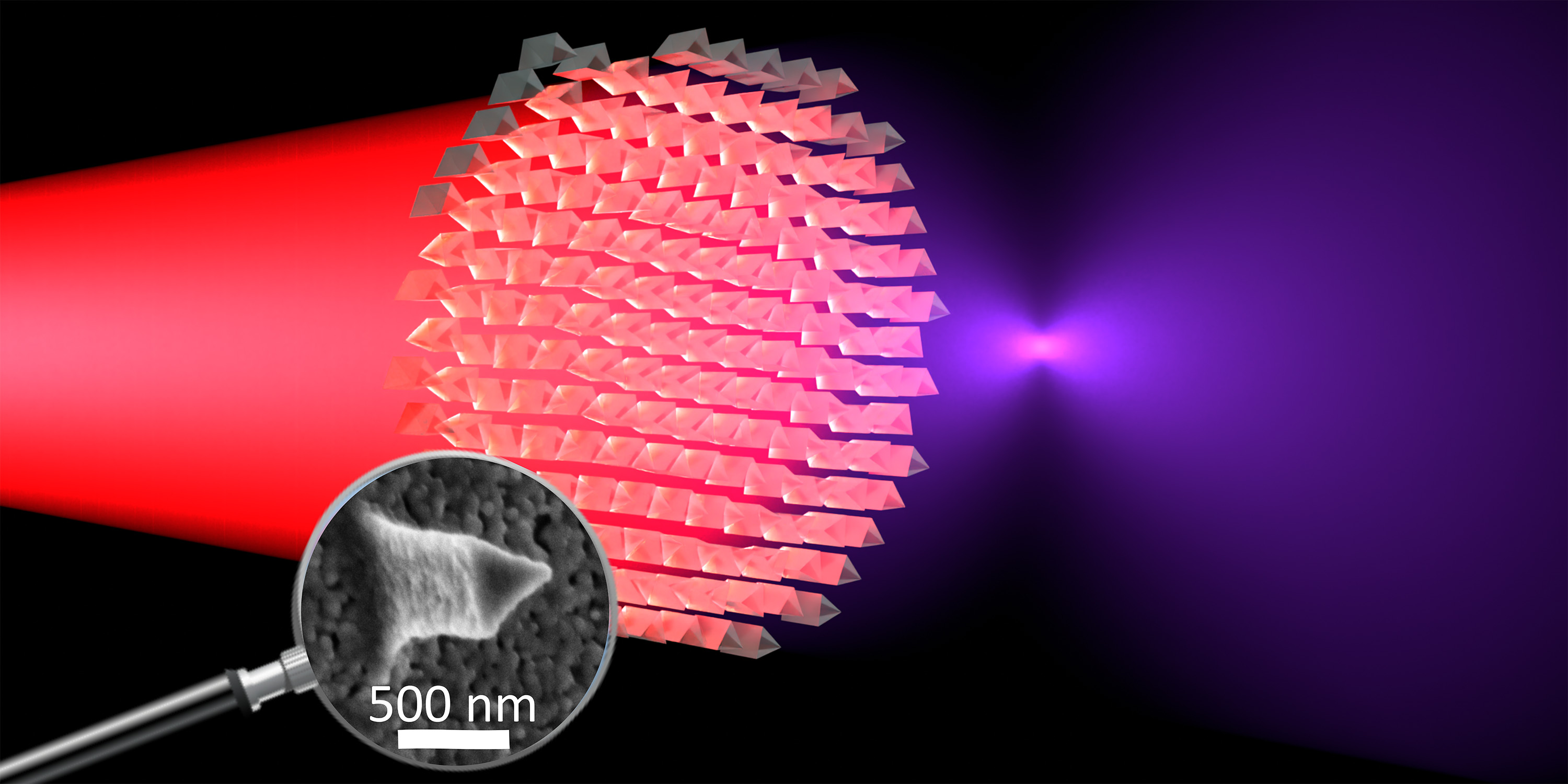
Professor Rachel Grange, who led the project at the Institute for Quantum Electronics, explained that this magic of light conversion is only made possible by the special structure of the ultra-thin metalens and its composition of a material that allows the occurrence of what is known as the nonlinear optical effect.
The nonlinear effect allows light to be converted from one colour to another. Green laser pointers, for instance, use this principle to transform invisible infrared into visible green light via crystal-based conversion.
To fabricate the metalens, the team pioneered a new process that makes the normally difficult-to-manipulate lithium niobate more manageable. Doctoral researcher Ülle-Linda Talts, co-first author of the study, likened it to a printing press: “The solution containing the precursors for lithium niobate crystals can be stamped while still in a liquid state. It works in a similar way to Gutenberg’s printing press.”
Once the stamped material is heated to 600°C, it assumes the crystalline structure required for optical conversion. The method is not only more cost-effective and faster than previous approaches but also suitable for mass production, with reusable moulds allowing multiple metalenses to be printed efficiently.
As well as offering new possibilities for compact optical systems in consumer electronics, this approach could see wider application across several fields:
- Anti-counterfeiting: metalenses with nanostructures too small to detect using visible light could be embedded into banknotes or artwork to provide reliable, high-security authentication features
- Optical sensing: devices could steer and convert laser light, enabling simple sensors to detect infrared radiation by shifting it into the visible spectrum
- Semiconductor fabrication: the lenses could reduce the need for complex deep-UV light systems in electronics patterning
Professor Grange added: “We have only scratched the surface so far and are very excited to see how much of an impact this type of new cost-effective technology will have in the future.”