

Automotive audio has evolved from entertainment-only purposes to being an integral part of the driving experience in an effort to enhance driver comfort and safety. Audio features such as active noise cancellation (ANC), immersive surround sound and personalised audio zones – traditionally limited to high-end vehicle models – are now making their way into entry-level models.
To keep pace with this trend while making vehicles more efficient and easier to manufacture, original equipment manufacturers (OEMs) and audio system designers are looking for higher levels of integration in the embedded processors used in automotive amplifiers. These processors need to meet system audio processing demands and OEM security and functional safety requirements. Audio system designers also want these systems to be scalable, simplifying redesign across OEMs and vehicle trim models.
In this article, we’ll explore the evolution of embedded devices such as the TI AM62D-Q1 processor and AM2754-Q1 microcontroller (MCU), as well as the most important design considerations when using these devices with other advanced semiconductors to develop digital amplifiers in modern vehicles.
The evolution of automotive audio processors and supporting components
Audio continues to be a differentiating factor between OEMs. In fact, most OEMs provide packages that add on to or replace stock sound systems such as premium-branded sound systems, branded immersive surround- sound capabilities, extra mid-range speakers and subwoofers. If you’ve shopped for a car recently, you’re probably familiar with the range of audio options in currently available models.

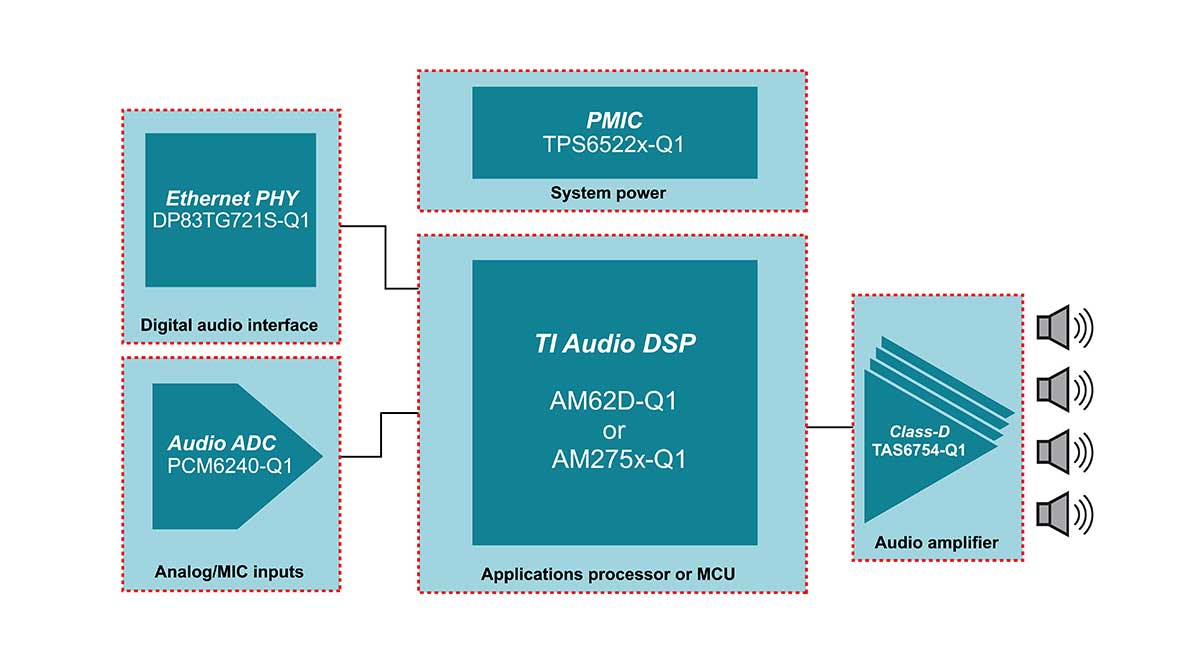
Traditionally, digital amplifiers in premium automotive audio systems were designed with a distributed architecture for audio processing, with separate MCUs, digital signal processors (DSPs) and networking integrated circuits (ICs) handling different tasks. While this discrete approach often provided design flexibility, it also increased system complexity, cost and size. The addition of immersive surround sound and road-noise cancellation (RNC) for a home-theatre like experience – while also optimizing fuel and energy efficiency at the same time – requires an increase in the number of components, audio channels and types of software. Figure 1 shows an example of an audio system in a modern vehicle with multiple speakers for surround sound, as well as microphones for RNC.
This article originally appeared in the November’25 magazine issue of Electronic Specifier Design – see ES’s Magazine Archives for more featured publications.