








In professional audio engineering, the Analog Front End (AFE) is the ultimate arbiter of signal quality. As the industry moves toward higher-resolution digital formats – 32-bit float recording and beyond 192kHz sample rates – the pressure on the initial analog capture stage has reached a breaking point. Traditional voltage-mode architectures, which have served as the industry standard for over half a century, are now hitting physical and mathematical ceilings.
This article provides a comprehensive technical deep dive into the transition from Voltage-Mode Instrumentation Amplifiers (INAs) to Current-Conveyor-based topologies. Using the Triad Semiconductor TS5510 as a benchmark, we examine how the ‘Universal AFE’ philosophy addresses the structural challenges of noise, headroom, and common-mode rejection that have long plagued the professional audio signal chain.
High resolution vs. analog reality
Professional audio engineers are currently operating in a technical paradox. Digitally, they can store and process audio with dynamic ranges and frequency responses far exceeding the limits of human hearing. On the analog side, however, this data entry point can still be restricted by amplification topologies designed when 16-bit performance was considered the peak of technology.
The fundamental challenge remains unchanged: capturing a millivolt-level signal from a transducer and elevating it to a point suitable for an Analog-to-Digital Converter (ADC) without introducing audible artifacts. Switching power supplies, wireless communication arrays, and complex lighting rigs all inject common-mode noise into the signal path. To achieve true high-fidelity capture, the AFE must not only be silent; it must be resilient.
The physics of the ‘common-mode enemy’
The ‘balanced’ line (using XLR or screw-terminal connectors) is the first line of defence in audio. By sending a signal and its inverted copy down two wires, any noise picked up along the way should, in theory, be identical on both wires – defined as common-mode – and cancelled out at the receiving end.
However, the efficacy of this cancellation depends entirely on the Common-Mode Rejection Ratio (CMRR) of the receiving AFE. In practice, the performance of traditional amplifiers in rejecting this noise is limited by the physical components used to build them. As cable runs grow, the cables act as massive antennas; ‘ground’ references can look very different when separated by a few hundred feet of cable. If the AFE cannot maintain a high CMRR across the entire audible frequency spectrum, this noise ‘leaks’ into the differential signal, resulting in hum, buzz, or other interference that can destroy a high-resolution recording.
Deep dive: total input capture range
The TS5510 introduces the concept of Total Input Capture Range (TICR), a metric that goes beyond simple dynamic range. In a traditional preamp, the distance between the noise floor and the clipping point at a single gain setting limits the ‘usable’ range.
With a 156dB TICR, the TS5510 spans from -128dBu (the physical noise floor of a resistor) to +28dBu (a signal equivalent to roughly 19.5V RMS), achieved through the current conveyor’s unique ability to handle high-swing voltages at its input without saturating its internal gain stages. The TS5510 achieves this on lower voltage rails by processing the signal as current, effectively ‘uncoupling’ the input signal swing from the internal supply limits.
The architectural ceiling of voltage-mode design
For decades, the Three-Operational-Amplifier Instrumentation Amplifier has been the cornerstone of audio input design. High open-loop gain and global negative feedback provide a flexible way to set gain. But this architecture presents three constraints.
1. The Gain-Bandwidth Product (GBWP) conflict. In a voltage-mode system, gain and bandwidth are a zero-sum game, whereas in a standard op-amp, they are constant. If a ribbon microphone requires +50dB of gain to reach line level, the available amplifier bandwidth is severely restricted, creating phase shifts at high frequencies and increased THD. In high-end audio, maintaining a linear phase response and wide bandwidth (often up to 100kHz to ensure zero phase shift at 20kHz) is essential. Most INA-based designs make this technically difficult and expensive at high gain settings
2. The CMRR resistor matching limitation. The CMRR of a traditional amplifier relies on the precise matching of internal resistor ratios. Even a 0.1% mismatch caps the CMRR at approximately 60dB. To achieve the 90dB or 100dB rejection required to truly isolate a signal in a noisy environment, manufacturers must use expensive, laser-trimmed resistor networks. These components are susceptible to ‘thermal drift’ – as the equipment heats up, the resistor values shift slightly, degrading noise rejection over the course of a recording session
3. Headroom and the ubiquitous use of pads. Standard AFEs have a fixed input ceiling governed by their rail voltage. To handle a ‘hot’ signal from, say, a drum microphone, engineers must engage a resistive ‘pad’. This added element typically introduces more thermal noise, significantly reducing the Signal-to-Noise Ratio (SNR). Essentially, the engineer is feeding a degraded signal into a high-resolution converter
Second-generation current conveyor
To break through these ceilings, silicon designers have turned to the Current-Mode Instrumentation Amplifier. The heart of this revolution is the Second-Generation Current Conveyor (CCII), an architecture originally proposed by Sedra and Smith.
The CCII is a three-terminal building block that operates in the current domain. Unlike an op-amp, it does not use global negative feedback to set gain. Instead, the gain is determined by a single resistor in an open-loop-like configuration.
Technical advantages of CCII in audio
- Bandwidth independence: because there is no global feedback loop, the bandwidth is largely independent of the gain. You can achieve +40 dB of gain with the same wide-open frequency response as at 0dB
- Inherent rejection: noise rejection is a function of the transconductance stage itself, not resistor matching, providing a stable, high CMRR (90+dB) that does not shift with temperature
Deep dive: the Universal AFE, TS5510
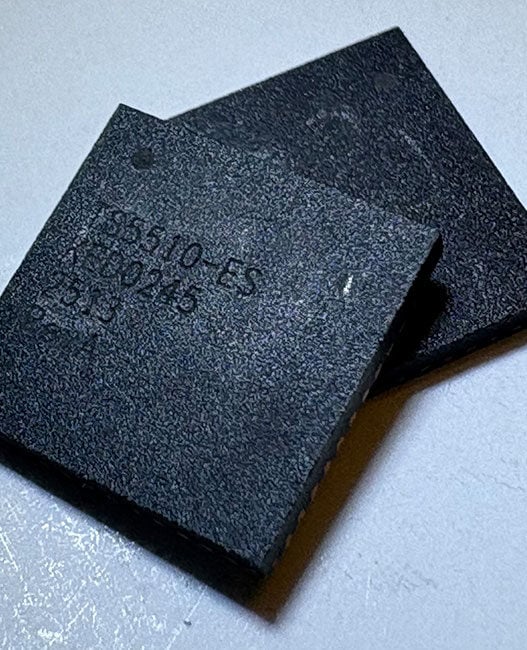
The TS5510 is a commercial breakthrough that brings this current-mode architecture to the pro-audio market. It is a 2-channel, low-noise, programmable-gain amplifier that redefines the ‘input stage’.
1. The 156dB Total Input Capture Range (TICR). The most striking specification of the TS5510 is its 156dB of TICR. This is the delta between its Equivalent Input Noise (EIN) of -128dBu and its maximum input level of +28dBu.
- The low end: -128dBu is the input-referred noise of the TS5510, roughly equivalent to the thermal noise floor of a 150-ohm resistor
- The high end: +28dBu is a massive signal (roughly 19.5 Vrms) that would saturate any other integrated AFE on the market
2. Eliminating the external pad. Because the TS5510 can handle +28dBu directly, it eliminates the need for external resistive pads. This ‘padless’ architecture preserves the integrity of the signal. Whether recording a whisper or a kick drum, the signal follows the same high-fidelity path, ensuring that the SNR is always optimised for the ADC.
3. Digitally Controlled Analog (DCA) advantages. While the signal path is purely analog and current-mode, the control is entirely digital. Via an SPI interface, gain can be adjusted from -18 to +47dB in precise 1dB steps. This allows for paged preamp settings that can be recalled perfectly in a Digital Audio Workstation (DAW), providing the sonic benefits of analog with the efficiency of digital.
Solving real-world audio engineering challenges
Ground loops and ‘hum’ in live recording. Live recordings are notorious for ground loop hum. Because current-mode architectures do not rely on precision resistor matching for their 90dB CMRR, they are significantly better at ‘cleaning up’ the signal in the chaotic electrical environment of a concert venue.
Complexity and board space. Traditional high-end preamps typically require dozens of discrete components, precision resistors, and bulky relays for pad switching. The TS5510 integrates all of this into a 7 x 7mm QFN package. This allows designers to build high-channel-count interfaces in a fraction of the space, with lower power consumption and higher reliability.
Future-proofing for 32-bit float and Industry 4.0
We are seeing a massive shift toward 32-bit float recording, which theoretically eliminates the need for ‘gain staging’ because it has such a vast dynamic range. However, 32-bit float is only useful if the AFE can actually capture that range. Fixed or limited variable input stages create a ‘bottleneck’ that floating point digital resolution cannot fix.
The TS5510’s 156dB TICR is the first analog architecture that truly matches the potential of high-bit-depth digital recording. It ensures the ‘analog window’ is wide enough to capture everything the microphone hears without the engineer having to worry about clipping or burying the signal in noise.
Solving the gain staging dilemma
For an audio engineer, ‘gain staging’ is the constant battle to keep a signal high enough to stay above the noise floor, but low enough to avoid clipping. This is particularly difficult with high-dynamic instruments like a grand piano or a drum kit.
The TS5510 eliminates this stress through its Padless Architecture. Traditionally, if a signal were too hot, you would engage a -20dB pad, immediately worsening the noise floor. In the TS5510’s current-mode architecture, the ‘attenuation’ is handled digitally through the conveyor’s programmable gain stage. Because the signal isn’t being ‘shunted’ by a resistive voltage divider, the SNR remains optimised across the entire range. This is the first time an AFE has allowed an engineer to capture a kick drum and a whisper through the exact same circuit path with zero hardware changes.
Common-mode rejection in practice
In a professional studio, ‘buzz’ and ‘hum’ are often blamed on cables, but the fault usually lies with the AFE’s inability to handle Common-Mode Voltage (Vcm). Common-mode voltage can be seen as an AC ‘offset’ that appears identically on both signal lines.
The TS5510’s current-mode architecture maintains high CMRR across a wide frequency spectrum. Because the rejection is a physical property of the current-mode transconductance stage rather than a mathematical balance of resistors, the ‘hum’ is rejected at the earliest possible point in the system.
ADC input drive capability
The AFE’s interface with the ADC is one of the most overlooked aspects of AFE design. Modern Delta-Sigma ADCs require a very low-impedance drive and anti-aliasing filters to prevent high-frequency noise from folding back into the audio band.
The TS5510 provides a high current, low impedance output drive designed to interface to either sampling ADCs (which typically need a high capacitance across their input) or continuous time delta-sigma front ends (which typically have low input resistance to suppress input noise). In addition, the output stage is designed to be powered by the same supply as the ADC, so even when driven into clipping, the TS5510 will never overdrive or damage the ADC.
The 32-bit float revolution
The recent emergence of 32-bit float recording in field recorders and DAWs has promised to ‘end clipping forever’. However, this is a half-truth. While the digital file can store a massive range, the analog hardware still has a physical limit. If the AFE clips at +18dBu, the ‘float’ file will simply record a clipped signal.
The TS5510 is the first integrated AFE to unlock the potential of 32-bit float. With its +28dBu headroom and 156dB TICR, it provides a ‘capture window’ wider than almost any acoustic event, allowing field recorders to operate with ‘set and forget’ gain levels, knowing that the analog hardware will not be the bottleneck.
Simplifying the DESIGN CYCLE
From a manufacturer’s perspective, the TS5510 significantly simplifies the engineering cycle. Designing a discrete preamp that matches these specs would require a team of expert analog designers, months of PCB revisions, and a lengthy BOM. By integrating the current conveyor, programmable gain, and high-voltage input protection into a single 7 x 7mm QFN package, Triad has commoditised high-end performance, allowing companies to focus on their software and user interface, rather than constantly fighting the physics of the analog input.
Power efficiency and channel density
In traditional audio-over-IP (AoIP) designs with 32, 64, or even 128 channels of preamplification packed into a single 1U rack space, power consumption and heat are the primary constraints. Discrete voltage-mode preamps are power-hungry, especially when designed for high headroom. The TS5510’s current-mode architecture is significantly more efficient, enabling higher channel density without noisy cooling fans that add acoustic noise and generate interference.
A new standard
The professional audio industry can no longer rely on incremental improvements to voltage-mode designs to meet the demands of modern high-resolution audio. The shift to current-mode architectures, as demonstrated by the TS5510, seems inevitable.
By solving the Common Mode Compliance issue and providing inherent, stable noise rejection, the Universal AFE provides a new blueprint for precision. It allows engineers to stop fighting the limitations of their hardware and start focusing on the art of the recording.
The voltage-mode feedback limitations aren’t strictly academic; they are daily obstacles in high-resolution environments. The shift to Current-Mode Instrumentation Amplifiers, as demonstrated by the TS5510, is a technical necessity.
As we move into an era of 156dB of capture range, the analog front end is finally catching up to the digital future it serves.
A final observation on CMRR: In practice, the performance of traditional AFE amplifiers in rejecting this noise is limited by the matching of physical components used to build them. In the TS5510, the CMRR is inherent in the topology – not limited by the matching of passives.