



Chalmers University of Technology researchers have developed an atomically thin material that enables two opposing magnetic forces to coexist, reducing energy consumption in memory devices by a factor of 10.
It is projected that within a few decades, the volume of data being stored, processed, and transmitted will account for nearly 30% of global energy consumption. This has prompted a search for new approaches to building more energy-efficient memory units.
The team at Chalmers is the first to unveil how a layered material combines two distinct magnetic forces, enabling a tenfold reduction in energy consumption in memory devices.
“Finding this coexistence of magnetic orders in a single, thin material is a breakthrough. Its properties make it exceptionally well-suited for developing ultra-efficient memory chips for AI, mobile devices, computers, and future data technologies,” says Dr. Bing Zhao, a researcher in quantum device physics at Chalmers and lead author of a study published in Advanced Materials.
Combining two opposing magnetic forces, ferromagnetism and antiferromagnetism, offers significant scientific and technical advantages and, until now, has only been possible by stacking ferromagnetic and antiferromagnetic materials in multilayer structures.
“Unlike these complex, multilayered systems, we’ve succeeded in integrating both magnetic forces into a single, two-dimensional crystal structure. It’s like a perfectly pre-assembled magnetic system – something that couldn’t be replicated using conventional materials. Researchers have been chasing this concept since magnetism was first applied to memory technology,” says Saroj P. Dash, Professor of Quantum Device Physics at Chalmers and leader of the research project.
Memory devices store information by controlling the orientation of electrons within a material. In conventional materials, this process depends on the application of an external magnetic field to reverse electron alignment. Chalmers’ new material features a built-in combination of opposing magnetic forces that create an internal force and tilted overall magnetic alignment.
“This tilt allows electrons to switch direction rapidly and easily without the need for any external magnetic fields. By eliminating the need for power-hungry external magnetic fields, power consumption can be reduced by a factor of ten,” says Dr. Zhao.
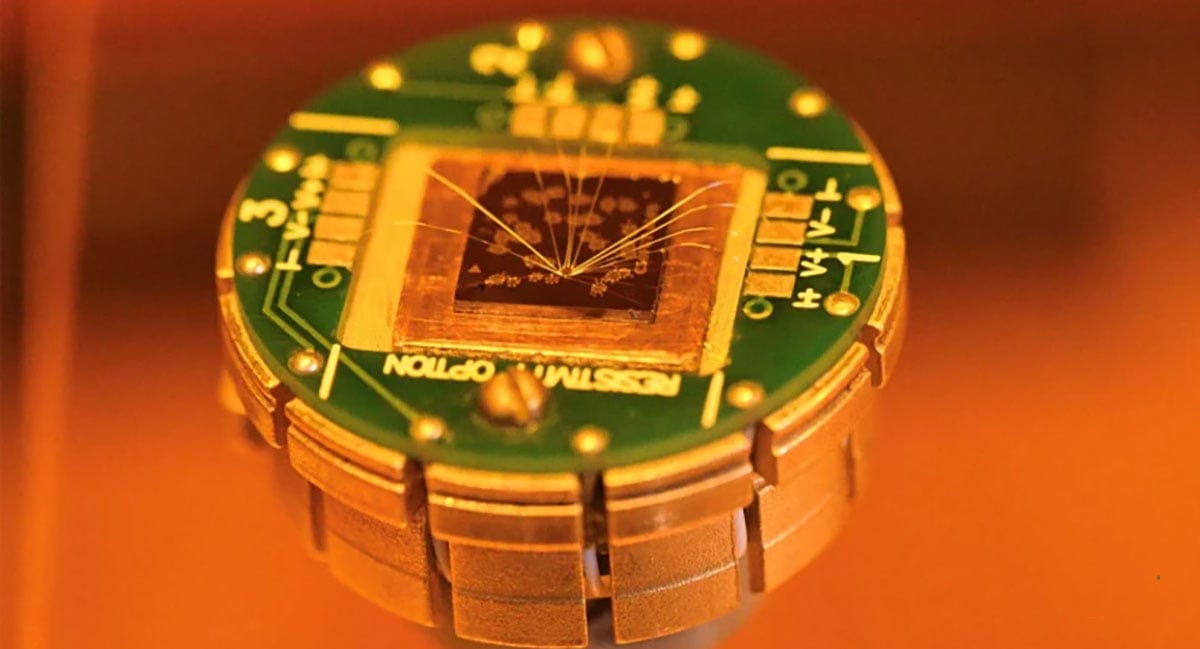
Advanced memory devices use stacked layers of two-dimensional crystal films. Rather than relying on chemical bonds like conventional materials, the layers are held together by van der Waals forces. The structure incorporates a magnetic alloy composed of both magnetic and non-magnetic elements – cobalt, iron, germanium, and tellurium – enabling ferromagnetic and antiferromagnetic behaviours to exist simultaneously within the same material.
“A material with multiple magnetic behaviours eliminates interface issues in multilayer stacks and is far easier to manufacture. Previously, stacking multiple magnetic films introduced problematic seams at the interfaces, which compromised reliability and complicated device production,” says Prof. Dash.
Essentially, this discovery could allow for a new generation of ultra-efficient, reliable memory solutions for AI, mobile technology, and advanced data processing.