



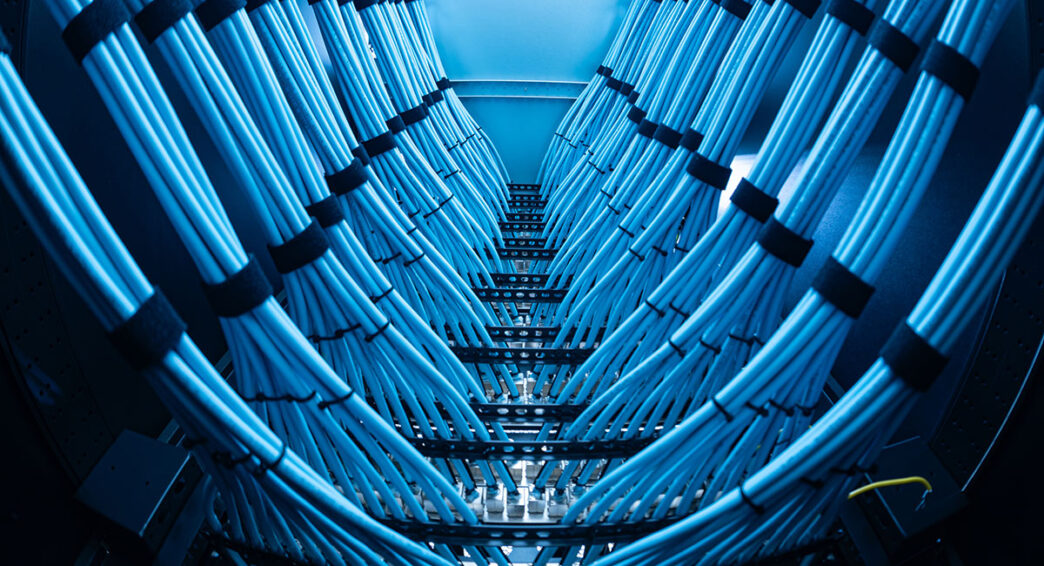
Fibre solutions are everywhere, connecting the world. Making sure that information is sent and received quickly – no lag, no compromise.
With the sharp rise of AI, data centres have become the epicentre of modern life – or at least our connected modern life! As much as wireless is amazing, if you want to stay connected, you’re going to need cables! It’s a bit like a body, really, the cables are your nervous system, carrying information from point to point from your brain (that’ll be the data centre).
When we speak about cable density, we are referring to the number of individual optical fibres and high-speed links that can be routed through a given space within a data centre.
Cable density in modern AI workloads
In modern AI workloads, you need cable density to be able to cope with the rising demand for high-bandwidth, low-latency traffic. This need is becoming increasingly common. AI training and inference, for example, generate vast amounts of east-west traffic (server-to-server), with thousands of GPUs exchanging data simultaneously. Traditional networking can’t scale to the required level without some hefty high-density fibre that supports aggregated high speeds. Optical fibre delivers these speeds while maintaining low latency compared with copper alternatives.
Compact spaces and high port counts
Racks in AI data centres often have hundreds, and in some cases thousands, of optical ports. Without high-density fibre cables and connectors (for example, multi-fibre push on (MPO) and multi-fibre terminated push on (MTP) connectors, and very small form-factor modules), the physical pathways quickly become congested. This can scupper airflow and complicate maintenance. Managing high fibre count efficiently is essential to avoid operational issues.
Scalability and future speed upgrades
Designing fibre infrastructure with high density allows data centre operators to scale toward higher speeds without major re-cabling or redesign later-stage deployment. Having structured, modular fibre pathways simplifies upgrades.
Airflow and cooling efficiency
If there is no clear plan for where these cables are placed and why, then this can affect cooling performance. Excessive bundles can block airflow, raise operating costs, and risk overheating. To minimise these effects, the cable density design needs to be considered early on.
What all this tells us is that density is important and should be designed thoughtfully because it is doing a lot of work to support the massive parallel data movement at the heart of AI clusters. It also enables future growth without physical bottlenecks.
Why cable selection is important
Just as considering the placement and job of cables is important, so is choosing the correct type of cable. Cable types and configurations directly affect performance, reliability, and cost.
Bandwidth and reach performance
Optical fibre supports much higher data rates over longer distances than copper. For short links within racks, multimode fibre provides high bandwidth efficiently. For longer distances within and between sites, single-mode fibre with dense wavelength division multiplexing (DWDM) can carry multiple terabit streams over one fibre pair.
Latency and signal integrity
In AI workloads, even microseconds of delay can affect synchronisation between GPUs across the cluster. High-quality optical cables, careful management of fibre length, and minimising excess connections help maintain low latency and signal integrity.
Connector management and density trade-offs
Higher-density connectors such as 8-, 16-, or 24-fibre MPO/MTP variants and very small form-factor technologies allow more links in the same physical footprint. Fibre management must balance the number of fibres with ease of installation and maintenance.
Compatibility with hardware speeds
Cable choice must match transport technologies (400G, 800G, 1.6T, etc.). Mismatched cables can lead to reduced performance or prevent full use of high-end transceivers fully.
So, cable selection affects throughput, service life, maintainability, and the ability to scale to new AI networking standards. A pretty big responsibility.
AI rests on the shoulders of fibre
Industry analysis indicates that AI-optimised data centres can require up to 10 times more fibre than conventional data centre setups to support dense GPU clusters, switch fabrics, and low-latency interconnects.
With more fibre demand comes a need for increased supply. It is indicated that optical cable usage for AI applications grew roughly 138% in 2024 and was expected to increase by 77% in 2025. When compared with data centre demand for non-AI applications, this is staggeringly higher. It is suggested that AI applications may need anything between two and 10 times more optical fibre cable compared to non-AI data centre facilities.
In the UK, a survey of operators shows over 80% report that insufficient fibre infrastructure has delayed expansions, and 95% consider high-capacity fibre availability a decisive factor for future buildouts.
These data points show the intrinsic nature of fibre and AI – it is the backbone of AI data centre networking. And its availability and design directly influence where and how AI facilities are built and expanded.