

Memory Protection Devices (MPD) has launched the PTP-2L Series, a range of spring-loaded contact probes for PCB testing and automated test equipment (ATE) that the company says will last for one million operations. That is around 10x the 100,000 cycles typical of standard pogo pins.
The probes make a temporary electrical connection between a test system and PCB test points, and MPD says they keep the same spring pressure and contact resistance over their full service life. For high-volume production lines, that means fewer fixture shutdowns to replace worn pins.
“Nobody wants their lines down because of a testing probe,” said Daniel Lynch, CEO of MPD, speaking to Electronic Specifier at electronica 2026. He acknowledges the pins may cost a little more up front, but argues the saving comes quickly: “You’ll pay a little bit more, but it’s still less than when you have to change it 10 times.”
Three parts, all gold plated
MPD puts the longer life down to the materials in each of the pin’s three parts, all of which are gold plated. The plunger is hardened tool steel for corrosion resistance and conductivity, and the barrel is phosphor bronze for strength and wear resistance.
The biggest departure is the spring. Where most pogo pins use standard steel, MPD has used piano wire, which it rates for one million operations with zero breakage. Lynch added that MPD also puts a thicker layer of gold plating on the tips than many manufacturers do, which helps them last longer.
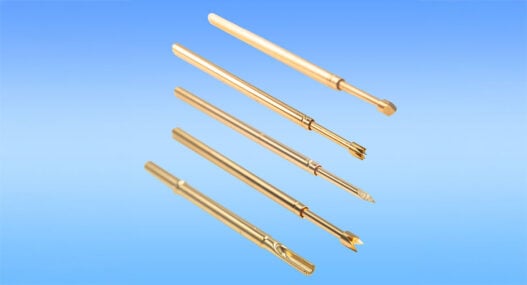
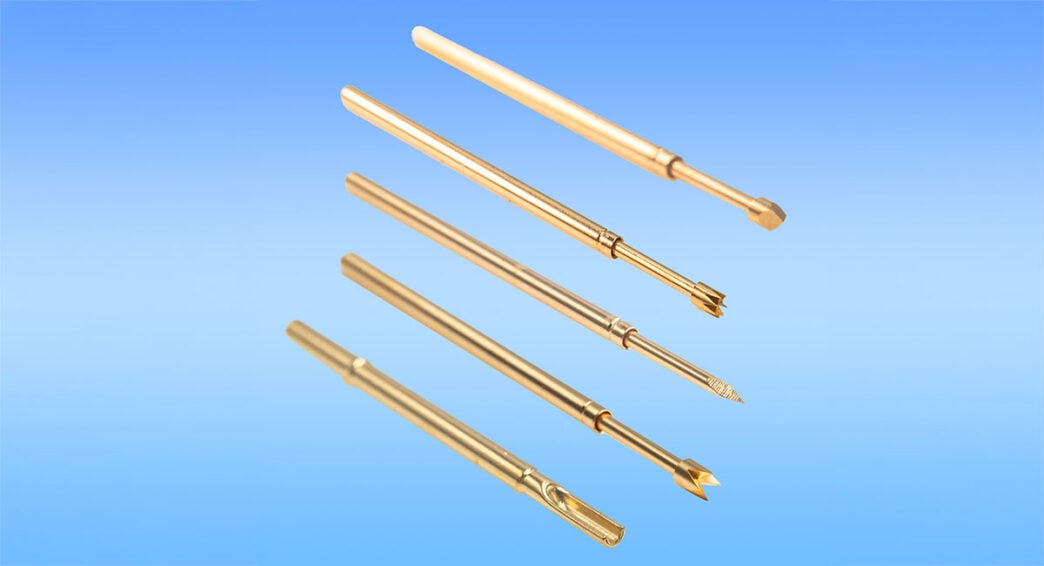
Tip options include 3-, 4- and 8-point crown, small and medium triangle pyramid, knife edge, and waffle. Target applications span in-circuit and functional testing, production-line fixtures, burn-in and semiconductor testing, charging docks and battery contacts, and temporary board-to-board connections.
Asked why longer-life pins had not appeared sooner, Lynch suggested that established suppliers simply have no reason to make them: a customer who replaces pins 10 times buys 10 times as many.
A leap of faith
Test probes are a new direction for MPD, which is best known for battery holders. Lynch said the idea came when a contact at a trade show asked whether the company made pogo pins. “That’s not really my realm, but I never say no,” he said.
The development took around three years. Much of that time went on learning the technology and finding the right factory, which Lynch said was harder than the design itself. The pins are made in Japan by a manufacturer that already produces one of MPD’s battery holders.
While customer requests played a part, Lynch said the main driver was the growth of AI and data centres, which means more PCBs and more test probes. “It’s not going to go away; it’s only going to increase,” he said.
At launch, MPD is offering 13 part numbers. It chose them after researching which types sell most, by length, diameter, and head style. The company’s catalogue covers up to 275 styles, and Lynch said it can produce others on request.
The PTP-2L Series is in stock through MPD’s global distribution network, and the company has begun sending out samples. As with all its product lines, MPD is encouraging engineers to try the pins first. “I don’t ask you to buy my part. I ask you to try my part,” said Lynch. He expects it will take 12 to 18 months to gather solid field data on performance.
MPD was founded in 1980 and is an ISO 9001-certified manufacturer. Its name comes from its first battery holders, which powered CMOS memory on computer motherboards. Its range now includes battery contacts, fuse holders, and 12V automotive components, and most of its business is in Europe and Asia.