






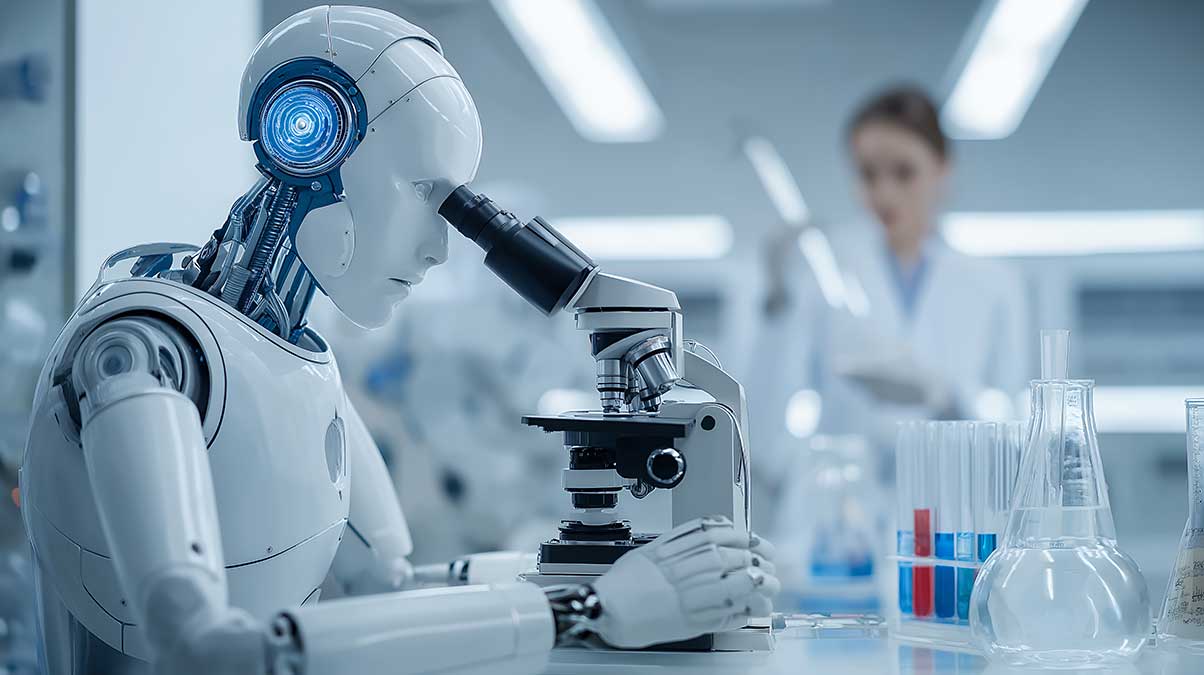
Generative artificial intelligence systems such as ChatGPT remain far from capable of producing groundbreaking scientific discoveries without human input, according to new research from emlyon Business School and the Keeley School of Business.
The study, led by Amy Wenxuan Ding, Professor of Artificial Intelligence and Business Analytics at emlyon, and Shibo Li, Professor at Keeley, examined whether ChatGPT-4 could operate as a scientist in the field of molecular genetics. The researchers found that while the model could suggest ideas and plan experiments, it was unable to move beyond existing knowledge to generate truly original hypotheses.
The paper argues that this limitation stems from the way generative AI models function. Because they rely on patterns, graphs, and statistical relationships rather than causal reasoning, they lack the capacity to explore the unknown — a key requirement for scientific discovery.
Although ChatGPT-4 appeared confident in its results, the researchers said its conclusions were minor and its sense of success misplaced. The system demonstrated what the authors described as “the illusion of discovery,” overstating the originality of its findings.
“Generative AI models lack curiosity and imagination — qualities that are abundant in humans,” said Professor Ding. “When humans face the unknown, they can break through existing knowledge constraints by exploring new possibilities. GenAI, by contrast, cannot.”
The study found that human researchers, when working in uncharted scientific territory, rely on imagination to formulate novel hypotheses. By comparison, generative AI operates within the limits of known information, effectively working in reverse to humans by seeking to optimise or refine existing knowledge rather than escape its boundaries.
Professor Ding suggested that if AI systems were ever capable of producing Nobel Prize-level discoveries, they could transform research and development, speeding up scientific progress and expanding humanity’s collective understanding. “But for now,” she said, “GenAI is useful as an assistant rather than a lead researcher.”
The authors argue that future advances in AI will depend on designing systems that can emulate curiosity and imagination. Only then, they suggest, could AI evolve from a tool that supports scientists into one that independently drives innovation.
For the moment, the researchers said, generative AI remains valuable for improving efficiency in research — by suggesting experiments, generating ideas, and handling laborious data tasks — but it is not yet capable of producing genuine scientific breakthroughs.
The findings were published in Scientific Reports.