






Sony’s image sensors have undergone various generations of architectures, each of which has been designed to address certain image-related issues in embedded systems. Among Sony’s high-resolution image sensors, the Sony IMX676 and Sony IMX412 deliver advanced capabilities such as high-speed imaging, superior low-light sensitivity, enhanced dynamic range, and improved near-infrared (NIR) response that meet the needs of vision systems.
Both IMX676 and IMX412 sensors belong to the same pixel class, but they are built on two distinct branches of Sony’s semiconductor evolution. The IMX412 leverages stacked BSI architecture to enable high frame rates and fast readout performance. The IMX676, built on the STARVIS 2 platform, combines BSI architecture with Deep Trench Isolation (DTI) technology and is renowned for delivering superior low-light sensitivity, improved dynamic range, and enhanced near-infrared response.
Understanding these architectural differences is essential when designing demanding vision applications where the choice between speed and image fidelity directly impacts overall system performance.
What are IMX412 and IMX676 sensors?
IMX412-Sony STARVIS
The IMX412 is a 12.3MP Type 1/2.3 diagonal 7.857mm back-illuminated stacked CMOS image sensor with approximately 12.33 million active pixels. It uses the R, G, and B primary colour mosaic filter and equips an electronic shutter with a variable integration time. The stacked architecture integrates the pixel array and processing circuitry on separate silicon layers, enabling very high frame rates. It is designed specifically for surveillance camera applications.
IMX676 – Sony STARVIS 2
The IMX676 is a 12.63-megapixel Sony back-illuminated CMOS image sensor built on the STARVIS 2 architecture. STARVIS 2 introduces Deep Trench Isolation (DTI) that dramatically reduces inter-pixel cross-talk compared to earlier BSI designs. This results in improved quantum efficiency, better colour accuracy, and enhanced near-infrared (NIR) sensitivity. The IMX676 offers approximately 12.6 megapixels in a square format and is available in colour and monochrome variants, making it highly versatile for industrial and machine vision applications.
Sony IMX676 vs IMX412: feature-by-feature breakdown
The table below summarises the key specifications of these sensors:
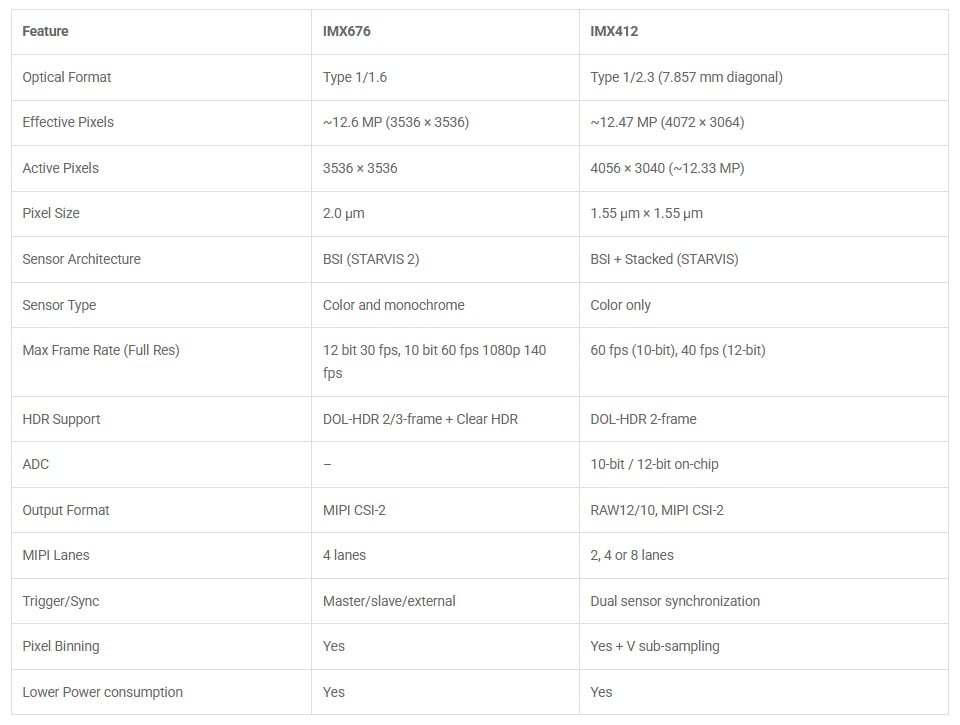
Sony IMX412 and Sony IMX676 sensors: a detailed comparison
Sensor architecture: STARVIS 2 vs. STARVIS
The most fundamental difference between these sensors lies in their underlying silicon architecture.
The IMX412-AACK employs a stacked BSI architecture where the photodiode layer and the signal processing circuitry are fabricated on separate silicon dies bonded together. This stacking enables extremely fast readout speeds, which is why the IMX412 can achieve high fps.
The IMX676 uses Sony’s STARVIS 2 BSI technology, which adds Deep Trench Isolation (DTI) on top of the standard BSI structure. DTI creates physical barriers between adjacent pixels, drastically reducing optical and electrical cross-talk. This translates to cleaner images, more accurate colour reproduction, and better NIR response – all without increasing pixel size.
Pixel size
The IMX676 uses a 2.0 µm pixel pitch, while the IMX412 uses the smaller 1.55 µm pixel pitch. Larger pixels gather more photons per unit time, which directly benefits low-light performance and dynamic range. The IMX676’s 2.0 µm pixel – combined with STARVIS 2 DTI technology – delivers stronger photon capture efficiency per pixel than the IMX412’s smaller 1.55 µm pixel.
However, the IMX412’s smaller pixel size allows it to fit approximately 12.33 million active pixels into the compact Type 1/2.3 optical format, enabling use with smaller, more affordable lenses common in surveillance applications.
IMX412 also delivers excellent sensitivity but balances it with higher resolution density.
Optical format
The IMX676 operates in a Type 1/1.6 optical format – a larger imaging circle that requires lenses designed for that format. The larger sensor area inherently captures more light overall under identical aperture conditions, contributing to improved sensitivity.
The IMX412 fits within the smaller Type 1/2.3 format. This compact format is well-established in the surveillance camera ecosystem, offering broad lens compatibility and enabling more compact camera module designs. Systems already designed around 1/2.3″ lenses can integrate the IMX412 with minimal optical redesign.
Frame rate
The Sony IMX412 offers full resolution at 60 fps (10-bit) and 40 fps (12-bit), and 1080p binning at 240 fps, while the Sony IMX676 offers full resolution at about 30 fps. For applications requiring high-speed capture, such as traffic enforcement, sports analytics, or high-throughput industrial inspection, the IMX412’s frame rate advantage is significant. The IMX676’s 30 fps at full resolution is adequate for most standard surveillance and machine vision tasks, but cannot match the IMX412’s burst capabilities.
Low-light performance
The IMX676 is purpose-built for enhanced low-light and NIR performance. It provides cleaner night imaging and improved signal-to-noise ratio in dim environments, making it particularly strong for surveillance and traffic monitoring.
Monochrome availability
The IMX676 is available in colour and monochrome configurations. The monochrome variant removes the Bayer colour filter array entirely, allowing every pixel to respond to the full luminance spectrum from UV through NIR. This dramatically boosts light sensitivity (typically 3-4x compared to the colour variant) and enables true NIR imaging without infrared filters.
The IMX412 is available in colour configuration only. For applications requiring monochrome imaging, such as OCR, barcode reading, or NIR-based biometric systems, the IMX676 monochrome is a natural choice.
High Dynamic Range (HDR) support
Both sensors support Digital Overlap HDR (DOL-HDR), but with different capabilities:
- IMX676: Supports DOL-HDR with 2-frame and 3-frame combinations, plus Clear HDR mode
- IMX412: Supports DOL-HDR with 2-frame combination at full resolution (4056 × 3040) at 30 fps
The image below illustrates the difference between Clear HDR and DOL-HDR in dynamic scenes.
For a more detailed explanation, refer to our blog ‘Clear HDR vs DOL HDR: Which HDR Technology is Right for Your Application? – e-con Systems’.
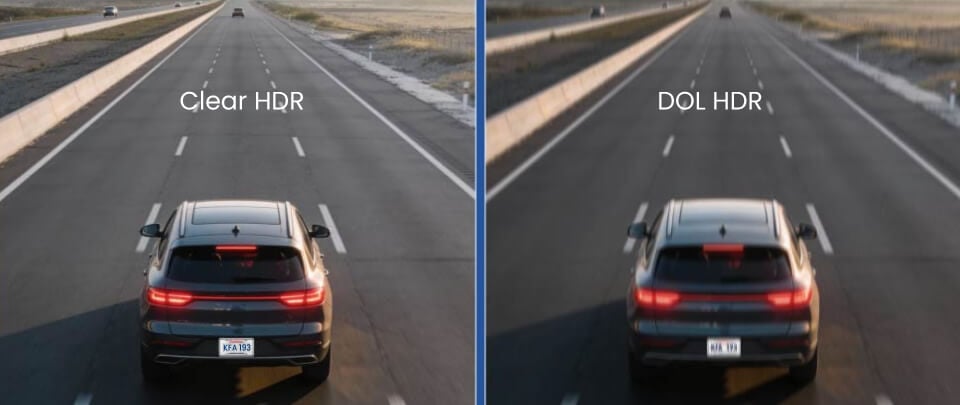
The IMX676’s Clear HDR mode provides a significant advantage in dynamic scenes where motion artifacts from sequential multi-exposure HDR would be problematic. The IMX412’s 2-frame DOL-HDR is effective for fixed-scene or slow-moving applications.
Synchronisation and multi-camera support
These sensors support multi-camera synchronisation. The IMX412-AACK provides dual sensor synchronisation operation capability, enabling precise frame-level timing for strobe-synchronised illumination and event-driven inspection systems.
The IMX676 and IMX412-AACK are high-resolution Sony BSI sensors in the 12 megapixel class, but they serve different niches. The IMX676’s STARVIS 2 architecture – with DTI, larger 2.0 µm pixels, monochrome availability, and Clear HDR – makes it the sensor of choice for demanding industrial, robotic, and precision imaging applications.
The IMX412-AACK’s stacked BSI architecture delivers exceptional frame rates, compact form factor, and proven performance in surveillance systems.
Low power
The IMX412 features a dedicated low-power mode. While IMX676 doesn’t have a Low Power Mode, it is actually quite efficient, where high-quality pixels (2.0 µm) and high dynamic range (HDR) are more important than saving a few milliwatts in a sleep state.
e-con Systems offers trusted Sony sensor-based camera solutions
Since 2003, e-con Systems has been designing, developing, and manufacturing OEM and ODM vision solutions. Our portfolio includes Sony sensor-based cameras with HDR, low-light optimisation, large and small pixel sizes, pixel binning, and advanced synchronisation capabilities.
Explore our Sony STARVIS-based camera modules:
We also specialise in complete camera customisation, from hardware trigger implementation and multi-camera synchronisation to custom form factors and lens integration. This ensures that our solutions meet your exact vision requirements.
Need help selecting the right Sony sensor-based camera for your application?
Talk to our vision experts by connecting with us at camerasolutions@e-consystems.com.