






Paige Hookway speaks with Ted Kao, AI Product Marketing Director, & Davis Sawyer, AI Product Marketing Manager, NXP Semiconductors about the transformative impact of artificial intelligence at the industrial Edge.
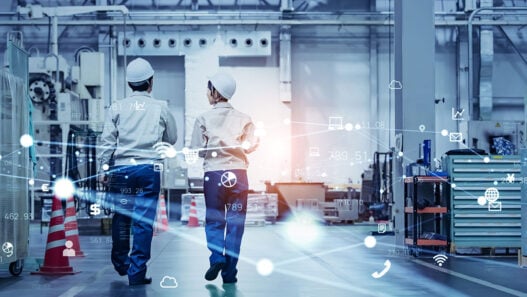
The definition of the ‘industrial Edge’ encompasses Edge computing in settings such as factories and manufacturing environments. Unlike consumer electronics, which have rapid product cycles and relatively short device lifetimes, or automotive electronics with their long planning horizons, industrial Edge devices require longevity, reliability, and must function in diverse and sometimes harsh environments. This sector is unique due to its heterogeneity of use cases, ranging from industrial automation to sensor data fusion, all running on platforms with very different compute, power, and memory constraints compared to consumer or automotive devices.
A key segment of the podcast addresses the technical challenges engineers face when deploying AI in industrial environments. Kao highlights three core obstacles: the severe compute and memory constraints of microcontrollers (MCUs), the importance of understanding what problems AI is actually solving (focusing on metrics such as latency, accuracy, and robustness), and the practical difficulties of data collection and preparation for model training. Sawyer supplements this with insights on integrating AI with legacy systems, highlighting how many industrial sites operate alongside older, less connected technologies. He emphasises the importance of creating future-proof, maintainable solutions as AI models and workloads rapidly evolve.
The conversation explores how NXP addresses hardware and software barriers by offering a range of MCUs and its eIQ software suite, including Time Series Studio, which simplifies developing, training, and deploying AI models that meet specific device constraints. Power-efficient neural processing units (NPUs), for example in the i.MX 9 series, are used to run advanced AI workloads at low power consumption.
Kao and Sawyer identify some of the most promising industrial Edge AI use cases, including the deployment of vision-language models (VLMs) for real-time monitoring and safety, predictive maintenance, and anomaly detection. These applications allow organisations to address issues proactively, minimising downtime and improving operational efficiency.
Security is highlighted as a critical concern. They advocate for Edge-based inferencing to protect proprietary and sensitive data, discuss real-time security threat detection, and emphasise best practices for updating and retraining models – such as using MLOps tools, monitoring for data drift, and over-the-air model and firmware updates.
Looking forward, Kao and Sawyer foresee continuous advances in AI model performance, efficiency, and adaptability at the Edge, including the emergence of smaller, domain-specialised models. They highlight NXP’s commitment to tools like eIQ GenAI Flow, agentic workflows, and securing AI throughout the application stack.
They advise engineers to start with clearly defined problems and accessible data, leverage proven reference designs, and stay abreast of cutting-edge solutions, noting that AI at the Edge is becoming increasingly attainable across industrial domains.
To hear more from Ted Kao and David Sawyer, you can listen to Electronic Specifier’s interview on Spotify or Apple podcasts.