



MIT scientists discovered that a special form of graphene – made by stacking ultra-thin layers of carbon at just the right angle – can carry electricity in a completely new way, without wasting any energy. This unusual behaviour could one day help us build super-efficient power systems and faster computers.
The discovery
What makes this breakthrough stand out is how the material achieves superconductivity. In ordinary superconductors, electrons pair up through vibrations in the atomic lattice. In magic-angle twisted tri-layer graphene (MATTG), however, the pairs appear to be bound together much more tightly, suggesting a completely different mechanism at work. By studying this unusual behaviour, scientists hope to uncover the rules behind unconventional superconductivity, which could guide the design of materials that work at higher temperatures and open the door to new technologies such as quantum computers and advanced sensors.
What superconductors do
Superconductors are materials that allow electricity to flow with no resistance. Because no energy is lost, they are very efficient. They are already used in things like MRI scanners, particle accelerators, and experimental power systems.
The challenge is that most superconductors only work when cooled to extremely low temperatures. This requires complex cooling systems, often using liquid helium or liquid nitrogen, which makes them expensive and difficult to use outside of specialised settings. Scientists are therefore searching for superconductors that can work under more practical conditions.
What is graphene?
Graphene is a single sheet of carbon atoms arranged in a honeycomb pattern. It is peeled from graphite, the same material found in pencil lead. Graphene is famous for being very strong and an excellent conductor of electricity.
In the 2010s, researchers predicted that stacking two layers of graphene at a very precise angle could produce unusual electronic behaviour. This idea led to the field of twistronics, where scientists study how twisting thin layers of materials can change the way electrons move.
Magic-angle twisted tri-layer graphene
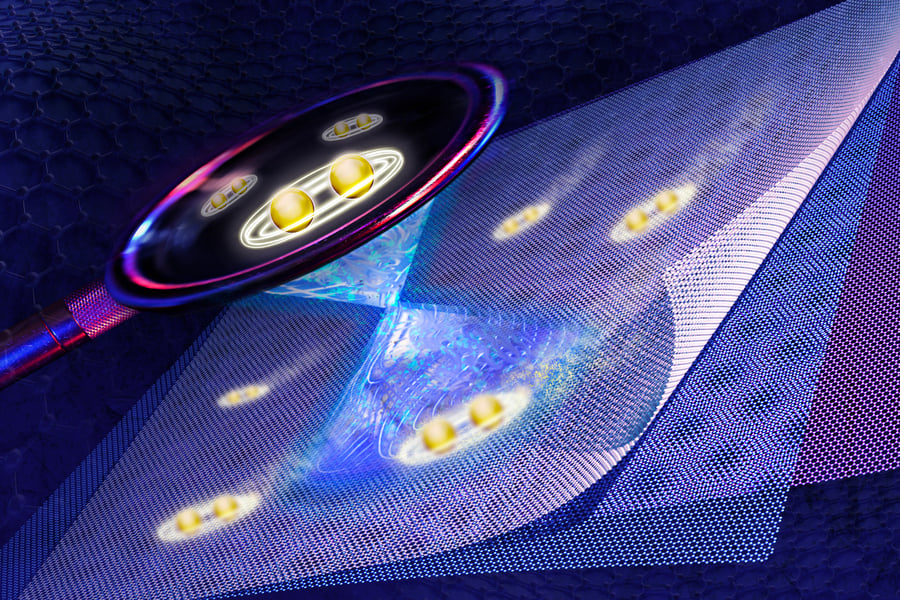
MATTG is made by stacking three sheets of graphene at a carefully chosen angle. This arrangement allows unusual properties to appear, including superconductivity.
In a superconductor, electrons move in pairs rather than individually. These pairs are called Cooper pairs, named after physicist Leon Cooper. In conventional superconductors, the pairs are weakly bound together by vibrations in the material’s atomic lattice. In MATTG, however, MIT researchers found evidence that the pairs are much more tightly bound, almost like molecules. This suggests that the way superconductivity arises in MATTG is different from the usual case.
Measuring the superconducting gap
To study superconductivity, scientists often measure the superconducting gap, which shows how stable the superconducting state is. The MIT team developed an experimental platform that combines two well-established techniques: tunnelling spectroscopy, which looks at how electrons can “tunnel” through barriers, and electrical transport, which measures resistance as current flows.
By combining these methods, they were able to see the superconducting gap in MATTG more clearly and confirm that it only appears when the material has zero resistance – the defining feature of superconductivity.
Instead of the flat shape seen in conventional superconductors, MATTG showed a sharp V-shaped profile. This is a strong sign that the material is an unconventional superconductor, meaning the electrons are pairing through a mechanism that is not yet understood.
Why this matters
Understanding unconventional superconductors is important because it could help scientists design materials that work at room temperature. That would remove the need for expensive cooling systems and make superconductors practical for everyday use.
Such materials could lead to lossless power cables, more efficient electrical grids, faster quantum computers, and new kinds of sensors. MIT’s Pablo Jarillo-Herrero, who first demonstrated magic-angle graphene in 2018, says that this discovery opens the door to studying other twisted two-dimensional materials. With their new platform, the team can watch superconductivity emerge in real time, giving them a direct view of how electrons pair and interact with other quantum states.
The hope is that these insights will eventually allow scientists to design superconductors that work under normal conditions, bringing us closer to a future of efficient energy and powerful new technologies.