








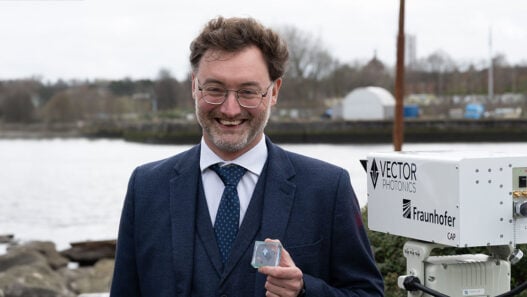

Accepting the award on behalf of Henkel was Holger Schuh, Henkel EIMEA Business Development Manager for Liquids and the paper’s author. Schuh, who has worked in the thermal materials market for over 25 years, notes the changing requirements for heat management that have been brought on by smaller, more complex product designs.
“The paper highlights the need for efficient thermal management solutions and, specifically, how liquid dispensed thermal materials are providing a viable alternative for applications where traditional pad-based thermal interface materials are not as effective,” he explains.
“With architectures that are not flat, the use of a liquid material allows better wet-out, lower contact resistance and improved thermal performance. Plus, liquid thermal solutions facilitate an automated process for higher throughput, which is a significant consideration.”
In addition to these benefits, the paper underscores other advantages of liquid-based thermal materials including high conformability for product design flexibility, lower component assembly stress, efficient use of material with minimal waste, and logistics simplification through the ability to source a single material for multiple programs. Not only does the paper present details on liquid Gap Fillers, Schuh’s work also outlines the various equipment options to be considered when employing liquid dispensed thermal materials.
“We were grateful for the opportunity to present this information to the nearly 200 people in attendance,” says Schuh in conclusion, “and we thank the IPC for recognising the importance of this topic by selecting the paper for the Best Paper Award.”