




Optical transceivers are compact, packaged devices that convert electrical signals into light pulses for transmission over fibre optic cables. They also convert incoming light signals into electrical signals that are used by servers, switches, and routers. In data centres, optical transceivers serve as the interface between these electronic devices and the fibre network, which carries significantly more data than copper wires and at faster speeds and over longer distances.
Today, many data centres are installing 800G Ethernet links to increase bandwidth and reduce latency to meet the demands of artificial intelligence (AI) and Cloud computing. The 800G optical transceivers that are used in these data centres, typically hyperscale facilities, consume more power and run at faster speeds than the 100G transceivers used in enterprise-level networks. Consequently, 800G optical transceivers generate more heat.
This increased heat places additional demands on data centre cooling and can negatively affect power usage effectiveness (PUE), a metric that data centre operators use to measure energy efficiency. High heat can also degrade the performance of the laser diodes in the optical transceiver’s transmit optical sub-assembly (TOSA). Because air has a relatively low thermal conductivity (TC), it is inefficient to remove this unwanted heat by air-cooling alone.
Thermal management
Thermally conductive silicones can help improve data centre PUE by dissipating heat from optical transceivers and other devices. Silicone is inherently thermally insulated due to its low thermal conductivity (0.17W/m.K), but the addition of a large amount of conductive fillers can significantly improve its ability to conduct heat. For example, a silicone filled with more than 85 volume percent of an aluminium oxide filler could achieve a thermal conductivity of 10W/m.K. This significantly enhances the thermal transfer capability between a heat generating electronic component such as a chipset and a heatsink.
Silicone provides other advantages as well. For example, it can protect optical transceivers against high operating temperatures, dust, and moisture. In addition, silicone can withstand thermal cycling, in which materials are subjected to repeated fluctuations between high and low temperatures. In optical transceivers, thermal cycling occurs during calibration, reliability testing, and whenever the device turns on and off during normal use, such as with changing data loads. By using thermally conductive silicones, module durability is substantially improved to withstand harsh power environments.
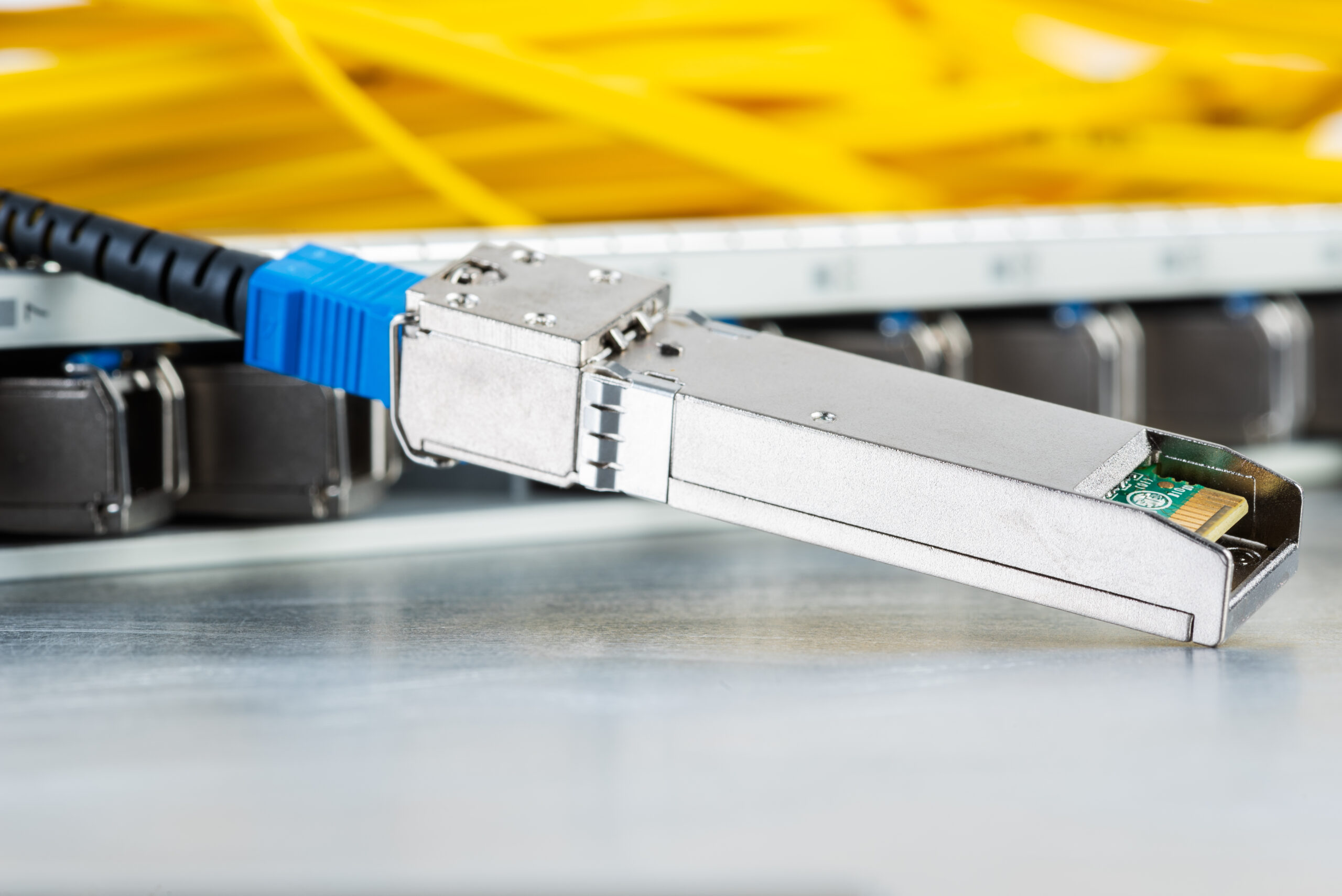
Importantly, silicone can also absorb some of the stresses that occur when different optical transceiver materials expand and contract at different rates. The coefficient of thermal expansion (CTE), a measure of size change in response to temperature, varies between materials used for different components, such as copper traces, silica fibre connections, silicon-based chips, and semiconductor laser diodes. When there are CTE mismatches, the resulting stresses can damage a transceiver’s solder joints and wire bonds. Thermally conductive silicones can absorb deformation and prevent thermal contact failure due to die warpage during power cycling.
Thermally conductive silicones can take the form of gels. Silicone thermal gels fill gaps between transceiver components that would otherwise contain air. These materials can be dispensed to accommodate large and irregular gaps in assemblies. They also conform to complex surfaces and support rework during product assembly due to their highly compliant properties, ensuring minimal or no pressure transfer between interfaces. To promote heat transfer, silicone thermal gels are applied to the transceiver’s high-speed TOSA box, microcontroller unit (MCU), tuneable laser, integrated circuits (ICs) and signal processors. In turn, this heat can be transferred to metal heat sinks, spreaders or plates, and to the transceiver’s metal enclosure.
Besides thermally conductive silicones, immersion coolants offer an alternative approach to heat dissipation. In data centres, optical transceivers can be submerged in a silicone-based liquid that transfers heat to a water circuit. Compared to hydrocarbon oils, which can also be used for immersion cooling, these silicone-based liquids provide greater thermal stability and are less prone to degradation, key considerations in high-reliability data centre applications.
EMI shielding and additional considerations
Thermal management is not the only challenge that designers of optical transceivers face. Electromagnetic interference (EMI) causes additional disturbances in device performance. While fibre optic cables are immune to EMI, a transceiver’s signal conversion processes generate high-frequency noise inside a device’s enclosure. This can prevent devices from operating efficiently and reliably. Printed circuit board (PCB) ground planes and careful component placement can help minimise internal crosstalk; however, metal cages and enclosures, including flexible shielding fingers, are needed for effective EMI control.
To address these challenges at the PCB level, electrically conducive silicone adhesives are used. These are applied to electrical connections and are used for grounding and electromagnetic compatibility, due to their durable mechanical and conductive properties and reliable performance at high temperature and vibrations. Products that contain silver-based fillers combine high electrical conductivity with strong EMI shielding across a wide range of frequencies. These specialized adhesives can be used instead of solder and are available in solvent-less formulations that help support environmental health and safety initiatives.
Like silicone thermal gels, silicone-based electrically conductive adhesives are conformable and stress-relieving. Importantly, these specialised materials also support greater manufacturing efficiency. For example, one-part products do not require mixing and support automated dispensing. They require curing, but offer fast heat-cure capabilities starting from 90°C. During inspection, ultraviolet light (UV) can be used to confirm proper application and cure quality.
By partnering with the right supplier, designers of optical transceivers can select silicone thermal gels, silicone immersion coolants and electrically conductive silicone adhesives that increase both manufacturing efficiency and data centre efficiency. In addition to reducing PUE, these materials can help critical components achieve greater reliability and improved performance in data centres that support AI workloads and cloud-based services.
About the author:
Yan Zheng, Ph.D., Senior Research Scientist PD, Engineered Materials – Great China, The Dow Chemical Company

Yan Zheng serves as the Senior Research Scientist in Engineered Materials Greater China, specialising in silicone-based thermally conductive interfacial materials. She also leads the global Consumer Electronics Conductive Technology Platform in Dow. Since beginning her career with Dow Corning in 2012, Yan has contributed significantly to foundational research in thermal technology and filler treatment, resulting in the successful commercialization of multiple thermally conductive products, including pottants, greases, gap fillers, and gels. She holds more than 30 active patent applications and is a recipient of R&D100, Edison, and Business Intelligence Group (BIG) Awards. Yan Zheng earned her Ph.D. in Polymer Chemistry & Physics from the Institute of Chemistry, Chinese Academy of Sciences.