




Automotive technology is racing toward ever-higher data rates to support advanced driver-assistance systems (ADAS), high-resolution sensors, and in-vehicle infotainment. Current trends show in-car network speeds climbing from 100Mb/s to 1Gb/s, then to 10Gb/s, and eventually up to 25Gb/s and beyond (KDPOF, 2021).
Given such bandwidth demands, it may be tempting to consider repurposing a proven Ethernet standard like 25GBASE-SR, originally developed for high-performance computing and data centres. However, the automotive environment poses unique challenges – extreme temperatures, constant vibration, tight constraints on cost and weight, long service life, and strict reliability targets – that 25GBASE-SR was never designed to meet (Pardo, Martínez, & Rodríguez, 2019; Gorski, 2023).
In response to these challenges, the IEEE 802.3 WG developed 25GBASE-AU, a new member of the automotive multi-gigabit Ethernet family defined under IEEE 802.3cz-2023. It addresses the shortcomings of 25GBASE-SR and introduces features tailored to harsh automotive conditions.
25GBASE-SR: optimised for data centres
25GBASE-SR, introduced under IEEE 802.3by, was developed to provide 25Gb/s Ethernet connectivity over multimode fibre in data centres. It is commonly used for short-reach links – typically up to 70m with OM3 fibre or 100m with optimised OM4 – under tightly controlled conditions (IEEE, 2016). Its strengths include low latency, low cost per gigabit, and reuse of mature 850nm VCSEL technology.
Although 25GBASE-SR is a proven solution for high-speed intra-rack communication in data centres, it was never intended for the realities of automotive deployment. Its reliance on clean fibre channels, short distances, and limited connector losses makes it vulnerable in environments where temperature swings, mechanical vibration, and electromagnetic noise are the norm.
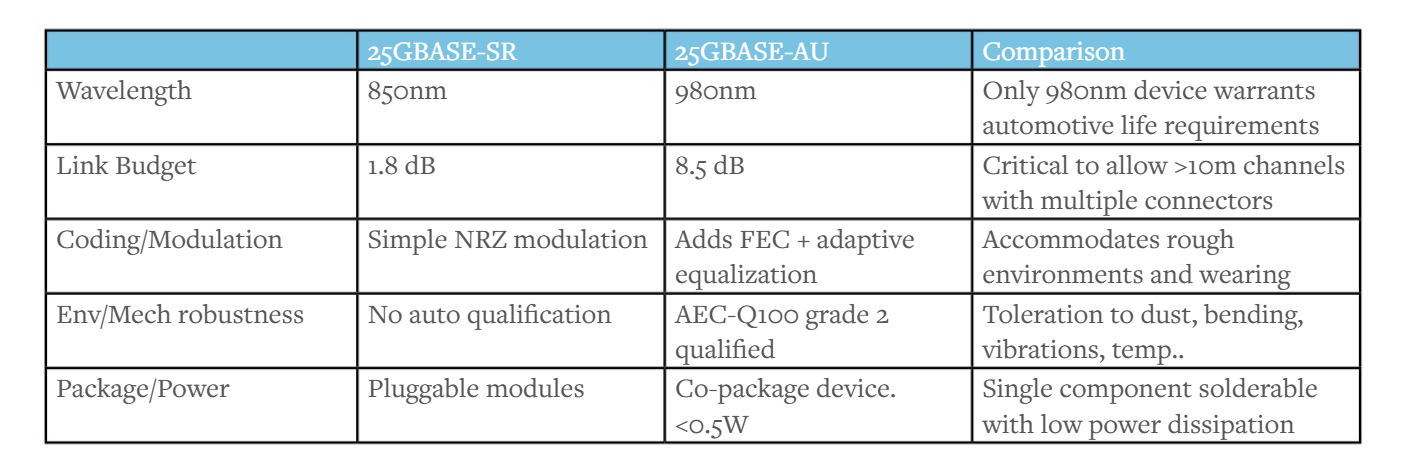
Furthermore, its tight link budget for channel insertion loss of just 1.8dB, limits its practical use in the automotive field. Even a single misaligned or contaminated connector could push a 25GBASE-SR link over its loss threshold. In contrast, a vehicle might include three to four such connectors in a single optical path – each introducing loss, reflections, and modal variation.
For all these reasons, 25GBASE-SR is poorly suited to automotive environments, and adapting it for vehicle use would require not just ruggedisation, but a total redesign – something 25GBASE-AU has already achieved.
25GBASE-AU: purpose-built for automotive networking
25GBASE-AU, defined in IEEE 802.3cz-2023, is a next-generation PHY tailored specifically for automotive-grade multi-gigabit optical communication. Rather than modifying data centre technologies like 25GBASE-SR, 25GBASE-AU was designed from the ground up to handle the harsh physical, electrical, and environmental conditions present in vehicles – all while delivering 25Gb/s full-duplex Ethernet with outstanding reliability.
Key technical characteristics of 25GBASE-AU
- Optical medium: 25GBASE-AU uses OM3 multimode fibre in a rugged, automotive-specific construction. The fibre is typically tight-buffered, bend-insensitive, and jacketed in robust, abrasion- and temperature-resistant materials. This fibre supports a minimum of 40m of link length while tolerating up to four inline connectors and still maintaining performance over the vehicle’s lifetime (IEEE, 2023)
- Wavelength: unlike SR’s 850nm VCSELs, 25GBASE-AU operates at 980nm, which offers superior thermal stability and laser longevity. VCSELs operating at this wavelength are less susceptible to heat degradation, maintaining optical power output and modulation performance at temperatures up to 105°C (Pardo et al., 2019). This makes them highly reliable under the continuous thermal cycling experienced in automotive environments
- Modulation and equalisation: like 25GBASE-SR, AU uses NRZ modulation, reducing the signal to noise ratio requirement, and integrates strong Forward Error Correction (FEC), as well as adaptive equalisation with real-time feedback mechanisms. These DSP features allow the system to compensate for temperature changes, aging-related loss, modal dispersion, and connector variability, ensuring long-term error-free performance (KDPOF, 2021)
- Link budget and connector loss: one of the defining strengths of 25GBASE-AU is its generous link budget. It is engineered for up to 8.5dB of total channel insertion loss at 25Gb/s – nearly 7dB more than 25GBASE-SR. This includes up to 8dB for connector insertion loss, accommodating real-world use cases where optical links traverse harsh paths with multiple, potentially imperfect connections. This margin is critical to achieving ‘zero defect’ communication over a 15-year lifespan in the vehicle
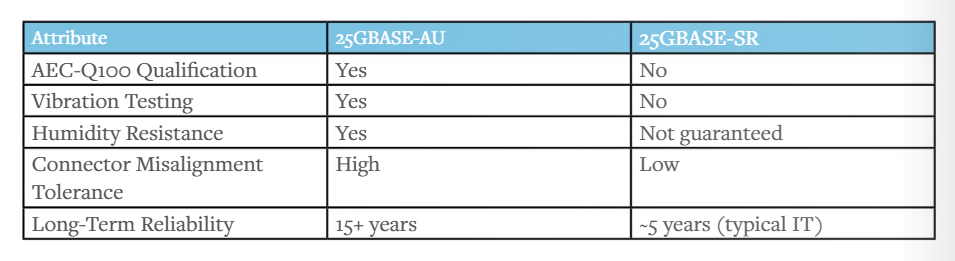
- Environmental qualification: all components of 25GBASE-AU transceiver implementation are qualified to AEC-Q100 Grade 2 or better, meaning they support -40 to +105°C ambient temperature operation. This rating ensures the PHY remains functional in engine bays, roof cameras, trunk ECUs, or under-seat sensor hubs without special cooling solutions (Gorski, 2023)
- Mechanical resilience: 25GBASE-AU transceivers and connectors are tested for shock, vibration, humidity ingress, and connector misalignment. In contrast to the LC connectors used in SR transceivers, AU uses compact, automotive-qualified optical connectors that maintain alignment and signal integrity under continuous movement
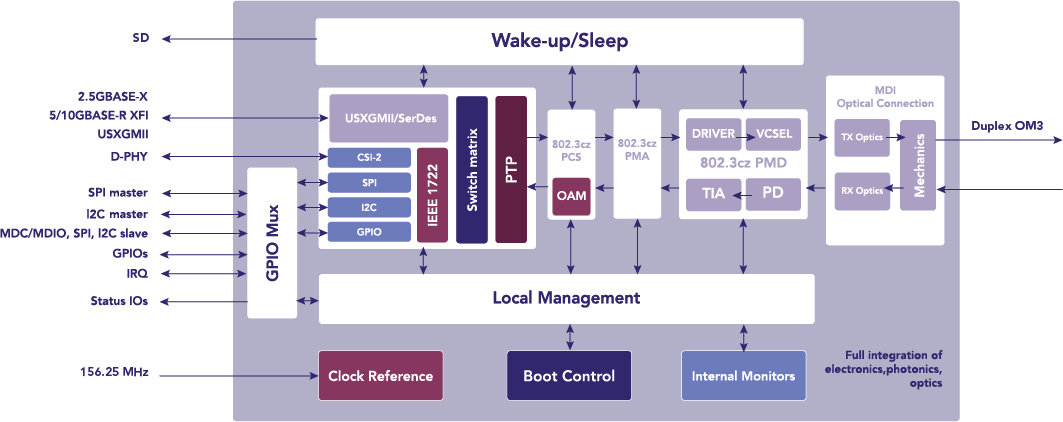
Image 3. Block diagram of the KD7251 automotive transceiver for multigigabit with 2.5, 5, and 10 Gbit/s, compliant with the IEEE Std 802.3cz
standard specification for high-speed data communication in vehicles Source: KD
- Diagnostics and maintenance: the standard includes in-band Operations, Administration, and Maintenance (OAM) functionality for link monitoring, wake up and sleep functionalities and error diagnostics. This enables real-time detection of degradation, such as power drop or connector contamination – allowing predictive maintenance before failure occurs (IEEE, 2023)
- Power efficiency and integration: automotive systems demand compact, low-power solutions. 25GBASE-AU PHYs are designed to consume less than 1W, even while operating at 25Gb/s. Moreover, their integration into co-packaged silicon modules allows direct SMT mounting onto ECUs, eliminating the need for bulky optical transceivers like those used in 25GBASE-SR systems
Conclusion
As vehicles increasingly integrate complex sensors, high-resolution cameras, LiDAR, and centralised computing platforms, 25Gb/s in-vehicle networking is no longer a futuristic luxury – it is an engineering necessity. The physical and environmental demands placed on these networks, however, are unlike anything found in data centres. They require technologies capable of operating across a wide temperature range, tolerating connector degradation, and delivering zero-defect communication over 10-15 years of daily use.
25GBASE-SR, while effective in the clean, temperature-controlled environments of data centres, fails to meet the realities of vehicle deployment. By contrast, 25GBASE-AU was engineered precisely to fill this gap. In short, 25GBASE-AU makes 25Gb/s Ethernet feasible in the automotive domain without compromises.

By Óscar Ciordia, Sales and Marketing Director, KD
This article originally appeared in the February’26 magazine issue of Electronic Specifier Design – see ES’s Magazine Archives for more featured publications.